

Understanding Artificial Intelligence In Navigation Systems Training Ppt




Try Before you Buy Download Free Sample Product
 Impress Your
 Audience
 100%
100% Editable
 Save Hours
 of Time


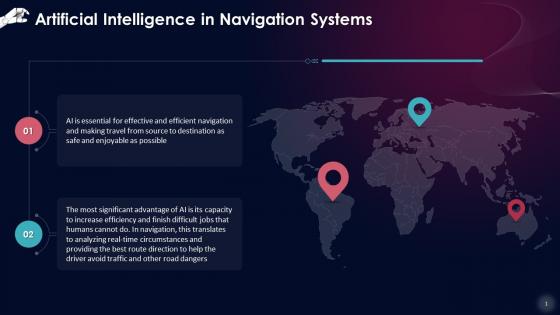
These slides demonstrate how AI can increase efficiency and finish complex tasks that humans cannot do. AI is essential for effective and efficient navigation and for making travel from source to destination as safe and enjoyable as possible.
People who downloaded this PowerPoint presentation also viewed the following :
Content of this Powerpoint Presentation
Slide 1
This slide demonstrates that AI can increase efficiency and finish complex tasks that humans cannot do. AI is essential for effective and efficient navigation and making travel from source to destination as safe and enjoyable as possible.
Slide 2
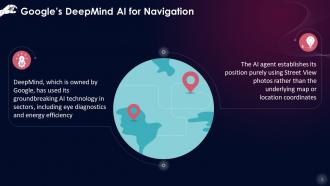
This slide talks about the DeepMind AI by Google which can be used for navigation without maps. Currently, autonomous robots and cars navigate using GPS and built-in maps, but recent advancements in the application of deep learning to traverse mazes has raised hopes of a more human-like approach.
Understanding Artificial Intelligence In Navigation Systems Training Ppt with all 18 slides:
Use our Understanding Artificial Intelligence In Navigation Systems Training Ppt to effectively help you save your valuable time. They are readymade to fit into any presentation structure.








FAQs for Understanding Artificial Intelligence In Navigation
So basically AI navigation is insane at crunching traffic data in real time - like way better than the old systems. Your arrival times become super accurate because it's constantly learning from traffic patterns. What's crazy is how it starts adapting to your specific driving style after a while. I didn't believe that part until I tried it myself, but it really does work. Plus it can spot potential road issues before they screw up your commute. When you're shopping around, just make sure it mentions machine learning stuff - that's where you'll actually notice the upgrade.
So your GPS is constantly pulling data from traffic sensors, other drivers' phones, and accident reports. It learns patterns - like how that one merge always backs up at 5pm. The app can actually spot slowdowns forming before they get bad and reroutes you automatically. Honestly, it's pretty wild how it knows about problems you can't even see yet. Next time you're driving, watch how your route keeps updating. The whole system works because it's analyzing what thousands of drivers are doing in real time.
So basically these algorithms learn from live traffic data, weather, your personal driving style - all that stuff. They'll figure out you hate highways and adjust accordingly. The crazy part? They start recognizing patterns like "oh, this construction always screws up Tuesday mornings" or whatever. Your GPS sometimes suggests routes that seem totally random, but honestly it's probably right - it's juggling way more factors than just distance. Gets smarter over time too. I've started trusting those weird detours more, and I'm usually glad I did.
So your GPS looks at tons of old traffic data plus current conditions to guess what's gonna happen ahead. Weather stuff too. It's learned from millions of drives, so it can predict jams and accidents before you hit them. Pretty crazy honestly. The whole thing updates constantly as new info comes in - that's why it'll suddenly tell you to take some random exit. Honestly I used to ignore those weird detours but now I just follow whatever it says. Usually saves me like 20 minutes of sitting in traffic that I would've been clueless about otherwise.
Your GPS basically stalks your driving habits - it tracks when you leave, which routes you pick, even if you're that person who always hits Starbucks at 8am. After a few weeks, it starts getting weirdly good at reading you. Like, it'll notice you hate highways or love those backroad shortcuts and just automatically suggest them. Honestly kind of creepy but useful? The longer you use it, the better it gets at predicting what you actually want. Try picking the same type of route for a week and watch it catch on to your style.
Honestly, the toughest part is getting your AI to think fast enough - we're talking split-second decisions while processing GPS, traffic, weather, all that stuff on pretty limited car computers. Data accuracy is a nightmare too. Privacy's another headache since you're tracking everyone constantly. Oh, and the training data? Super biased toward cities, which is why GPS still sucks in rural areas. Construction zones will break your system every time. I'd start with really solid data validation first. Build fallbacks for when things inevitably go wrong - trust me, they will.
Dude, the AI processes sensor data in milliseconds - way faster than any human could react to obstacles or pedestrians jumping out. You get automatic emergency braking, real-time hazard prediction, plus it adjusts routes based on weather and traffic. Honestly the amount of data these things crunch at once is insane. The system learns from millions of driving scenarios too, so it can spot dangerous situations developing before they actually happen. Oh and definitely go with multiple sensor types feeding into it - you don't want to rely on just one data source for something this critical.
Yeah, they're actually pretty solid at handling random stuff! Google Maps and Waze pull data from traffic sensors and other drivers constantly, so they'll reroute you mid-drive when accidents pop up. I've had it happen tons of times - kinda wild how fast it processes like thousands of route options. The algorithms are honestly impressive at picking the quickest alternative based on what's happening right now. Just keep your location services on and make sure you've got decent data connection, otherwise you'll miss those real-time updates when you actually need them.
So basically, these navigation apps are pulling data from everywhere - GPS satellites, your phone's gyroscope thing, traffic cameras, plus all the route data from other drivers. Pretty wild when you think about it. Every time someone hits traffic or takes a detour, the AI learns from it and adjusts future predictions. It's constantly comparing what actually happened vs what it thought would happen. Then there's real-time stuff too - construction, accidents, road closures. Machine learning algorithms crunch all this info together. Honestly, it's kind of crazy how much smarter these systems get just from millions of people using them daily.
So there's three big things to watch out for: privacy stuff, bias, and who gets blamed when things go wrong. These AI systems are basically tracking everywhere you go, which is kinda creepy if you ask me. Plus they might route different people different ways based on assumptions about neighborhoods or demographics - super sketchy. And what happens when the AI screws up and causes an accident? Someone's gotta be responsible. You'll want to check your systems regularly for bias and be upfront about what data you're collecting. It's messy territory honestly.
Your GPS basically looks at road density, traffic patterns, building clusters, and speed limits to figure out if you're in the city or countryside. The crazy part is how much data it's processing - satellite imagery, live traffic feeds, driving history from other users. Pretty nuts when you think about it. Based on all that info, it switches up how it plans your route. In cities it'll suggest surface streets and factor in parking nightmares, while rural areas get more highway-focused routing. The arrival times change too since city traffic is so unpredictable compared to open roads.
Dude, the sensor game has gotten crazy good lately. LiDAR now gives AI this insanely detailed 3D view it can process instantly. Cameras work way better in dark conditions too, which honestly used to be such a pain point. GPS pulls from like multiple satellite systems at once now - way more reliable. The gyroscopes and IMU stuff? So much more accurate than even a few years ago. But here's the cool part: all these sensors actually talk to each other seamlessly now. Your AI gets this super rich data mix to work with instead of trying to figure things out from just one source.
So AI turns your trucks into this smart system that actually thinks ahead - pretty wild stuff. Routes get optimized in real-time based on traffic and weather. Your fuel costs drop, deliveries get faster. The system learns from how your drivers actually work too, which is honestly the coolest part. You'll catch maintenance problems before breakdowns happen, automatically shuffle deliveries when something goes wrong, even figure out the best way to load warehouses. All that scheduling nightmare? Gone. I'd say start with just one delivery zone for route optimization, then expand when you see those fuel savings roll in.
So basically, AI makes walking and biking way smarter than regular GPS. It'll warn you about sketchy intersections or construction that normal maps totally miss. Plus it learns your style - maybe you hate busy streets or need accessible routes. Weather integration is clutch too - it'll find covered paths when it's about to pour (learned that one the hard way lol). The cool part? It's actually designed for pedestrians and cyclists instead of just tweaking car directions. Honestly beats getting lost or ending up on some highway shoulder. Multiple data sources working together = much safer routes.
So basically, GIS is like the foundation - it's got all the map data and spatial stuff. Then AI jumps in and makes it actually useful for you. It learns your driving patterns, figures out traffic, and suggests routes that don't suck. Honestly, the route prediction thing is pretty impressive when it works. Your phone's constantly analyzing where people go and when, then uses that to recommend stops or shortcuts. It's kind of like having a smart copilot that gets better over time. Next time you're driving somewhere, check out those suggested pit stops - that's the AI doing its thing with all that geographic data.
-
Superb! The innovative and inspiring template designs provide an edge to the presentation.
-
Amazing variety of PowerPoint slides. Really helpful in designing professional presentations.