Unique customer complaint handling process flow analysis ppt model

Rating:
80%
Unique customer complaint handling process flow analysis ppt model
Slide 1 of 7

or

Favourites Favourites

Try Before you Buy Download Free Sample Product

Audience Impress Your
Audience
Editable 100%
Editable
Time Save Hours
of Time
The Biggest Sale is ending soon in
0
0
:
0
0
:
0
0
Rating:
80%
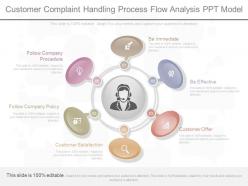
Presenting unique customer complaint handling process flow analysis ppt model. This is a customer complaint handling process flow analysis ppt model. This is a six stage process. The stages in this process are be immediate, be effective, customer offer, customer satisfaction, follow company policy, follow company procedure.

Content of this Powerpoint Presentation

Description:

The image is a PowerPoint slide titled "Customer Complaint Handling Process Flow Analysis PPT Model." It outlines key steps in managing customer complaints effectively. 

The process flow is depicted in a circular format with six key elements, each numbered and connected by arrows, suggesting a step-by-step progression:

1. Be Immediate: 

This step emphasizes the importance of prompt responses to customer complaints.

2. Be Effective: 

This step focuses on the need for the solutions provided to be effective in addressing the customer's concerns.

3. Customer Offer: 

This step may involve offering the customer something to address the complaint, whether it's a refund, exchange, or other forms of compensation.

4. Customer Satisfaction: 

At this stage, the goal is to ensure that the customer is satisfied with the resolution of their complaint.

5. Follow Company Policy: 

This step advises adherence to the company's set policies when handling complaints.

6. Follow Company Procedure: 

This final step reinforces the importance of following established procedures to ensure consistency and fairness in handling complaints.

Use Cases:

This customer complaint handling process is crucial for maintaining customer trust and loyalty, and it can be adapted across various industries:

1. Retail:

Use: Training staff on customer service.

Presenter: Customer Service Manager

Audience: Retail employees, store managers

2. Telecommunications:

Use: Managing service-related complaints.

Presenter: Operations Director

Audience: Customer support agents

3. Hospitality:

Use: Ensuring guest satisfaction and handling feedback.

Presenter: Hotel General Manager

Audience: Hotel staff, reception team

4. Banking:

Use: Addressing customer financial disputes and inquiries.

Presenter: Branch Manager

Audience: Bank tellers, customer service representatives

5. Healthcare:

Use: Managing patient feedback and care concerns.

Presenter: Patient Services Coordinator

Audience: Healthcare providers, administrative staff

6. Airlines:

Use: Resolving ticketing and service issues.

Presenter: Customer Relations Officer

Audience: Airline customer service teams

7. Software Services:

Use: Handling client issues with software products.

Presenter: Support Team Lead

Audience: Technical support staff, account managers

FAQs for Unique customer complaint handling process flow

Honestly, just respond fast and don't get all defensive when they complain. Listen to what they're actually saying first. Then you'll need to dig into what went wrong - that investigation part can drag on forever if it's complicated. Once you figure it out, offer them a real solution or at least explain what you can do about it. I'd follow up later too, just to check they're good with how things got handled. The whole thing only works if you actually care though, not just fake it. Oh and track how long you're taking to respond - people definitely notice when you're being slow about it.

Track your first resolution rate - that's how many complaints you actually fix without people having to call back. Response times are obvious but still matter. Customer satisfaction scores after you "solve" things will tell you if they're actually happy or just gave up, honestly. I'd also watch complaint volume trends because if the same crap keeps happening, you're probably just putting band-aids on bigger problems. Throw these on a simple dashboard and review monthly with your team. Way easier than you'd think.

Training your staff is huge for handling complaints well. When people know how to actually listen and calm things down, way fewer issues blow up into big problems. Your employees won't panic when faced with angry customers - they'll feel confident instead of getting all defensive (which honestly makes everything worse). You want to cover the actual process but also teach empathy and communication skills. Oh, and do refresher training every so often. People forget the details over time, especially the subtle stuff that really matters when someone's upset.

Honestly, start with a basic ticketing system - that alone will save your sanity. All customer complaints funnel into one place instead of scattered emails everywhere. From there, you can add automated routing so complaints go to the right person automatically. The dashboards are actually pretty cool, showing real-time volumes and response times. AI chatbots handle the simple stuff first, though they're still kinda hit-or-miss sometimes. What's nice is customers can complain however they want - email, chat, social media - and it all connects. Set up automatic follow-ups too so nothing falls through cracks.

Don't get defensive or make excuses - that's the fastest way to piss someone off even more. Listen first before jumping into solution mode. Taking complaints personally is huge too, or throwing other teams under the bus. Customers see right through copy-paste responses, so actually address their specific issue. I've seen people think they're done once they offer a fix, but honestly? You gotta follow up later. Make sure whatever you did actually worked. It's wild how many complaints could've been avoided if someone just checked back in a few days later.

So first thing - sort your complaints into buckets. Product issues, service problems, whatever makes sense for your business. Then track how often each type comes up because honestly, one angry customer is way different than ten people complaining about the same thing. I just throw everything in a spreadsheet but use whatever works for you. The good stuff happens when you figure out WHY each category keeps popping up. Pick your worst 3 complaint types this month and come up with one real fix for each. Don't overthink it - just start somewhere and you'll see patterns emerge pretty quickly.

Honestly, I'd focus on four main things. Response time is probably your easiest win - just how fast you acknowledge complaints coming in. Resolution time matters too, but don't get obsessed with speed over quality. Customer satisfaction after you've "fixed" things is huge because sometimes quick fixes aren't actually fixes, you know? Oh, and first-contact resolution rate - nobody wants to repeat their story to five different people. Pull these numbers monthly instead of stressing over every bad day. I always start clients with response time since it's the lowest hanging fruit.

Honestly, it all comes down to having clear processes that everyone actually follows. Write out step-by-step procedures for different complaint types - sounds boring but it works. Templates are your friend for keeping responses consistent. I'd also track everything in one system so people aren't scrambling to find previous conversations (been there, it sucks). Regular team check-ins help too, especially for the weird cases that don't fit your normal playbook. Oh, and have supervisors review stuff monthly. You'd be surprised how quickly people start doing their own thing without realizing it.

Okay so here's the thing - fixing complaints fast actually makes customers MORE loyal than before they had problems. Crazy, right? It's all about that psychology of how you handle their worst moment with your brand. Get back to them within 24 hours (seriously, don't wait). The speed matters, but so does actually caring about their issue. I've seen this work - people literally become your biggest fans when you turn around a bad situation quickly. Oh and always circle back to check they're actually happy with how you fixed things, not just that you "resolved" it.

Honestly, just make it easy and worthwhile for them to complain. Train your staff to say "thanks for telling us" instead of getting all weird about it - you'd be shocked how many people screw this part up. Give customers tons of ways to reach you: chat, email, phone, whatever. Oh and here's the key thing - actually tell them what happened after they complained. Even if it's just "yeah we're working on that." People will keep giving feedback when they see it matters, but if you ghost them? They'll just leave and trash you online instead.

So I'd follow up around 24-48 hours after fixing their issue, then maybe once more after a week. Just shoot them a quick email or call - "hey, is everything still working okay?" That kind of thing. Honestly, I always set calendar reminders because I'm terrible at remembering this stuff when things get crazy. Oh, and this is actually a great time to ask how your whole complaint process went - like what sucked, what didn't. Some people do surveys but I think that's overkill. Just don't make it sound robotic, you know? Set those reminders right when you close the case.

So here's what works - use a simple matrix for sorting complaints. Safety stuff, legal issues, major service breakdowns? Those go straight to the top no matter who's asking. Then you've got your high-impact ones - big clients, anything public-facing, stuff that keeps happening. They skip ahead too even if they're not urgent. Honestly, most teams mess this up and do it backwards. Set clear triggers so people know when to pull management in immediately. Don't wing it in the moment - having criteria decided beforehand saves everyone's sanity. Like, a safety complaint from some random person still beats your biggest client asking about their bill, you know?

You definitely need a central system to track everything - dates, customer details, the actual problem, how you fixed it. Trust me, we totally screwed up last year when a complaint just disappeared into thin air! Give each case a unique ticket number and update the status as you go. Categories are huge for spotting patterns later on. Honestly, consistency is everything with documentation format so anyone on the team can jump in. Oh, and set up those automated follow-up reminders or you'll forget. Start with a solid intake form first though - saves so much headache when people actually fill out complete info instead of leaving half the fields blank.

Honestly, social media's perfect for catching complaints before they blow up. Set alerts for your brand name so you'll know when people are complaining. Quick public responses work wonders - acknowledge the issue, then pull them into DMs for the real conversation. Other customers see you actually give a damn about fixing stuff, which is huge for your reputation. I'd check your main platforms every day and maybe create some quick templates for the usual complaints. Way better than pretending problems don't exist and watching them snowball.

Document everything - seriously, every single interaction could end up as evidence later. Follow privacy laws like GDPR when you're collecting customer data. Your team needs training on what they can legally promise (learned this the hard way once). Different industries have their own rules too - finance and healthcare are super strict about complaint processes. Set up escalation procedures that loop in legal counsel early if things smell like a lawsuit. Oh, and never promise stuff you can't actually deliver - that'll bite you.

Ratings and Reviews

80% of 100
Review Form
Write a review
Most Relevant Reviews
  1. 80%

    by Claud Hughes

    Attractive design and informative presentation.
  2. 80%

    by Cortez Graham

    Topic best represented with attractive design.

2 Item(s)

per page: