


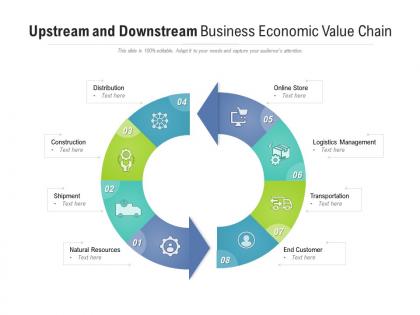
Upstream and downstream business economic value chain




Try Before you Buy Download Free Sample Product
 Impress Your
 Audience
 100%
100% Editable
 Save Hours
 of Time


Our Upstream And Downstream Business Economic Value Chain are explicit and effective. They combine clarity and concise expression.
People who downloaded this PowerPoint presentation also viewed the following :
Upstream and downstream business economic value chain with all 2 slides:
Give your audience a fulfilling experience. They will find our Upstream And Downstream Business Economic Value Chain elevating.
FAQs for Upstream and downstream business
You want to figure out what's actually making you money vs what's just bleeding cash. Look at everything - operations, marketing, how you get stuff to customers, all of it. Which parts do your customers actually care about? Honestly, most businesses have way more fat than they realize. Map out what you're doing now and ask yourself "does this add real value or am I just doing it because that's how we've always done it?" Some activities will be obvious money-wasters you can cut. Others might be your secret sauce that sets you apart from everyone else - those you want to invest in harder.
So basically you break down your business into all its different pieces - like logistics, customer service, production, whatever. Then compare how you do each thing versus your competitors. Are you way cheaper at something? Do customers love one particular thing you do? Sometimes the cool stuff is hiding in boring places you wouldn't expect. I'd start by just listing out everything your business actually does, then be brutally honest about where you're crushing it compared to others. The whole point is finding those spots where you're either doing it for way less money or creating something customers genuinely care about that nobody else offers.
So primary activities are the main things that create value for customers - like inbound logistics, operations, outbound logistics, marketing/sales, and service. Support activities help these run smoothly: procurement, tech development, HR, and firm infrastructure (all the boring backend stuff honestly). Picture a restaurant - the primary stuff is cooking and serving food. Support would be hiring staff and buying equipment. You'll want to figure out which activities actually give you an edge over competitors versus what you can outsource to save money. Makes sense?
Look, tech is basically a multiplier for everything you're already doing. Automated inventory and real-time tracking fix your supply chain headaches. AI optimizes production and predicts when stuff breaks down (which honestly saves so much drama). Route optimization cuts your shipping costs big time. Marketing gets way more precise with data analytics - no more shooting in the dark. Customer service improves with chatbots and better CRM systems. My advice? Find your biggest pain point first and tackle that with whatever tech makes sense.
So value chain analysis basically gives you a roadmap for pricing decisions. You can see exactly which parts of your business actually create value versus the stuff that just burns cash. Maybe your R&D is killer but your logistics are meh - that tells you where to focus. I think the coolest part is spotting where you're wasting money on things customers don't even care about. Then you can either cut those costs or invest more in what actually lets you charge premium prices. It's like getting inside info on your own business.
So first thing - map out every single step from raw materials to when it hits the customer. Document all of it. Then hunt for where you're bleeding time, money, or quality. Redundant processes are usually the worst offenders. Talk to the people actually doing the work though - they know exactly where things get messy way better than management does. Unnecessary handoffs between departments kill efficiency too. Once you spot the problem areas, ask yourself if each step truly adds value for customers. If not? Cut it. The visual layout part is actually kind of satisfying once you see all the waste.
Customer feedback is super important for value chain stuff because it shows what actually matters to them. Like, you might think your packaging is amazing, but if they keep saying they just want cheaper prices, well... there's your answer. It helps you figure out which activities are worth the cost vs which ones are just burning money for no reason. What I do is take their specific comments and match them up to different parts of the value chain - way better than trying to guess what they care about. Makes the whole thing actually useful instead of just theoretical, you know?
Just grab a whiteboard and map out everything from buying supplies to getting stuff to customers. Sounds boring but trust me on this one. Then be brutally honest - where are you actually adding value vs just burning cash? Don't need some overpriced consultant for this. Pick 2-3 things that customers genuinely care about and dig into those costs first. Everything else can wait. The whole trick is starting small and not lying to yourself about what really moves the needle for people willing to pay you.
Start with cost per activity and cycle time - those are your core ones. Quality metrics and customer satisfaction scores matter too, but don't go crazy tracking everything. I'd focus on maybe 4-5 that actually connect to what you're trying to achieve. Operational stuff like inventory turnover is solid if you're in that kind of business. The value-added vs non-value-added time thing is super helpful for spotting waste. Oh, and bottleneck indicators if you've got obvious choke points. Honestly though, cost and time first, then build from there once you get the hang of it.
So globalization basically makes you rethink where to put each piece of your business. You can source materials from whoever's cheapest globally, manufacture where labor's dirt cheap, then serve customers through local hubs. Way bigger toolkit to play with. But here's the thing - you've gotta weigh those cost savings against supply chain headaches, quality control nightmares, and what locals actually want. My old boss learned this the hard way with their Vietnam expansion. Map out which activities need global scale versus local touch. I'd start by auditing your current setup and finding obvious wins where moving stuff won't tank your quality.
Honestly, the hardest part is getting finance to actually share their cost data - they guard that stuff like it's state secrets or something. Then you've got to figure out where one activity stops and another starts, which is messier than it sounds. How do you even put a number on things like customer service impact? That's always tricky. If your company has multiple product lines, things get complicated fast. I'd say pick one simple process first and just mess around with it until you get the hang of it. Once you're comfortable, then branch out to the bigger stuff.
Working closely with suppliers can really boost your value chain - better quality, lower costs, faster innovation. Share forecasting data and collaborate on product development. You'll both get better planning with fewer nasty surprises. Your suppliers know their materials and processes way better than you do, so tap into that expertise. I've seen companies get preferential treatment during shortages just because they had solid relationships. Strong partnerships also give you flexibility when things go sideways. Start with your most critical suppliers - don't just place orders, have actual strategic conversations with them regularly.
Honestly, value chain analysis is a game-changer for finding sustainability wins. Map out everything from raw materials to final delivery - you'll be shocked at where you're bleeding energy and resources. I always tell people to look hard at their suppliers too, since that's where a lot of environmental problems hide. The cool thing? You can spot exactly where changes will actually move the needle AND save money. Start with your biggest waste hotspots first - why fix small stuff when there's low-hanging fruit everywhere? Once you see it all laid out, the priorities become pretty obvious.
Look, value chain segmentation is basically about picking your battles. You figure out what different customer groups actually care about, then optimize those specific parts of your business for them. Don't try being everything to everyone - that's a recipe for mediocrity. Premium customers might want the full concierge experience while budget shoppers just want efficiency. Makes total sense when you think about it. Map out your top 2-3 customer segments against what you're currently doing. You'll probably find you're wasting money in some areas and totally neglecting others.
For value chain stuff, I'd go with Lucidchart or Visio if you want something visual and easy. Lucidchart's my go-to honestly - way more user-friendly than Visio. Need something more heavy-duty? IBM Blueworks or ARIS can handle the complex enterprise mapping with cost analysis built in. Though honestly, if you're just testing the waters, PowerPoint works fine for basic diagrams. I know that sounds lame but whatever gets the job done, right? The main thing is picking something your whole team will actually stick with instead of abandoning after two weeks.
No Reviews