

Value chain analysis framework ppt background images





Try Before you Buy Download Free Sample Product
 Impress Your
 Audience
 100%
100% Editable
 Save Hours
 of Time


Enhance camaraderie with our Value Chain Analysis Framework Ppt Background Images. Give a boost to feelings of amity.
People who downloaded this PowerPoint presentation also viewed the following :
Value chain analysis framework ppt background images with all 5 slides:
Be the favourite if your fraternity with our Value Chain Analysis Framework Ppt Background Images. They will soon be fawning on you.

FAQs for Value chain analysis framework
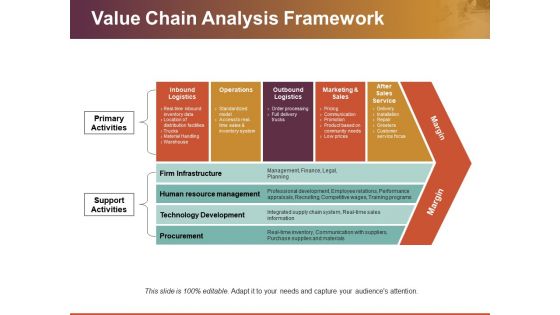
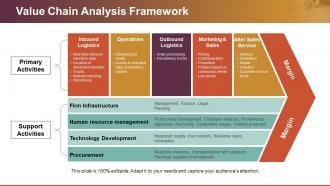
Okay so you've got two main categories here: primary and support activities. Primary stuff is your core business flow - inbound logistics, operations, outbound logistics, marketing/sales, and service. Basically how you make and deliver your product. Support activities are procurement, tech, HR, and company infrastructure. They keep everything running behind the scenes (though yeah, HR might get annoyed being called "support"). Honestly, the key is mapping each activity first, then figuring out where you're actually adding value versus just hemorrhaging money. Some companies get way too caught up in the fancy framework and miss the obvious stuff.
So basically, value chain analysis breaks your business into separate activities - then you figure out which ones actually give you an edge over competitors. Look at both the main stuff (operations, sales) and behind-the-scenes things like HR and tech. Maybe your shipping is crazy fast, or customers love dealing with your support team. Hard to notice when you're just looking at the big picture though. Once you map everything out, focus more on what you're already crushing and shore up the weak areas before competitors notice them. It's honestly pretty eye-opening when you do it right.
Look, tech basically makes everything in your business run faster and cheaper. Start by figuring out where things get stuck - like is your production slow? Use automation. Can't predict what customers want? AI helps with forecasting. Honestly, cloud systems are probably the biggest game-changer because you can see everything happening in real time, from buying supplies to shipping stuff out. Digital platforms also make dealing with suppliers way less of a headache. The trick is just spotting your biggest bottlenecks first, then finding the right tools to fix them.
Map out your whole value chain step by step - procurement, order processing, delivery, customer service, the works. Most companies are blind to their own friction points, honestly. Focus on anything that touches customers directly. Then ask yourself: does this step actually help customers or just create busywork for us? I'd start with your biggest complaint and trace it backwards to find where things go wrong. The bureaucracy stuff that doesn't add real value? That's usually where you'll find your pain points hiding.
So primary activities are what customers actually see and pay for - your operations, logistics, marketing, all that front-facing stuff. Support activities run behind the scenes: HR, IT, procurement, infrastructure. Here's the thing though - support might seem less important but try running your business when the servers go down lol. Primary activities bring in the money, but support makes it all possible. When you're analyzing your value chain, you'll want to map both types. That's how you spot where to cut costs or maybe find an edge over competitors. Makes sense?
Honestly, value chain analysis is just a fancy way of tracking where your money goes at every single step - from buying raw materials to getting stuff to customers. Map out each activity and you'll see which ones are total resource hogs. Then you can figure out where to cut fat without screwing up quality. It's like cost accounting but actually useful for strategy. You might spot where competitors are beating you or find quick wins for cost cuts. Focus on the activities that'll save you the most cash first - that's where the real payoff is.
Yeah, definitely works for service businesses too. You just gotta flip your thinking a bit. Instead of tracking physical stuff moving around, map out how your service actually gets to customers. Primary activities become service design, getting clients, delivering the work, support afterwards. HR, IT, procurement - those stay as support functions. Take a consulting firm. You'd trace how they build expertise, land clients, run projects, keep relationships going. Really helpful for seeing where you're crushing it value-wise and where money's probably leaking out. I'd start by sketching out your whole delivery process first - gives you the foundation to build on.
Honestly, I'd start with Porter's Value Chain - it's the gold standard for a reason. Map out your primary and support activities first. Then get into the weeds with process mapping. Lucidchart works great, but don't sleep on old-school whiteboards. Some of my clearest breakthroughs happened just sketching stuff out by hand, weird as that sounds. Cost accounting data is crucial too - you need those numbers to see where money's actually going. SWOT analysis pairs well with this. Oh, and benchmark against competitors if you can get the data. Keep it simple at first though. Complex frameworks can wait until you've got the basics down.
Working closely with your suppliers is honestly a game changer. You'll catch quality problems way earlier, and they often know about cool new materials or tech before anyone else does. I mean, they're literally specialists in their field, right? The cost savings add up too when you're not dealing with constant surprises. Don't just treat them like order-takers though - actually partner with them. Pick your most important suppliers and schedule regular calls to brainstorm improvements together. It's like having extra team members who want your business to succeed.
So basically, value chain analysis shows you exactly where your company's doing the most environmental damage - and where fixing things will actually matter. Map out everything from sourcing materials to disposal. You'll probably be shocked at the hotspots! Manufacturing usually eats up tons of energy, and don't get me started on how much packaging gets wasted. The cool part is finding circular opportunities - like using waste from one process as input for another. You can also see how you stack up against competitors. Just start by mapping your current chain and measuring carbon at each step.
So globalization lets you spread your business activities across different countries to get the best bang for your buck. Like doing R&D in Silicon Valley, manufacturing in Vietnam, customer service in the Philippines - you get the idea. The cost savings can be huge. But man, managing it all becomes a total headache. You're juggling currency changes, political drama, trying to coordinate meetings across like 12 time zones. My advice? Map out what you're doing now first. Then figure out what's actually worth moving vs. what'll just create more chaos than it's worth.
Honestly, I'd start with the stuff that's either costing you the most money or where you're trying to beat competitors. Track cost per unit and cycle times for sure. Quality rates matter too, plus how happy customers actually are at each step. Don't sleep on resource utilization - basically, are you wasting inputs? If you've got suppliers, monitor how they're performing. Inventory turnover is another big one, though that might depend on your industry. Here's the thing though - pick maybe 3-5 metrics max that actually move the needle for your goals. Otherwise you'll drown in data and not act on anything useful.
Value chain analysis is basically mapping out everything your business does - operations, marketing, delivery, plus the behind-the-scenes stuff like HR and tech. Honestly, it's wild how much you'll discover once you see it all written down. Hunt for places where you're overspending or where competitors are crushing you. But here's the thing - also look for what you're already doing really well that customers actually value. Those are your money makers right there. Oh, and don't forget to check what you could outsource for way cheaper. Just sketch it out this week, nothing fancy.
Honestly, the worst mistake is being way too generic. You can't just grab some textbook template and call it done. Map out YOUR actual activities first - what you really do day-to-day. Don't obsess over costs alone either, value creation is huge. I've seen people try analyzing every tiny detail at once (total nightmare) when you should focus on stuff that actually gives you an edge. Oh and definitely don't lock yourself in a room to do this - chat with people from different departments who know how things really work. They'll save you tons of time.
At minimum, do it yearly. But honestly? That's pretty bare bones. If your industry moves fast, quarterly makes more sense. I'd say most companies should do a deep dive annually then lighter check-ins every six months or so. Major stuff should trigger immediate reviews though - new competitors, market changes, big operational shifts. It's like recalculating your route when traffic gets crazy. Don't just stick to rigid schedules. Train your team to speak up when something feels off with your current analysis, and set those calendar reminders now.
-
Informative design.
-
The content is very helpful from business point of view.