

Value creation business




Try Before you Buy Download Free Sample Product
 Impress Your
 Audience
 100%
100% Editable
 Save Hours
 of Time


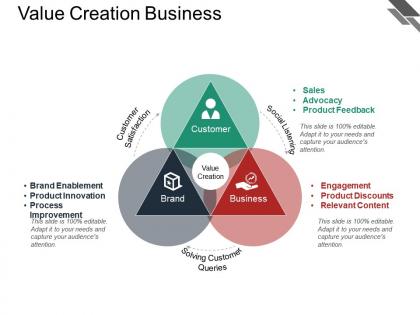
Understand what drives value for your customers by utilizing this Value Creation Business slideshow. Mention the components of the value creation process including domain, parameter, and approach along with their sub-parts with this profit creation PPT slide. Present some effective examples of core values such as dependability, reliability, loyalty, commitment, consistency, honesty and efficiency with this readily available PowerPoint layout. Calculate the acquisition cost for customers with the help of this finance PowerPoint graphic. Highlight the goal of the best cost strategy which is to keep costs and prices lower than other providers of similar products. Showcase how creating value for shareholders insures the future availability of investment capital to fund operations. Also, there are high-grade icons present in the slide that will make your presentation much more effective and reliable. Deliver the best quality products to your clients and maintain good terms with them by downloading this ready to use cost strategy PPT presentation.
People who downloaded this PowerPoint presentation also viewed the following :
Value creation business with all 5 slides:
Judge the distance with our Value Creation Business. Accurately assess how far you can go.


FAQs for
Look, it really comes down to three things: actually solving a problem customers care about, keeping your costs tight, and pricing smart. Most companies I see are burning cash on stuff that doesn't matter - like, seriously, the bloat is insane. You want to do what competitors do but better or cheaper. Multiple revenue streams help too if you can swing it. The sweet spot? When you grow without your costs exploding proportionally. I'd start by mapping out where you're genuinely adding value vs just shuffling money around. That'll show you where to focus your energy.
Track the obvious stuff first - revenue growth, profit margins, ROI. But don't ignore the softer metrics like customer satisfaction and employee engagement either. Market share changes tell you a lot too. Here's what gets messy though: figuring out if that revenue spike actually came from your new product or just good timing. Honestly, most companies track way too much data they never use. Pick maybe 6 metrics max that you'll actually review quarterly. Compare them against whatever goals you set originally. Short, focused reviews work way better than drowning in spreadsheets.
Honestly, customer feedback is like having a cheat code for your business. You stop guessing what people want and actually know. Look for the gaps between what you're giving them and what they really need - that's where the money is. The trick is actually doing something with what they tell you, then letting them know you listened. I probably sound like a broken record about this, but seriously - just pick one way you're already getting feedback and really dig into what patterns you're seeing. Way better than throwing stuff at the wall and hoping it sticks.
Look, tech innovation only matters when it fixes actual problems people have. AI helps doctors catch diseases faster. Manufacturing gets cheaper with automation. Apps make annoying tasks way easier - you know the drill. But here's the thing that bugs me: most "breakthrough" tech is just expensive junk hunting for a purpose. Real value comes from spotting where people waste time or money, then building something that actually helps. Don't fall for shiny objects. Focus on genuine pain points in whatever industry you're in - that's where the magic happens.
Look, sustainability stuff actually pays off big time. Your energy bills drop like crazy - I'm talking real money here. Customers are obsessed with green brands now, so you can literally charge more. Good employees want to work somewhere that doesn't suck for the planet. Oh, and all those ESG investors? They throw money at companies doing this right. Regulations keep getting stricter anyway, so you're just getting ahead of it. Honestly, just find where you're wasting the most resources first. That's where the easy wins are hiding.
Dude, engaged employees are seriously your secret weapon. They're way more productive and actually give a shit about what they're doing. Plus they don't quit every five minutes, which saves you a fortune on hiring costs. I swear, training new people constantly will drain your soul. Your customers notice the difference too - engaged staff just deliver better experiences. And honestly? They become your best marketers without you even asking. Start tracking engagement scores and connect them to your actual business numbers. You'll be shocked how much it moves the needle on profits.
Look, partnerships are all about filling gaps you can't handle alone. You get access to their expertise, markets, whatever - while they tap into your strengths. Honestly? It's way more efficient than trying to build everything from scratch. Two companies can split costs and reach customers neither could get to solo. The trick is finding someone whose skills complement yours perfectly - like if you're great at product but suck at marketing, find a partner who's the opposite. I'd start by figuring out what you're actually missing, then hunt for teams that crush those exact areas.
Honestly, the worst thing you can do is fall in love with a solution before you even know if there's a real problem. I've watched so many teams build "cool" features that literally nobody asked for. Don't spend months perfecting something in secret either - just ship it and see what happens. Oh, and actually talk to customers instead of guessing what they want. Sounds obvious but people skip this step constantly. Also vanity metrics are basically useless. Like who cares if your signup rate looks good if nobody's actually using the thing? Do customer interviews first. Trust me on this one.
So competitive analysis is basically your cheat sheet for finding market gaps you can actually fill. Look at what competitors do well, but more importantly - what they're totally missing. That's where the gold is. You'll avoid building something that already exists (been there, made that mistake) and figure out smart pricing too. I always tell people to hunt for those white spaces where customers are still frustrated. Once you spot those unmet needs, build your whole thing around solving them better than everyone else. It's like having a head start, honestly.
Try three things that actually work: regular retrospectives, cross-functional workshops, and metrics that measure real outcomes. Retrospectives help teams figure out what's creating value vs just busy work. Design thinking sessions are solid too - gets people focused on customers instead of internal stuff. Honestly, the biggest thing is making value creation everyone's job, not just some leadership catchphrase. Change your reward systems to recognize actual delivery over checking boxes. Once you do that, the culture shift happens pretty naturally. People start caring about impact instead of just looking busy.
Honestly, you've got to keep your finger on the pulse constantly. Survey your customers regularly - their feedback is literally gold since they'll tell you when their priorities shift. Like maybe they used to obsess over speed but now it's all about being eco-friendly, you know? Watch what competitors are doing too, especially new players jumping in. Your sales team hears this stuff first, so grab coffee with them monthly. Don't wait for those boring quarterly meetings to pivot your messaging. Stay flexible and ready to adjust when the market tells you what it wants. React fast or get left behind.
Honestly, you want to mix financial stuff with operational metrics. Revenue growth and profit margins are obvious ones, but don't sleep on customer lifetime value - that's where the real money shows up later. I always tell people to track the leading indicators too, like customer satisfaction and employee engagement, since they predict what's coming. ROI matters but it's kinda useless if you're only looking short-term. My buddy at work swears by balanced scorecards that include both hard numbers (revenue per employee, cost savings) and softer stuff like brand strength. Just pick metrics that actually match your goals and track them consistently.
Dude, storytelling changes everything. I've seen presentations where people just dump features and data - everyone's checking their phones within 5 minutes. But tell a story? Suddenly they're actually listening. Here's the thing - stories make people visualize the problem you're solving. They can picture themselves using your solution instead of just hearing about abstract benefits. Way more memorable too. Always kick off with a customer story or real use case. Sets the whole tone and gives context for everything else you'll share. Trust me on this one.
Honestly, start with whatever's driving you crazy right now - don't try to fix everything with data at once. Operations stuff is huge - you'll spot inefficiencies you never noticed. Customer behavior predictions help with retention too. Real-time insights make decision-making way faster, which is clutch. Oh, and predictive maintenance? Total game-changer for avoiding costly downtime. You can also personalize offerings better and find new revenue streams. Resource allocation gets smarter, costs drop. I mean, the ROI potential is pretty solid once you pick that one specific problem and actually commit to solving it with analytics.
Don't just tack on value creation at the end - weave it into your planning from the start. Figure out what "value" actually means to your key people first. Customers? Employees? Investors? Then run every strategic move through that filter before spending money on it. Honestly, I've watched so many companies craft these gorgeous strategies that look amazing on paper but create zero real value. Build value checks into your quarterly reviews - like, make it a standing agenda item. When stuff isn't working, those insights help you course-correct fast. Way better than realizing six months later you've been chasing the wrong things.
-
Unique and attractive product design.
-
Designs have enough space to add content.