

Value creation stages




Try Before you Buy Download Free Sample Product
 Impress Your
 Audience
 100%
100% Editable
 Save Hours
 of Time


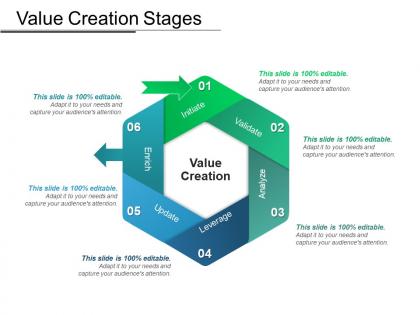
Increase your brand reputation using this Value Creation Stages PowerPoint slideshow. Take the assistance of this surplus creation PowerPoint template to show the phases of value creation like initiation, validation, analysis, leverage, updating, and enrichment. Take advantage of this wealth maximization PowerPoint infographic to define the mission as well as the vision of your company. Utilize this profit creation PPT slide to counter issues associated with exploration, creation, and delivery of value at the earliest. Moreover, you can present the ways to create value for customers like understanding value proposition, identifying consumer segments, focusing investments amongst others. Portray the key principles of value creation such as value-driving factors, consumer segmentation, meeting the right decisions, etc. with this value PPT layout. Download this amazing profit creation PPT graphic to provide a smooth and seamless experience to your clients.
People who downloaded this PowerPoint presentation also viewed the following :
Value creation stages with all 5 slides:
Our Value Creation Stages ensure a fascinating combination. All the components act in harmony.
FAQs for
The primary stages of value creation include value proposition development, resource acquisition, operational processes, delivery mechanisms, and customer relationship management. These stages work systematically by identifying market needs, securing strategic resources, and streamlining production workflows, with many organizations finding that integrated execution across all stages delivers enhanced customer experiences and sustainable competitive advantage.
Organizations measure value through stage-specific metrics like input costs, process efficiency ratios, output quality scores, and customer satisfaction indices. Financial services track loan processing times and approval rates, while manufacturing monitors production throughput and defect rates, ultimately enabling data-driven optimization and competitive advantage across operations.
Customer feedback serves as a critical input across all value creation stages, from initial ideation and product development to delivery optimization and post-launch refinement. Through systematic feedback collection, companies can identify unmet needs, validate concepts, streamline processes, and enhance user experiences, with many organizations finding that customer-driven insights ultimately accelerate innovation cycles and deliver stronger competitive positioning.
Technological advancements streamline value creation stages by automating production processes, enhancing supply chain visibility, enabling real-time customer insights, and facilitating faster market delivery. Through AI, IoT, and data analytics, organizations significantly reduce operational costs, minimize inefficiencies, and accelerate product development cycles, with many manufacturing and retail companies finding that integrated technologies ultimately deliver competitive advantage and superior customer experiences.
Common challenges during value creation include resource constraints, market uncertainty, competitive pressure, operational inefficiencies, and talent acquisition difficulties. These obstacles often require businesses to balance innovation with cost management, adapt quickly to changing customer needs, and streamline processes across departments, with many organizations finding that strategic planning and cross-functional collaboration ultimately deliver sustainable growth and competitive advantage.
Companies align value creation stages with strategic goals by establishing clear performance metrics, integrating cross-functional teams, and implementing regular strategic reviews at each stage. Through systematic alignment processes, organizations streamline resource allocation, enhance operational efficiency, and accelerate time-to-market, with many enterprises finding that synchronized value stages deliver competitive advantage and sustained growth.
Key metrics for evaluating value creation include customer acquisition cost, lifetime value, revenue growth, market penetration rates, and operational efficiency ratios at different stages. Early-stage companies focus on user engagement and product-market fit indicators, while mature organizations emphasize profitability margins, return on investment, and competitive positioning, with many finding that combining leading and lagging indicators delivers comprehensive performance insights.
Cross-departmental collaboration enhances value creation by breaking down silos, accelerating innovation cycles, and optimizing resource allocation across organizational functions. When marketing, operations, and product development teams work together, organizations streamline decision-making processes, reduce redundancies, and deliver more cohesive customer experiences, ultimately achieving faster time-to-market and improved competitive positioning.
Market research informs value creation by providing customer insights for opportunity identification, competitive analysis for value proposition development, and user feedback for product design and testing. Through surveys, focus groups, and behavioral analytics, organizations enhance decision-making across ideation, development, and launch phases, ultimately delivering products that meet market demands and achieve competitive advantage.
Innovation in later value creation stages drives market differentiation, operational optimization, and sustainable competitive advantages through advanced technologies, strategic partnerships, and enhanced customer experiences. It enables organizations to streamline processes, reduce costs, and deliver superior value propositions, with many enterprises finding that continuous innovation ultimately transforms them from commodity providers into market leaders.
External factors significantly influence value creation stages by altering market demand, resource availability, competitive dynamics, and operational costs across development phases. Economic downturns can delay ideation and development stages while constraining funding, whereas favorable conditions accelerate market entry and scaling, with many organizations finding that adaptive strategies during different economic cycles ultimately deliver sustained competitive advantage and resilient growth trajectories.
Cultural influences shape value creation through consumer preferences, communication styles, business practices, regulatory environments, and market expectations across different regions. Companies operating globally find that successful value creation requires adapting products, services, and strategies to local cultural contexts, ultimately delivering culturally resonant solutions while maintaining operational efficiency and competitive advantage.
Small businesses can implement value creation strategies through agile decision-making, direct customer relationships, and rapid iteration cycles, while larger corporations leverage economies of scale, extensive resources, and market reach. Small businesses often excel in personalized services, niche targeting, and quick pivots, while corporations benefit from standardized processes and broad distribution networks, with many finding that combining focused innovation with strategic partnerships ultimately delivers competitive advantage regardless of organizational size.
Value creation directly enhances customer retention by consistently delivering meaningful benefits that exceed expectations, building trust, and fostering long-term loyalty through personalized experiences. Organizations across retail, financial services, and healthcare find that strategic value creation reduces churn rates, increases lifetime customer value, and ultimately delivers sustainable competitive advantage in increasingly saturated markets.
Businesses ensure sustainability throughout value creation stages by integrating environmental considerations into sourcing, production, and distribution processes, adopting circular economy principles, and implementing resource-efficient technologies. Through strategic partnerships with sustainable suppliers, renewable energy adoption, and waste reduction initiatives, organizations minimize environmental impact while enhancing operational efficiency, ultimately delivering long-term competitive advantage and stakeholder value.
-
Innovative and attractive designs.
-
Design layout is very impressive.