

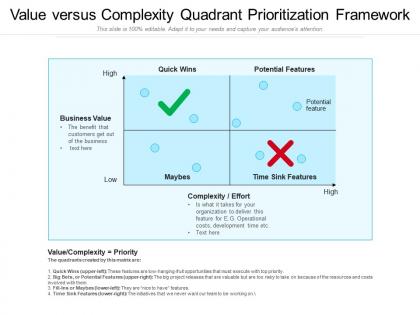
Value versus complexity quadrant prioritization framework




Try Before you Buy Download Free Sample Product
 Impress Your
 Audience
 100%
100% Editable
 Save Hours
 of Time


Our Value Versus Complexity Quadrant Prioritization Framework are topically designed to provide an attractive backdrop to any subject. Use them to look like a presentation pro.
People who downloaded this PowerPoint presentation also viewed the following :
Value versus complexity quadrant prioritization framework with all 2 slides:
Use our Value Versus Complexity Quadrant Prioritization Framework to effectively help you save your valuable time. They are readymade to fit into any presentation structure.
FAQs for Value versus complexity
So basically you've got Value and Complexity as your two main things. Value is like - how much impact will this actually have? Think revenue, user happiness, strategic stuff that matters to your goals. Complexity covers dev time, technical headaches, dependencies, all that fun stuff. Honestly, I just use a 1-5 scale for both because getting too detailed makes my brain hurt. What you're hunting for are those high value, low complexity gems - quick wins that'll make you look like a rockstar. Those should definitely go first.
So this Value-Complexity Matrix thing is actually pretty solid. You plot projects on two axes - business value vs how hard they'll be to build. Quick wins are high value, low complexity - do those first obviously. Low value, high complexity stuff? Skip it or at least ask why you're even considering it. What I like is it stops those endless "but this is important too" conversations because everyone can see the trade-offs laid out visually. Makes prioritizing way less painful. Oh and it's great for getting stakeholders on the same page - they can't argue with a chart, right? Try it next planning meeting.
Dude, manufacturing companies are obsessed with this thing - they use it to figure out which product lines are actually worth the hassle versus which ones just eat up resources. Consulting firms basically live by it when helping clients clean up their portfolios. Tech companies? They're constantly using it for deciding what features to build next. Makes sense though, since these industries deal with crazy complexity every day. I mean, when you've got a million different options pulling you in different directions, you need something to help you focus. Just plot everything on the matrix and boom - you'll see what actually matters.
So basically you draw a 2x2 grid - customer value on one side, how hard it is to build on the other. Quick wins are high value but easy to build, so do those first obviously. Major projects are the high value, super complex ones - worth doing but you'll need to plan them out properly. Avoid the nightmare quadrant (low value + complex) unless you hate money lol. The easy but meh stuff? Fine for when your devs need something to work on. I actually wish more teams did this instead of chasing shiny features. Try plotting your top 10 this week and see what happens.
You'll want to track stuff like revenue impact, cost savings, or customer satisfaction for value. Complexity is more about dev time, resources needed, technical difficulty - that kind of thing. Revenue potential vs story points is a solid starting combo, honestly. Some teams go crazy with weighted scoring systems but that just makes everything harder than it needs to be. Pick maybe 2-3 metrics per axis that everyone gets and can actually measure consistently. You can always tweak it later once you've used the matrix for a while and see what works.
You gotta get everyone on the same page about what you're actually measuring first. Like, what does "high value" even mean to your company - revenue? Customer happiness? Strategic stuff? Same with complexity. I've watched teams argue forever because everyone's got their own definition in their head. Do some practice rounds where you all score the same projects together, hash out the differences, then write down what you agreed on. Oh and definitely revisit this every few months because priorities change way more than people think they will.
Honestly, the worst mistake is underestimating how messy things get - technical debt, dependencies, all that stuff that seems minor but isn't. Teams get way too excited about "innovative" features without actually checking if users want them. I've watched people waste entire meetings debating if something's medium vs high complexity instead of just building a quick prototype to find out. Don't treat the matrix like it's set in stone. Get your tech people AND business folks involved in scoring. Also, circle back on your assessments once you know more - things change.
Yeah, it totally works with agile! During sprint planning, just plot your user stories on the matrix - value vs complexity. Quick wins are those high-value, low-complexity ones that go straight into your current sprint. Medium complexity but high value? Those are perfect for discussing in your next planning session. The matrix thing sounds way more complicated than it actually is, honestly. Just remember to update it as you go since effort estimates change and customer feedback shifts what's valuable. It's basically your backlog prioritization shortcut.
Oh man, this is so true - cultural differences completely change how people see what's "high value" versus complex. Like, some cultures prioritize long-term thinking while others want quick wins. And what seems simple to your team might feel overwhelming to someone else because of how they approach risk or make decisions. I learned this the hard way on a project once. Communication styles are huge too - honestly, it's wild how different groups can look at the exact same situation and have totally opposite takes. You should definitely hash out these differences with your stakeholders first, otherwise you'll be plotting stuff that makes zero sense to half your team.
You definitely need stakeholder input for this - don't try doing it solo. Business people know what actually matters to customers. Tech teams understand how messy implementation gets. I learned this the hard way when I made a matrix that looked great but was totally wrong because I just guessed at everything. Workshop sessions work best where everyone can argue about placement. Gets a bit heated sometimes but that's where you find the real insights. Both sides bring pieces you'd never think of on your own, and honestly the debates usually reveal stuff that changes your whole perspective on features.
Dude, you gotta visualize this stuff. When you plot projects on that grid, the quick wins just pop out at you - high value, easy to do. No more staring at boring lists trying to figure out what matters. The trash projects become super obvious too (high effort, low payoff = nope). Honestly, it's like finally putting on glasses when you didn't realize you needed them. Your team stops arguing about dumb stuff because everyone can literally see which projects make sense. Way better than just talking in circles about priorities.
Honestly, any tool that does 2x2 grids will work fine. I usually just throw something together in Excel or Google Sheets - plot your stuff as dots in the quadrants. Miro and Mural are solid if you want it to look prettier and need people collaborating on it. PowerPoint works too if that's what everyone's already using. Actually, some of the best sessions I've been in were just sketched on whiteboards. The whole point is everyone can see where things land and drag them around when you're debating. Don't overthink the tool - start with whatever you're comfortable with and go from there.
Oh totally, you've gotta keep updating that matrix! Don't just make it once and forget about it. I usually check mine monthly when we're actively building stuff, or whenever something major changes. Features will literally hop around between quadrants as you learn more. That "easy win" you were excited about? Might turn out way more complex once you dig into the code. User feedback changes things too - sometimes what you think is valuable just... isn't. Keep your old versions though, and write down why things moved. Trust me, future you will thank you when someone asks "wait, why did we deprioritize this again?"
Yeah, tons of companies do this well. Spotify's probably the most famous example - they used it for their recommendation features, knocking out easy wins like "Recently Played" before diving into the crazy AI algorithms. Amazon does it all the time with AWS rollouts too. Here's what I've noticed though: the best teams don't just do this once and forget about it. They go back to that matrix every few months because honestly, what seemed "low complexity" in January might look completely different by summer. Market feedback changes everything. Start with those high-value, low-effort quick wins first. Builds momentum and keeps stakeholders happy while you're grinding through the harder stuff.
Honestly, the Value-Complexity Matrix is like having a crystal ball for sketchy projects. You plot stuff based on value versus how hard it'll be, and boom - suddenly you can see which initiatives are gonna be total resource vampires. Quick wins jump out at you (high value, easy to do), while those nightmare projects in the high-complexity, low-value corner practically scream "avoid me!" I always start with easier wins to build some momentum before tackling the big hairy ones. Makes your team feel less defeated, you know? Use it during quarterly planning to reality-check your roadmap before you commit to anything stupid.
-
Unique research projects to present in meeting.
-
Editable templates with innovative design and color combination.
-
Really like the color and design of the presentation.