

Value Vs Effort Task Prioritization Framework





Try Before you Buy Download Free Sample Product
 Impress Your
Audience
 100%
Editable
 Save Hours
of Time


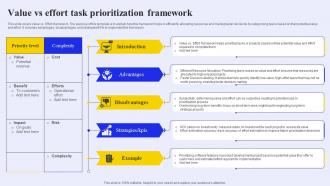
This slide covers Value vs. Effort framework. The purpose of this template is to explain how this framework helps in efficiently allocating resources and making faster decisions by categorizing tasks based on their potential value and effort. It includes advantages, disadvantages, and strategies or KPIs to implement this framework.
People who downloaded this PowerPoint presentation also viewed the following :
Value Vs Effort Task Prioritization Framework with all 9 slides:
Use our Value Vs Effort Task Prioritization Framework to effectively help you save your valuable time. They are readymade to fit into any presentation structure.








FAQs for Value Vs Effort
Key factors include deadline urgency, resource availability, stakeholder impact, task dependencies, and strategic alignment with project objectives. These prioritization criteria work together by minimizing bottlenecks, optimizing team productivity, and ensuring critical deliverables stay on track, with many project managers finding that systematic prioritization ultimately delivers faster completion times and higher stakeholder satisfaction.
The Eisenhower Matrix improves decision-making by categorizing tasks into urgent-important, important-not urgent, urgent-not important, and neither urgent nor important quadrants. Organizations using this framework streamline resource allocation, enhance strategic focus, and reduce decision fatigue, with many executives finding that systematically prioritizing quadrant two activities delivers sustainable competitive advantage and improved operational efficiency.
Stakeholder input provides critical perspectives on business impact, resource requirements, and strategic alignment, ensuring prioritization decisions reflect diverse organizational needs and constraints. Through structured feedback sessions, surveys, and collaborative workshops, teams can balance competing priorities while maintaining stakeholder buy-in, ultimately delivering solutions that meet user expectations and business objectives more effectively.
Technology automates task prioritization through AI algorithms, machine learning models, automated scheduling systems, intelligent workflow management, and predictive analytics tools. These solutions streamline operations by analyzing deadlines, resource availability, and project dependencies, with many organizations finding that automated prioritization reduces manual oversight, accelerates decision-making, and ultimately delivers enhanced productivity and strategic resource allocation.
Common prioritization pitfalls include overcommitting to low-impact tasks, failing to reassess priorities regularly, ignoring stakeholder alignment, lacking clear criteria for decision-making, and treating everything as urgent. These mistakes undermine productivity by creating bottlenecks, reducing focus on strategic objectives, and overwhelming teams, with many organizations finding that establishing transparent frameworks and regular review cycles ultimately delivers better resource allocation and competitive outcomes.
Remote teams often rely on digital prioritization tools, asynchronous communication, and structured frameworks like OKRs or sprint planning, while in-office teams can leverage spontaneous discussions, visual boards, and immediate consensus-building. Remote environments require more explicit documentation and regular check-ins, but ultimately deliver greater flexibility and transparency, with many distributed organizations finding that formal prioritization processes actually enhance focus and accountability across time zones.
Metrics for evaluating prioritization effectiveness include cycle time reduction, resource utilization rates, goal achievement percentages, stakeholder satisfaction scores, and return on investment measures. These indicators enable organizations to assess whether their prioritization frameworks are delivering faster project completion, better resource allocation, and improved business outcomes, with many companies finding that tracking these metrics reveals optimization opportunities and enhances strategic decision-making processes.
Prioritization enhances productivity in fast-paced environments by streamlining task management, reducing decision fatigue, and ensuring critical objectives receive immediate attention. Through strategic frameworks like the Eisenhower Matrix or OKRs, organizations across sectors—from financial services to healthcare—deliver faster project completion, improved resource allocation, and enhanced team focus, ultimately maintaining competitive advantage amid increasing operational demands.
Visual aids enhance prioritization by transforming complex data into clear, actionable insights through priority matrices, impact-effort charts, timeline visualizations, and comparative dashboards. These tools enable teams to quickly identify high-value opportunities, assess resource allocation trade-offs, and communicate strategic decisions across organizations, with many finding that visual frameworks streamline consensus-building and accelerate implementation timelines.
Key psychological biases affecting prioritization include confirmation bias, anchoring bias, availability heuristic, sunk cost fallacy, and recency bias. These cognitive patterns can skew decision-making by overemphasizing recent events, familiar information, or initial impressions, with many organizations finding that structured frameworks and diverse perspectives help minimize bias impact, ultimately delivering more objective prioritization outcomes.
Different industries approach task prioritization based on their operational demands, with healthcare prioritizing patient urgency and safety protocols, financial services focusing on regulatory deadlines and risk management, and manufacturing emphasizing production schedules and supply chain efficiency. These sector-specific frameworks enable organizations to streamline workflows, enhance resource allocation, and deliver faster services while maintaining industry standards, ultimately providing competitive advantage in increasingly complex business environments.
Prioritization significantly enhances employee morale by reducing overwhelm, providing clear direction, and enabling meaningful progress on important tasks. When organizations implement strategic prioritization frameworks, employees experience less stress, greater sense of accomplishment, and improved work-life balance, with many companies finding that clear priorities ultimately deliver higher engagement and job satisfaction.
Prioritization frameworks adapt to agile environments through iterative value assessment, sprint-based ranking systems, stakeholder feedback loops, and continuous backlog refinement. These approaches enable development teams in software companies, financial services, and healthcare organizations to respond quickly to changing requirements, deliver high-impact features faster, and maintain competitive advantage through flexible resource allocation.
Time management serves as the foundation for effective prioritization by providing structured frameworks for allocating resources, setting realistic deadlines, and maintaining focus on high-impact activities. Through strategic time blocking and deadline management, organizations streamline workflow efficiency, minimize resource conflicts, and enhance project delivery timelines, with many businesses finding that structured time management ultimately delivers improved productivity and competitive advantage in increasingly demanding markets.
Leaders can communicate prioritization decisions through clear rationale sharing, visual roadmaps, regular team meetings, transparent criteria explanation, and consistent follow-up discussions. This approach enables teams to understand decision-making logic, align efforts with strategic objectives, and adapt quickly to changing priorities, with many organizations finding that transparent communication ultimately delivers improved execution, reduced confusion, and stronger team buy-in across all levels.
-
World-class PowerPoint designs that are fully customizable!
-
What an exhaustive collection of templates you guys have there in slideteam. Impressive!!!