


Waste management manpower budget municipal solid waste management ppt designs




Try Before you Buy Download Free Sample Product
 Impress Your
 Audience
 100%
100% Editable
 Save Hours
 of Time


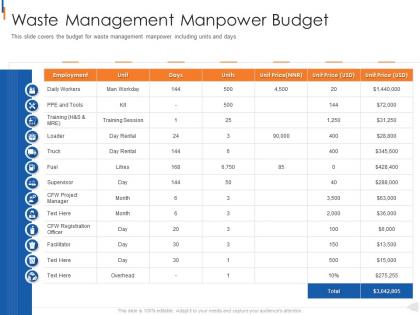
This slide covers the budget for waste management manpower including units and days.
People who downloaded this PowerPoint presentation also viewed the following :
Waste management manpower budget municipal solid waste management ppt designs with all 2 slides:
Use our Waste Management Manpower Budget Municipal Solid Waste Management Ppt Designs to effectively help you save your valuable time. They are readymade to fit into any presentation structure.

FAQs for Waste management manpower budget municipal solid waste
Manpower budget estimation requires analyzing collection frequency, service area size, waste volume projections, equipment requirements, and regulatory compliance needs. These factors determine staffing levels across operations, maintenance, and administration, with municipalities and private waste companies finding that seasonal variations, population growth, and specialized services like hazardous waste handling significantly impact long-term budget planning and operational efficiency.
Technology enhances waste management manpower allocation through IoT sensors, route optimization software, predictive analytics, GPS tracking, and automated scheduling systems. These solutions streamline operations by providing real-time bin monitoring, optimizing collection routes, and predicting maintenance needs, with many municipalities finding significantly reduced labor costs and improved service delivery.
Key performance indicators for waste management manpower include collection efficiency rates, route optimization metrics, safety incident frequency, customer complaint resolution times, and cost per ton collected. These KPIs enable organizations to streamline operations, enhance service quality, and reduce operational costs, with many municipalities and waste management companies finding that systematic performance tracking ultimately delivers improved resource allocation and competitive advantage.
Workforce training significantly impacts waste management budgets by reducing operational costs, minimizing safety incidents and insurance claims, improving equipment efficiency and longevity, and enhancing regulatory compliance. Well-trained personnel streamline collection routes, optimize sorting processes, and reduce contamination rates, with many municipalities and waste management companies finding that comprehensive training programs ultimately deliver 15-20% cost savings annually.
Public-private partnerships influence waste management manpower budgeting by enabling shared resource allocation, transferring operational responsibilities to private entities, and introducing performance-based staffing models. Through strategic partnerships, municipalities can reduce direct labor costs while accessing specialized expertise, with many cities finding that hybrid staffing approaches deliver enhanced service efficiency and optimized budget allocation.
Community outreach and education significantly reduce manpower requirements by encouraging proper waste sorting, recycling compliance, and disposal practices among residents. These programs enable municipalities to streamline collection routes, minimize contamination processing staff, and reduce enforcement personnel needs, while ultimately delivering cost savings and operational efficiency for local waste management departments.
Regulatory requirements significantly increase manpower budgets for waste management programs by demanding specialized compliance officers, certified technicians, and dedicated monitoring staff. These mandates require organizations to hire environmental specialists, safety coordinators, and documentation personnel, with many municipalities and corporations finding that regulatory compliance typically represents 25-40% of their total waste management staffing costs, ultimately ensuring environmental protection while driving operational expenses.
Common challenges include inadequate funding allocation, lack of skilled workforce availability, informal sector integration difficulties, seasonal demand fluctuations, and limited training resources. Developing countries often struggle with balancing cost-effective operations while maintaining service quality, with many municipalities finding that strategic workforce planning and phased training programs ultimately deliver improved waste collection efficiency and sustainable environmental outcomes.
Seasonal variations significantly impact manpower budgeting by creating fluctuating demand patterns, requiring flexible staffing strategies, and necessitating careful resource allocation planning. Many municipalities and waste management companies address these challenges by implementing temporary hiring programs, cross-training permanent staff, and utilizing predictive scheduling, ultimately delivering cost-effective operations while maintaining consistent service levels.
Strategies include cross-training employees for multiple roles, implementing flexible scheduling systems, utilizing data analytics for demand forecasting, adopting route optimization software, and integrating automated sorting technologies. These approaches streamline operations by reducing labor redundancies, improving resource allocation, and enhancing operational efficiency, with many waste management companies finding that strategic workforce planning ultimately delivers significant cost reductions and improved service delivery.
Geographical layout significantly influences manpower budgets through terrain complexity, population density variations, and travel distances between collection points. Rural areas with scattered populations require more personnel and vehicle hours to cover extensive routes, while urban regions with concentrated waste generation enable more efficient resource allocation, ultimately affecting labor costs, fuel expenses, and overall operational efficiency for waste management organizations.
Underestimating manpower needs in waste management projects leads to service disruptions, regulatory compliance failures, equipment breakdowns, and increased operational costs due to overtime expenses. Many municipalities and waste management companies find that insufficient staffing ultimately compromises collection schedules, safety protocols, and customer satisfaction, while creating long-term financial burdens that exceed initial budget savings.
Data analytics contributes to accurate manpower budgeting by analyzing historical collection patterns, seasonal waste fluctuations, route efficiency data, and demographic trends to predict staffing needs. Through predictive modeling and real-time monitoring, waste management companies can optimize crew scheduling, reduce overtime costs, and enhance service reliability, with many municipal services finding that data-driven workforce planning delivers significant operational savings while maintaining consistent collection schedules.
Manpower budgets should prioritize specialized roles in recycling technologies, sustainability compliance, and circular economy implementation, while expanding training programs for existing staff on green practices and waste-to-energy systems. Organizations increasingly find that investing in sustainability-focused expertise delivers enhanced operational efficiency, regulatory compliance, and competitive advantage, with many waste management companies reducing long-term costs through strategic workforce development.
Stakeholder engagement helps determine manpower needs by identifying community requirements, regulatory compliance demands, service expectations, and operational constraints through collaborative planning sessions. Through comprehensive stakeholder consultation, waste management organizations can accurately assess staffing levels for collection routes, processing facilities, and customer service operations, while building community support that ultimately enhances program effectiveness and resource allocation efficiency.
-
Great experience, I would definitely use your services further.