


What Is Brand Personality And How To Choose The Right Traits Internal Brand Rollout Plan




Try Before you Buy Download Free Sample Product
 Impress Your
 Audience
 100%
100% Editable
 Save Hours
 of Time


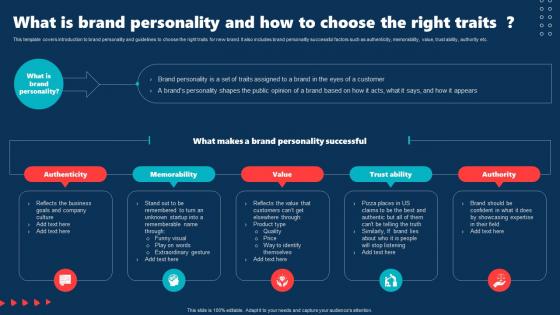
This template covers introduction to brand personality and guidelines to choose the right traits for new brand. It also includes brand personality successful factors such as authenticity, memorability, value, trust ability, authority etc.
People who downloaded this PowerPoint presentation also viewed the following :
What Is Brand Personality And How To Choose The Right Traits Internal Brand Rollout Plan with all 6 slides:
Use our What Is Brand Personality And How To Choose The Right Traits Internal Brand Rollout Plan to effectively help you save your valuable time. They are readymade to fit into any presentation structure.





FAQs for What Is Brand Personality And How To Choose The Right Traits Internal
Key traits that define a brand's personality include sincerity, excitement, competence, sophistication, and ruggedness, along with specific characteristics like trustworthiness, innovation, and authenticity. These traits work together to create emotional connections with consumers, differentiate from competitors, and guide consistent messaging across all touchpoints, with many organizations finding that well-defined brand personalities ultimately drive stronger customer loyalty and market positioning.
Understanding brand personality significantly influences marketing strategies by shaping messaging tone, channel selection, visual identity, target audience approach, and content themes to create authentic connections. This strategic alignment enables companies to differentiate themselves in crowded markets, build emotional customer relationships, and develop consistent campaigns across platforms, with many brands finding that personality-driven marketing delivers higher engagement and stronger customer loyalty.
Brand personality significantly influences customer loyalty by creating emotional connections, fostering trust, and differentiating companies from competitors through consistent messaging and values alignment. When brands maintain authentic personalities that resonate with target audiences, customers develop deeper relationships beyond transactional interactions, with many retail and service organizations finding that distinctive brand personalities ultimately drive repeat purchases and long-term advocacy.
A brand's personality can be effectively communicated through color psychology, typography choices, visual imagery, logo design, and layout composition. These design elements work together strategically, with companies like Apple using minimalist aesthetics to convey innovation and premium quality, while brands like Coca-Cola leverage warm reds and flowing scripts to express friendliness and approachability, ultimately creating memorable customer connections.
Companies assess their brand personality through customer surveys, social media sentiment analysis, brand perception studies, competitor comparisons, and internal stakeholder interviews. These methods reveal how audiences currently perceive brand traits, with many organizations finding that comprehensive assessment across multiple touchpoints uncovers gaps between intended messaging and actual customer perceptions, ultimately enabling strategic realignment.
Brand personality significantly influences consumer perception by creating emotional connections, building trust, and differentiating products in competitive markets. Through consistent personality traits like reliability or innovation, brands shape purchasing decisions, foster customer loyalty, and command premium pricing, with companies like Apple and Nike demonstrating how distinctive personalities drive consumer preference and long-term business success.
Storytelling enhances brand personality by creating emotional connections, showcasing core values, and making abstract brand attributes tangible through relatable narratives. Through compelling case studies, customer success stories, and authentic brand origin tales, organizations can transform presentations from feature-focused pitches into memorable experiences, ultimately building trust and differentiation in competitive markets.
Apple exemplifies minimalist innovation, Nike embodies athletic determination, and Harley-Davidson represents rebellious freedom, while Dove projects nurturing care and Tesla showcases futuristic sustainability. These brands demonstrate that authentic personality alignment with target audiences drives emotional connections, customer loyalty, and premium positioning, with many companies finding that consistent personality expression across all touchpoints ultimately delivers competitive differentiation and sustained market advantage.
Brand personality evolves through strategic repositioning, market shifts, consumer behavior changes, competitive pressures, and leadership transitions that require adaptation. Companies like Apple, McDonald's, and Nike have successfully transformed their personalities by refreshing messaging, updating visual identity, and aligning with contemporary values, ultimately delivering stronger market relevance and sustained competitive advantage.
Businesses align their brand personality with their target audience through comprehensive market research, consistent messaging across touchpoints, authentic storytelling, and strategic visual identity choices. Through demographic analysis and behavioral insights, companies like Nike with athletes or Apple with creative professionals successfully match personality traits to audience values, ultimately delivering stronger emotional connections and competitive differentiation.
Brand personality can be integrated into social media strategies through consistent voice and tone, visual identity alignment, storytelling approaches, content themes, and engagement styles that reflect core brand traits. Companies like Nike emphasize empowerment and athleticism across platforms, while Wendy's leverages wit and boldness, ultimately creating authentic connections that enhance customer loyalty and differentiate from competitors in increasingly crowded digital spaces.
Brand personality alignment effectiveness can be measured through brand recall rates, emotional connection surveys, customer sentiment analysis, purchase intent studies, and social media engagement metrics. These measurements enable organizations to track how consistently their personality resonates across touchpoints, with many companies finding that strong alignment delivers increased customer loyalty, higher conversion rates, and sustained competitive advantage in crowded markets.
Cultural factors significantly influence brand personality development by shaping consumer values, communication styles, behavioral expectations, and aesthetic preferences that brands must align with for market resonance. Through cultural adaptation, brands modify their messaging, visual identity, and positioning across different regions, with companies like McDonald's and Coca-Cola successfully tailoring their personalities to local customs while maintaining core brand essence, ultimately delivering culturally relevant experiences and stronger market penetration.
Brands face significant challenges when redefining their personality, including maintaining customer loyalty during transitions, ensuring internal alignment across all touchpoints, and managing potential confusion in market positioning. While established brands risk alienating existing customers, they must balance authenticity with evolution, requiring substantial investment in retraining, rebranding, and consistent messaging across all channels.
Small businesses can cultivate strong brand personality through consistent storytelling, authentic social media engagement, strategic partnerships, and community involvement, while leveraging cost-effective digital tools and platforms. Through targeted content creation, local networking, and personalized customer interactions, these approaches enable smaller organizations to build memorable brand identities, foster customer loyalty, and compete effectively against larger competitors.
-
Nice and innovative design.
-
Wow! The design and quality of templates on SlideTeam are simply the best.