

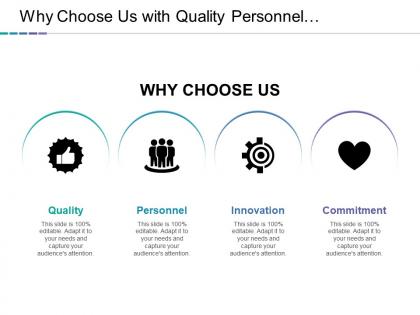
Why choose us with quality personnel innovation and commitment




Try Before you Buy Download Free Sample Product
 Impress Your
 Audience
 100%
100% Editable
 Save Hours
 of Time


Get the audience cheering for you. Win their affections with our Why Choose Us With Quality Personnel Innovation And Commitment.
People who downloaded this PowerPoint presentation also viewed the following :
Why choose us with quality personnel innovation and commitment with all 5 slides:
Our Why Choose Us With Quality Personnel Innovation And Commitment ensure your idea goes the distance. From concept to commercial feasibility.

FAQs for Why choose us with quality personnel
So basically there are four main things to think about - content, process, product, and environment. Content is what you're teaching (like having different reading levels). Process is how kids learn best - some are visual, others need to move around. Product is how they show you they get it. Environment matters too, which honestly took me forever to figure out! Some kids need dead silence while others work better with background noise or in groups. Don't try to differentiate everything at once though - you'll lose your mind. Pick one thing first, maybe let them choose how to show what they learned, then add more later.
Honestly, differentiation works because kids actually *want* to learn when the work matches where they're at. No more forcing everyone through the same boring routine. Students feel way more confident when they can access stuff at their level and show what they know in different ways. It's like... remember trying on jeans that actually fit for once? Everything just clicks. They start caring more because the work feels doable, not impossible or mind-numbing. Try letting them choose how to demonstrate a concept first - you'll be surprised how their whole attitude changes.
Start with grouping kids by where they're at skill-wise and how they learn best. Then mix up your content and assignments to match. Some need visuals, others are totally hands-on learners or need to hear things explained. Choice boards work really well - basically different assignment options hitting the same goal but with varying difficulty levels. I'm always doing quick check-ins to see who gets it and who's struggling. Oh, and don't feel bad about treating students differently! Fair doesn't mean everyone gets identical work. Stay flexible and adjust as you go.
Honestly, tech is a lifesaver for differentiation. Adaptive platforms automatically give your advanced kids harder stuff while struggling ones get extra support - no more making a million different worksheets! Online discussions are great too since quiet kids can contribute without having to speak up in class. Real-time data shows you exactly who's lost, which is clutch. I'd say pick one tool - maybe try a digital choice board this week? See what happens. The key is starting small rather than overwhelming yourself (learned that the hard way).
Think of formative assessment as your cheat sheet for figuring out what each kid actually needs. I'm always doing quick pulse checks - exit tickets, thumbs up/down, just walking around and listening. Then I group them based on what I see. Some need extra help, others are bored out of their minds and ready for harder stuff. Without checking in constantly, you're basically flying blind and hoping for the best. Even something super simple like "hold up 1-5 fingers for how confident you feel" gives you enough to switch up tomorrow's groups. It's honestly the only way differentiation actually works instead of just being this thing we say we do.
Okay so there's basically three ways to mix things up. Change the *content* - give different reading levels or videos based on who needs what. Switch up the *process* - some kids work alone, others in groups, whatever clicks for them. And vary the *product* - presentations, essays, art projects, you know? Honestly though? Don't try to do everything at once or you'll lose your mind. I learned that the hard way my first year! Just pick one thing per lesson. Maybe offer two different articles to read, or let them choose between a poster and a written report. You'll get better at juggling more as you go.
Ugh, the logistics are brutal - you're juggling learning paths for 25+ kids at once. Time's always against you since everyone needs different help, and tracking progress? Total nightmare. Creating materials for different skill levels eats up your entire weekend, I swear. Plus assessment gets weird when you need multiple ways to check if they actually get it. Honestly though, don't try to personalize everything right away or you'll burn out. Start with maybe 2-3 strategies in one subject and build from there. Way less overwhelming that way.
So differentiation is basically giving kids different ways to learn and show what they know - total game changer for special needs students. Maybe one kid writes an essay, another makes a poster or does a video instead. You can tweak content difficulty or switch up how you present stuff (visual, audio, hands-on activities). Honestly, half the battle is just figuring out each student's strengths first. I'd say start simple though - give two options for one assignment and see what happens. You'll be shocked how much some struggling kids can actually pull off when they find their groove.
So basically I create different versions of the same content - easy vocab and short sentences for kids who struggle, then the full text plus extra stuff for advanced readers. Honestly, graphic novels are lifesavers for this. Audio versions help too, or just breaking longer readings into chunks. The goal is getting everyone to learn the same big ideas, even if they're reading at different levels. I usually aim for 2-3 difficulty levels that actually match what my students can handle. Oh, and those high-interest/low-level books? Game changer for reluctant readers.
Oh totally! So I assign different roles based on who's good at what. Like, shy kids get to be the researcher or note-taker - they're still contributing but don't have to talk nonstop. Meanwhile your chatty ones can run the discussion. Honestly learned this after watching some poor kid just sit there silent for 20 minutes once, felt terrible. You could also do think-pair-share or have everyone present just one part so no one's off the hook. The trick is planning out who does what instead of just throwing them together and hoping for the best.
Honestly, the best thing you can do is teach kids to figure out what they need and speak up about it. Give them those learning style surveys first - then do goal-setting meetings where they talk through their strengths and what's hard for them. Learning menus work great too (students pick activities based on what they're ready for). I'm obsessed with student-led conferences where they basically present their own progress and ask for help. The trick is letting go of control bit by bit. Start with guided reflection questions, then work toward independent learning contracts. Makes them actual partners instead of just sitting there waiting for you to fix everything.
Oh man, cultural stuff makes such a huge difference in how kids learn. Some respond well to direct feedback, others shut down completely - I definitely bombed that my first year! Communication styles are all over the place too. Plus family expectations about group work vs working alone vary so much between cultures. It's not just about different skill levels anymore, you know? I'd honestly start with a quick survey asking kids how they prefer to learn and what their families value education-wise. That'll give you way better insight than just guessing.
Honestly, tiered assignments are a lifesaver - same concept but different difficulty levels. Like basic addition for some kids, word problems for others. I'd also try flexible grouping. Sometimes pair strong kids with ones who need help, other times group similar levels together (depends on the day, really). Choice boards let students pick how they want to practice, which they love. Oh, and math stations are amazing because kids rotate through different activities while you pull small groups. My sister swears by this approach. Don't try everything at once though - pick one method first and see how it goes.
Totally! Standards just tell you what kids need to learn - differentiation is how they get there. Like, everyone's hitting the same math standard but maybe some use manipulatives while others do group work or harder problems. Assessment's honestly the tricky part, but you can do choice boards or let them show mastery different ways. Projects, different question types, whatever works. Just gotta make sure it all proves they learned the standard. I'd start small - pick one unit and map out different activities for the same objectives. Way less overwhelming that way.
Honestly, you really need that professional development if you want differentiation to actually work. Most teacher prep programs barely scratch the surface of this stuff - which is kind of ridiculous when you think about it. Good PD gives you the real strategies: flexible grouping, tiered assignments, figuring out who's ready for what. Without it? You're just guessing at how to modify things for different kids. I'd look for training that has hands-on practice, not just theory. The follow-up coaching makes a huge difference too. It's one of those things where you don't realize how much you don't know until someone shows you better ways to do it.
-
Awesome presentation, really professional and easy to edit.
-
Very unique, user-friendly presentation interface.