

Work Capability Assessment Powerpoint Presentation Slides




Try Before you Buy Download Free Sample Product
 Impress Your
 Audience
 100%
100% Editable
 Save Hours
 of Time


Assess the competence of employees using these Work Capability Assessment PowerPoint Presentation Slides. Take the assistance of these capability management PPT templates to show the organization structure of your company. Showcase the components of capability assessment like increased revenue, required capabilities, and estimated growth potential with these capability analysis PPT slides. Take advantage of this employee development PowerPoint slideshow to illustrate the five maturity levels namely initial, managed, defined, predictable, and optimizing. Utilize this workforce ability presentation deck to portray the current vacancies in your department and designations along with their educational requirements. Plan for a recruitment budget in advance, create a training plan and consistently validate it using these capability management PPT layouts. Unveil the agency capabilities like business processes, performance measurement, organizational culture, etc. using these capability maturity PPT infographics. Download these amazing capability analysis PowerPoint visuals and motivate subordinates to reach their highest potential for higher productivity.
People who downloaded this PowerPoint presentation also viewed the following :
Content of this Powerpoint Presentation
Slide 1: This slide introduces Work Capability Assessment. State your company name and begin.
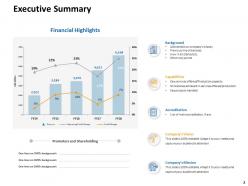
Slide 2: This slide presents the Executive Summary.
Slide 3: This slide showcases the Key Management.
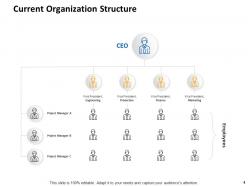
Slide 4: This slide presents the Current Organization Structure.
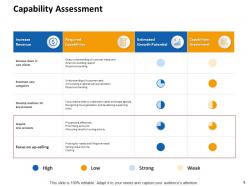
Slide 5: This slide showcases Capability Assessment- High, Low, Strong, Weak.
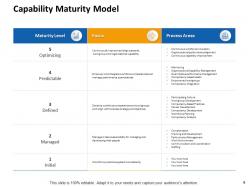
Slide 6: This slide describes the Capability Maturity Model.
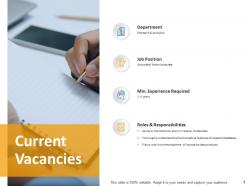
Slide 7: This slide showcases the Current Vacancies with job position, min. experience required etc.
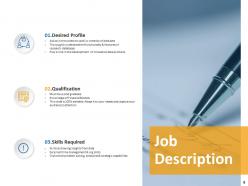
Slide 8: This slide displays Job Description. Showcase desired profile,skills required, qualification etc.
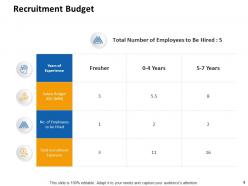
Slide 9: This slide presents the Recruitment Budget.
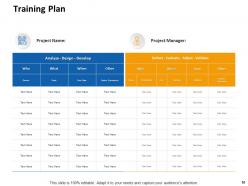
Slide 10: This slide showcases the Training Plan with Project Name and Project Manager
Slide 11: This is Work Capability Assessment Icons Slide.
Slide 12: This slide is titled as Additional Slides for moving forward.
Slide 13: This slide displays time for Coffee Break.
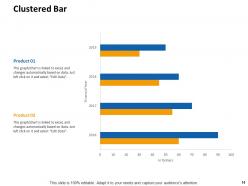
Slide 14: This slide displays Clustered Bar chart with different product comparison.
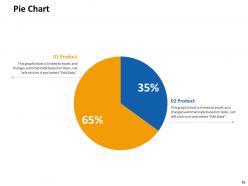
Slide 15: This slide displays Pie Chart with the percentages.
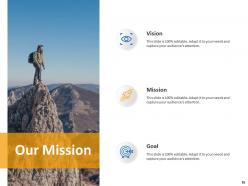
Slide 16: This is Our Mission slide with Vision, Mission and Goal.
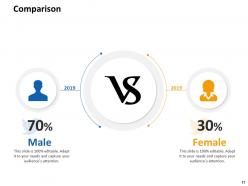
Slide 17: This is Comparison slide with data in percentage.
Slide 18: This is Meet Our Team slide with names and designation.
Slide 19: This is About Us slide to showcase company specifications.
Slide 20: This is Puzzle slide with text boxes.
Slide 21: This slide represents Magnifying Glass to highlight the important content under it.
Slide 22: This is Idea Generation slide to showcase ideas, information etc.
Slide 23: This is Thank You slide with address, Email address, and contact number.
Work Capability Assessment Powerpoint Presentation Slides with all 23 slides:
Use our Work Capability Assessment Powerpoint Presentation Slides to effectively help you save your valuable time. They are readymade to fit into any presentation structure.




FAQs for Work Capability Assessment
Work Capability Assessment objectives include determining functional capacity for employment, identifying reasonable workplace accommodations, evaluating disability benefits eligibility, and establishing rehabilitation needs. These assessments streamline decision-making for employers, insurers, and healthcare providers by delivering objective data on work limitations, enabling strategic resource allocation, and ultimately enhancing return-to-work outcomes across various industries.
Work capability assessment processes vary significantly across healthcare systems through different evaluation criteria, provider networks, and administrative frameworks. While some systems like the UK's utilize specialized assessments through designated centers, others integrate evaluations within existing healthcare infrastructure, with many finding that streamlined approaches enhance patient access and reduce processing times, ultimately delivering more consistent outcomes.
Work capability assessments evaluate individuals through functional capacity analysis, medical documentation review, cognitive and physical testing, workplace accommodation needs, and vocational rehabilitation potential. These comprehensive evaluations enable employers and healthcare professionals to determine suitable job modifications, return-to-work timelines, and disability benefits eligibility, ultimately delivering personalized employment solutions while ensuring workplace safety and productivity.
Medical professionals serve as primary evaluators in work capability assessments, conducting comprehensive examinations, reviewing medical histories, analyzing functional limitations, and providing expert clinical opinions on an individual's capacity to perform specific job requirements. Through detailed medical evaluations, doctors, occupational therapists, and specialists determine work restrictions, recommend accommodations, and guide return-to-work strategies, ultimately enabling employers to make informed decisions while ensuring employee health and safety.
Psychological factors significantly influence Work Capability Assessment results by affecting self-reporting accuracy, symptom presentation, and functional demonstration during evaluations. Mental health conditions like anxiety, depression, or trauma can amplify perceived limitations, while coping mechanisms and motivation levels directly impact performance on assessment tasks, with healthcare providers increasingly recognizing that comprehensive evaluations must account for both psychological and physical factors to deliver accurate capability determinations.
Accommodations include extended time limits, alternative formats like large print or audio, assistive technologies, modified physical requirements, and accessible testing environments. These adaptations ensure equitable evaluation by removing barriers while maintaining assessment integrity, with many organizations finding that comprehensive accommodation policies enhance both compliance and candidate experience, ultimately delivering fairer hiring practices and broader talent access.
Individuals can prepare effectively by gathering comprehensive medical documentation, completing detailed questionnaires honestly, and practicing clear descriptions of daily limitations and challenges. Many applicants find that maintaining symptom diaries, organizing supporting evidence from healthcare providers, and understanding assessment criteria ultimately delivers better outcomes, while preparation significantly enhances their ability to communicate functional impacts accurately.
Assessment outcomes directly determine benefit eligibility by establishing whether individuals meet disability criteria for programs like Employment and Support Allowance, Personal Independence Payments, or Universal Credit. These determinations significantly impact financial support levels, with many claimants finding that favorable assessments enable access to enhanced rates and additional resources, while unfavorable outcomes may require appeals or alternative support strategies.
Work Capability Assessments for individuals with long-term conditions typically occur every 1-3 years, though frequency depends on condition stability, medical prognosis, and individual circumstances. Through regular reassessment schedules, healthcare providers and employers can track progression patterns, adjust workplace accommodations, and optimize support strategies, with many organizations finding that structured evaluation timelines enhance employee retention while ensuring appropriate resource allocation and compliance with evolving health needs.
Common misconceptions about Work Capability Assessments include assuming they're designed to deny benefits, that they're one-size-fits-all evaluations, that mental health conditions aren't properly considered, and that results are permanent or unchangeable. While these assessments present both challenges and opportunities for accurate evaluation, many organizations are finding that comprehensive, individualized approaches enhance fairness and deliver better outcomes for claimants.
Work capability assessment data influences policy changes by informing benefit eligibility criteria, resource allocation decisions, and program effectiveness evaluations through comprehensive analysis of claimant outcomes and assessment patterns. This data enables policymakers to identify systemic issues, adjust support frameworks, and optimize service delivery, with government agencies finding that evidence-based policy modifications ultimately enhance program efficiency and deliver more targeted support for genuinely disabled individuals.
Work Capability Assessments present both significant ethical challenges and opportunities for improvement, including fairness in evaluation criteria, transparency in decision-making processes, dignity preservation throughout assessments, and ensuring adequate support systems. While these assessments help organizations allocate resources effectively, many institutions find that implementing comprehensive training, standardized protocols, and regular review mechanisms ultimately delivers more equitable outcomes and enhanced stakeholder trust.
Cultural attitudes towards work significantly influence how assessment outcomes are perceived, interpreted, and accepted by both individuals and organizations. In collectivist cultures, assessments emphasizing team contributions may be more valued than individual performance metrics, while individualistic cultures prioritize personal achievement measures, with many organizations finding that culturally-sensitive assessment frameworks enhance employee engagement and deliver more accurate capability evaluations.
Support systems during work capability assessments include dedicated case managers, healthcare professional liaisons, advocacy services, interpreter assistance, and specialized accommodation coordinators. These resources streamline the assessment process by providing personalized guidance, ensuring clear communication, and facilitating necessary adjustments, with many individuals finding that proactive support coordination significantly enhances their assessment experience and outcomes.
Improving assessment fairness and accuracy involves implementing standardized evaluation criteria, utilizing multiple assessment methods, providing comprehensive assessor training, and incorporating regular bias audits. These measures enhance objectivity by establishing consistent benchmarks, diversifying evaluation approaches, and ensuring cultural sensitivity, with many organizations finding that systematic review processes and stakeholder feedback ultimately deliver more equitable outcomes and stronger legal compliance.
-
Understandable and informative presentation.
-
Very unique and reliable designs.
-
Innovative and attractive designs.