


0614 rubella virus medical images for powerpoint




Try Before you Buy Download Free Sample Product
 Impress Your
 Audience
 100%
100% Editable
 Save Hours
 of Time


Attract customers to your facility. Our 0614 Rubella Virus Medical Images For Powerpoint will make them come in droves.
People who downloaded this PowerPoint presentation also viewed the following :
Content of this Powerpoint Presentation
Description:
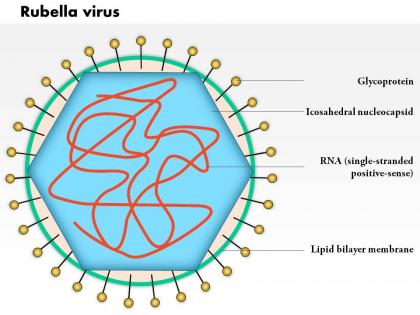
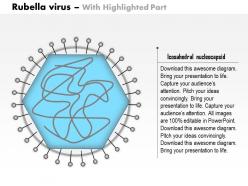
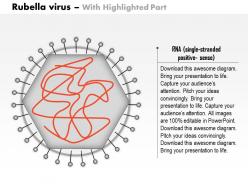
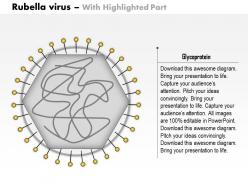
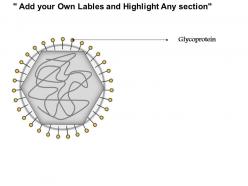
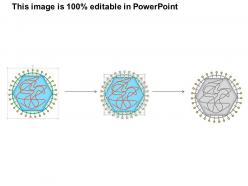
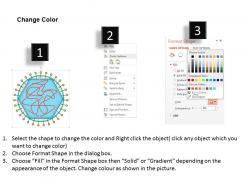
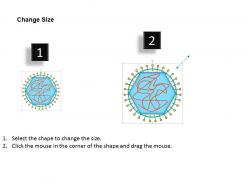
The image is a simplified graphical representation of the Rubella virus structure. Rubella, also known as German measles, is a contagious viral infection best known by its distinctive red rash.
1. Rubella virus is the title, confirming the subject of the illustration.
2. Glycoprotein labels are attached to structures sticking out from the virus's surface. These glycoproteins are responsible for the virus's ability to attach to and invade host cells.
3. Icosahedral nucleocapsid is indicated by the geometric shape within the virus, signifying the protein shell that encases the viral genetic material.
4. RNA (single-stranded positive-sense) describes the type of genetic material found in Rubella, which is a single strand of RNA that's ready for immediate translation into proteins.
5. Lipid bilayer membrane illustrates the outermost layer of the virus that encompasses the nucleocapsid, contributing to the virus's structure and its interactions with host cells.
Use Cases:
Here are 7 industries that could use this image in their presentations:
1. Education:
Use: Teaching the structure of viruses in biology class.
Presenter: Biology teacher.
Audience: Students.
2. Healthcare:
Use: Training medical staff about viral infections and their causative agents.
Presenter: Healthcare trainer or medical professional.
Audience: Nurses, doctors, and other healthcare workers.
3. Pharmaceutical:
Use: Presenting research on antiviral drugs targeting the Rubella virus.
Presenter: Pharmaceutical researcher or scientist.
Audience: Pharmaceutical company stakeholders and scientists.
4. Biotechnology:
Use: Discussing genetic characteristics of viruses for vaccine development.
Presenter: Biotechnologist.
Audience: Research and development team members.
5. Public Health:
Use: Educating about vaccination and virus prevention strategies.
Presenter: Public health official.
Audience: General public or health policymakers.
6. Medical Publishing:
Use: Illustration in textbooks or educational materials about infectious diseases.
Presenter: Editor or medical writer.
Audience: Readers or students in the medical field.
7. Scientific Research:
Use: Presentation of findings from studies on the Rubella virus.
Presenter: Scientist or researcher.
Audience: Peers in a scientific or research conference.
0614 rubella virus medical images for powerpoint with all 11 slides:
Gain from the area based experience of our 0614 Rubella Virus Medical Images For Powerpoint. Benefit from their glocal capability.

FAQs for 0614 rubella virus medical
So rubella's basically a small RNA virus - around 50-70 nanometers with an envelope it steals from host cells (kinda clever honestly). Three main proteins you'll see: E1 and E2 glycoproteins on the surface, plus C protein wrapping the RNA core. E1 does the cell fusion stuff while E2 binds to receptors. Oh and since it has that envelope, it's way more fragile than other viruses. Detergents will wreck it pretty easily. Makes lab work a bit tricky sometimes but also means it doesn't survive as long outside the body.
So rubella spreads just like a cold - through droplets when people cough or sneeze. The tricky part? You're contagious about a week before you even get the rash, which is honestly kind of unfair. It can stick around on surfaces too. Pregnant women really need to be careful since it causes birth defects - that's the scary part. But hey, the MMR vaccine works really well, so definitely check if you're up to date. Especially if you're thinking about having kids or you're around them a lot.
So rubella usually starts with this mild rash on the face that spreads downward. You'll also get a low fever and swollen lymph nodes behind the ears - that's pretty classic. Joint pain happens too, especially in women. Honestly, it's so mild that tons of people don't even realize they have it, which is kinda the problem. The rash typically lasts three days (that's why they used to call it "three-day measles"). But here's the thing - if a pregnant woman gets it, it can cause serious birth defects. Always get serology testing if you suspect it, particularly with women who could be pregnant.
So basically, rubella gets in through your nose/throat and starts copying itself in those cells plus nearby lymph nodes. About a week later it spreads through your bloodstream to skin, joints, all that stuff. The rash you see? That's actually your immune system fighting back, not the virus directly messing you up - kinda wild how that works. It can cross the placenta during pregnancy though, which causes congenital rubella syndrome. Honestly, pregnant women are way more at risk than regular adults who catch it.
So rubella during pregnancy is seriously scary stuff - it can cause congenital rubella syndrome in babies. We're talking heart problems, cataracts, hearing loss, developmental delays. First trimester infections are the worst, like up to 90% chance of major complications. Later on it's not as bad but still risky. The timing really makes a huge difference. Good thing is it's completely preventable with the MMR vaccine. I always tell people to get their rubella titers checked before trying to conceive - such a simple blood test but honestly could save you from so much devastation down the road.
The rubella vaccine works really well - like 95% effective. That's why we've actually wiped out rubella completely in tons of countries, which is honestly pretty wild when you think about it. High vaccination rates create herd immunity that protects everyone. Pregnant women especially benefit since rubella can cause serious birth defects - deafness, heart problems, the whole deal. If you're in public health, just keep pushing those coverage rates up. Even small dips can trigger outbreaks, and nobody wants to deal with that mess.
So the big thing is the MMR vaccine - kids get it at 12-15 months, then again around 4-6 years. Pretty much every country does this now as part of regular shots, which has helped tons. When there's an outbreak, they do contact tracing and try to vaccinate anyone who's vulnerable (especially women who might get pregnant since rubella can really mess up a developing baby). They also test blood samples sometimes to see how protected the community is. You need like 95% vaccination rates to stop outbreaks from spreading, which honestly seems hard to maintain these days with all the vaccine hesitancy stuff going on.
You need like 85-90% of people vaccinated to really shut down rubella transmission. Below that and you'll start seeing outbreaks, especially in schools. The tricky part? People spread it before they even feel sick, which honestly makes it way harder to contain. That's why the whole community needs good coverage - it's not just about you, it protects pregnant women too since rubella can mess up their babies. If you're hearing about cases popping up locally, might be worth checking what your area's vaccination rates look like.
Yeah so rubella's weird - it's basically the black sheep of the Togaviridae family. Most of its relatives like chikungunya get spread by mosquitoes and cause nasty joint pain or encephalitis. Rubella? Nah, it just spreads through coughs and sneezes between people. You get that mild rash everyone talks about, but the real problem is when pregnant women catch it - can mess up the baby. The other viruses in this family are honestly way scarier symptom-wise. Don't make the mistake I did and assume they're all similar just because they're related.
CRS basically messes kids up for life, unfortunately. Hearing loss hits like 85% of them - that's usually the biggest problem they'll deal with. Eye stuff too - cataracts, glaucoma, and it gets worse as they age. Most have developmental delays and heart problems that need constant medical attention. What's really frustrating is some symptoms don't even show up until they're teenagers - diabetes, thyroid issues, all that fun stuff. If you're working with any of these patients, they really need those regular check-ups with multiple specialists. Early intervention actually helps a ton.
So there's basically two ways to test for rubella - blood tests for antibodies (IgM and IgG) and RT-PCR that finds the actual virus. Honestly, the antibody tests are what doctors use 99% of the time since they show if you're immune and catch recent infections. RT-PCR costs more and isn't really needed unless it's an acute case. Oh, and timing's key here - IgM shows up when you're sick, IgG hangs around forever after you've had it or got vaccinated. I'd just go with the regular blood work first, way easier.
Honestly, it comes down to personal freedom vs protecting people who can't protect themselves. Rubella during pregnancy causes horrible birth defects - we're talking deafness, heart problems, the works. Some folks won't vaccinate for religious reasons or whatever, which I get, but then they're putting pregnant women at risk. Most schools require it now because the science is pretty clear. Public health people usually say start with education, try to convince people first. But when that doesn't work? Sometimes you need mandates. Community immunity matters too much to just hope everyone does the right thing voluntarily.
Vaccination pretty much wiped out rubella - we're talking a 97% drop since 2000. Before the MMR vaccine, there were hundreds of thousands of cases every year. Now? Tons of countries don't even see it anymore. The big win was stopping congenital rubella syndrome, which was honestly the scariest part. You still gotta watch for it though, especially with unvaccinated people or travelers coming from places where vaccine rates suck. Oh, and always ask about vaccination history when you see someone with a rash - learned that one the hard way.
Honestly, it's kind of a weird problem - the rubella vaccine worked *too* well. Most developed countries wiped it out, so there's zero money in improving it now. Research gets super complicated too since you'd need pregnant women for studies, which is ethically messy given the whole birth defects thing. The current vaccine actually works great, but it needs refrigeration. That's a nightmare in poorer countries where rubella's still around. If I were you, I'd look into heat-stable versions or maybe combo vaccines that could reach more people globally.
Honestly, the chances look pretty good! Rubella only infects humans, so it's theoretically possible like smallpox was. The Americas already eliminated it completely. We've got a solid vaccine that works long-term too. Main issues are funding and getting vaccines to poorer countries consistently. Japan just had a huge outbreak which was kinda surprising. But yeah, if you're working on this stuff, I'd focus on building up those routine vaccination programs. That's where the real progress happens. Short sentences work better than I expected for this topic.
-
Unique research projects to present in meeting.
-
Top Quality presentations that are easily editable.