

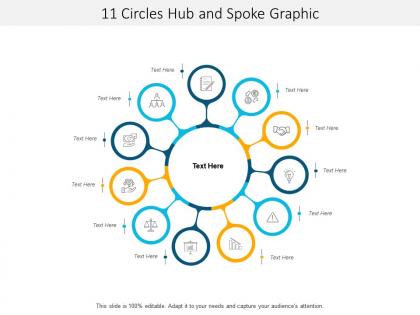
11 circles hub and spoke graphic




Try Before you Buy Download Free Sample Product
 Impress Your
 Audience
 100%
100% Editable
 Save Hours
 of Time


Identify your biggest assets with our 11 Circles Hub And Spoke Graphic. Elaborate on areas of core competency.
People who downloaded this PowerPoint presentation also viewed the following :
11 circles hub and spoke graphic with all 5 slides:
Awaken to a great future with our 11 Circles Hub And Spoke Graphic. Get a glimpse of the glory awaiting you.




FAQs for 11 circles hub
Key benefits include centralized inventory control, reduced transportation costs, simplified network management, enhanced operational efficiency, and improved customer service consistency. This strategic approach streamlines distribution by consolidating shipments through central hubs, with many retail and manufacturing companies finding that it significantly reduces overall logistics complexity while delivering faster delivery times and better resource allocation across multiple markets.
The hub and spoke model enhances communication efficiency by centralizing information flow through a single hub, reducing redundant messages, streamlining decision-making processes, and minimizing communication bottlenecks between departments. This centralized approach enables faster directive distribution, clearer accountability chains, and more coordinated responses across divisions, with many organizations finding that operational efficiency improves significantly while reducing miscommunication costs.
The hub and spoke model is widely applied in airlines, logistics, telecommunications, and financial services because it optimizes resource allocation and operational efficiency. Airlines use major airports as hubs to streamline connections, while logistics companies leverage central distribution centers, and banks utilize regional headquarters, ultimately delivering cost reduction, improved service coverage, and enhanced coordination across networks.
Implementing a hub and spoke model globally presents coordination complexity, cultural differences across regions, time zone management challenges, and potential bottlenecks at central hubs. While this structure streamlines decision-making and resource allocation, organizations often find that balancing standardized processes with local market needs requires significant investment in communication systems and regional expertise, ultimately demanding strategic cultural integration efforts.
Technology optimizes hub and spoke efficiency through automated routing systems, real-time tracking platforms, predictive analytics for demand forecasting, and AI-powered logistics coordination. These digital solutions streamline operations by reducing transit times, minimizing inventory costs, and enhancing visibility across networks, with many logistics companies finding that integrated technology platforms deliver significantly improved customer service and operational scalability.
Data analytics enables comprehensive performance assessment by tracking key metrics like throughput rates, cost per transaction, delivery times, resource utilization, and customer satisfaction across all network points. Through advanced analytics platforms, organizations can identify bottlenecks, optimize routing efficiency, predict demand patterns, and benchmark hub performance against spoke requirements, ultimately delivering improved operational efficiency and strategic insights for network optimization.
Yes, the hub and spoke model adapts effectively to digital marketing by centralizing core brand messaging at the hub while extending specialized content across multiple channels like social media, email campaigns, blogs, and paid advertising. This approach enables consistent brand identity, streamlined content creation, and coordinated campaigns across platforms, with many organizations finding that centralized strategy with distributed execution delivers better customer engagement and measurable ROI.
The hub and spoke model enhances customer experience by centralizing expertise, standardizing service quality, and enabling consistent support across all locations. Through centralized training and resource allocation, businesses like banks and healthcare networks deliver faster response times, seamless service integration, and personalized interactions, while maintaining operational efficiency that ultimately reduces costs and improves customer satisfaction.
The hub and spoke model presents both environmental challenges and opportunities, including increased fuel consumption from indirect routing, higher emissions from centralized processing, but also enhanced load consolidation, reduced empty vehicle miles, and optimized fleet utilization. Many logistics companies find that strategic hub placement ultimately delivers lower per-package carbon footprints through improved operational efficiency and resource allocation.
Companies measure hub and spoke success through operational efficiency metrics, cost reduction analysis, service delivery speed, and customer satisfaction scores across all locations. Financial services firms and retail chains track centralized processing times, resource utilization rates, and regional performance consistency, while manufacturing companies monitor inventory turnover and distribution effectiveness, ultimately delivering measurable competitive advantage and scalable growth.
**INPUT**: What are some case studies that illustrate successful implementation of the hub and spoke model? **OUTPUT**: Successful hub and spoke implementations include FedEx's Memphis hub for global logistics, Delta Airlines' Atlanta operations, Amazon's fulfillment centers, and major banks' centralized processing systems. These organizations streamline operations by consolidating resources, reducing redundancies, and optimizing distribution networks, ultimately delivering faster services, lower operational costs, and enhanced customer experiences across multiple markets. *[Word count: 58 words]*
Smaller companies can leverage hub and spoke models by centralizing core functions like customer service, procurement, and technology while distributing specialized operations across regional markets or product lines. This approach enables them to achieve economies of scale typically reserved for larger competitors, streamline resource allocation, and respond quickly to local market demands, ultimately delivering enhanced operational efficiency and competitive positioning against established industry leaders.
The hub and spoke model centralizes operations through strategic distribution points, while traditional linear supply chains follow sequential, point-to-point pathways from suppliers to end customers. Hub and spoke systems enhance scalability, reduce transportation costs, and improve inventory management through consolidation, with many logistics companies finding that centralized hubs deliver faster delivery times and greater operational flexibility than linear approaches.
Businesses mitigate hub and spoke risks through diversification strategies, redundant infrastructure development, robust disaster recovery planning, and strategic backup hub establishment. Many organizations increasingly invest in secondary distribution centers, cross-training programs, and flexible supply chain partnerships, ultimately delivering operational resilience while maintaining centralized efficiency advantages in an unpredictable business environment.
Emerging trends like automation, sustainability mandates, digitalization, and regionalization are reshaping hub and spoke effectiveness across sectors. While automation enhances operational efficiency and reduces costs, sustainability requirements drive organizations toward localized networks, with many logistics companies, healthcare systems, and financial institutions finding that hybrid models combining centralized coordination with distributed delivery ultimately deliver greater resilience and customer responsiveness.
No Reviews