

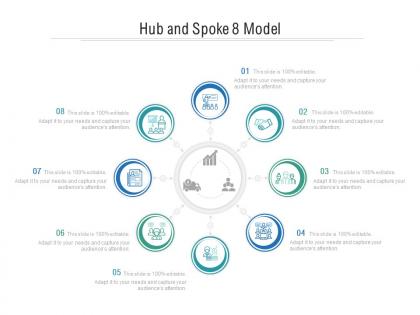
Hub and spoke 8 model




Try Before you Buy Download Free Sample Product
 Impress Your
 Audience
 100%
100% Editable
 Save Hours
 of Time


Get customers comfortable with your brand. Deepen the bonds with our Hub And Spoke 8 Model.
People who downloaded this PowerPoint presentation also viewed the following :
Hub and spoke 8 model with all 5 slides:
Boost awareness of your brand with our Hub And Spoke 8 Model. Everyone will get comfortable with it.




FAQs for Hub and
The core principle behind the Hub and Spoke model involves centralizing critical functions, resources, and decision-making authority in a central hub while connecting to decentralized operational units or spokes. This strategic structure enables organizations to maintain operational consistency, streamline resource allocation, and enhance communication flow, while allowing spokes sufficient autonomy to respond to local market conditions, ultimately delivering both efficiency and flexibility.
The Hub and Spoke model improves efficiency by centralizing operations through strategic hubs, streamlining route planning, and optimizing resource allocation across networks. Through consolidation at central points, logistics companies minimize transportation costs, reduce delivery times, and enhance coordination capabilities, while enabling better inventory management and scalability, ultimately delivering significant operational advantages in increasingly complex supply chains.
Airlines like Delta and American Airlines exemplify the Hub and Spoke model, routing flights through major hubs like Atlanta and Dallas, while logistics companies such as FedEx and UPS centralize operations through Memphis and Louisville respectively. This strategic approach enables these organizations to streamline operations, optimize resource allocation, and deliver enhanced connectivity across extensive networks, ultimately providing competitive advantages in increasingly complex markets.
The Hub and Spoke model delivers centralized control, streamlined operations, cost efficiency through shared resources, simplified communication pathways, and enhanced scalability compared to traditional networks. This strategic approach enables organizations to optimize resource allocation, reduce operational complexity, and maintain consistent service standards across multiple locations, with many companies finding that centralized coordination ultimately enhances competitive advantage while minimizing infrastructure costs.
The Hub and Spoke model facilitates better communication by centralizing information flow through a central hub, eliminating communication silos, reducing message distortion, and ensuring consistent messaging across departments. Through this strategic structure, organizations streamline decision-making processes, accelerate response times, and enhance coordination between teams, with many companies finding that centralized communication ultimately delivers improved operational efficiency and stronger organizational alignment.
Companies face challenges including complex logistics coordination, significant upfront infrastructure investments, staff retraining requirements, and potential service disruptions during implementation. While manufacturing, retail, and financial services organizations often experience initial operational inefficiencies and integration difficulties, many find that strategic planning and phased rollouts ultimately deliver streamlined operations and enhanced competitive advantage.
Technology enhances the Hub and Spoke model through real-time data analytics, automated routing systems, centralized inventory management, and integrated communication platforms. These digital solutions streamline operations by optimizing distribution routes, reducing inventory costs, and accelerating decision-making processes, with logistics companies and retail chains finding significantly improved efficiency and customer responsiveness.
The Hub and Spoke model enhances customer service by centralizing expertise, standardizing processes, and enabling specialized support teams to serve multiple locations efficiently. Through this centralized approach, organizations streamline response times, maintain consistent service quality across all touchpoints, and leverage shared resources, with many companies finding that customers experience faster resolution and more knowledgeable support interactions.
Success metrics for Hub and Spoke implementations include operational efficiency ratios, cost reduction percentages, service delivery times, resource utilization rates, and customer satisfaction scores. Organizations across industries like logistics, healthcare, and financial services typically measure consolidation savings, improved coordination between locations, reduced redundancies, and enhanced service consistency, ultimately delivering streamlined operations and competitive advantage.
The Hub and Spoke model centralizes critical resources at headquarters while distributing operational functions to satellite locations, enabling strategic resource allocation, standardized processes, and efficient cost management. Through this structure, organizations streamline decision-making, reduce duplication across locations, and optimize talent deployment, with many retail chains and financial services finding that centralized expertise delivers better customer experiences and competitive advantage.
The central hub serves as the primary decision-making authority, establishing strategic direction, policies, and operational standards that all spokes must follow. This centralized approach streamlines governance, ensures consistency across departments or locations, and enables faster strategic pivots, with many organizations finding that hub-directed decisions deliver improved coordination and competitive advantage.
Small businesses can leverage the Hub and Spoke model by establishing a central headquarters that coordinates multiple satellite locations, franchises, or service points, enabling scalable expansion while maintaining operational control. This approach allows companies to penetrate new markets systematically, reduce overhead costs through centralized functions like HR and procurement, and deliver consistent customer experiences across locations, ultimately creating competitive advantage through strategic geographic diversification.
Potential drawbacks include single point of failure risks, bottlenecks at the central hub, limited direct connectivity between spokes, and reduced operational flexibility during peak demands or system failures. While this model streamlines management and reduces costs, organizations in sectors like telecommunications and logistics increasingly adopt hybrid approaches, combining hub-and-spoke efficiency with direct connections to maintain resilience and competitive advantage.
Cultural factors significantly influence Hub and Spoke effectiveness through communication styles, hierarchical acceptance, and decision-making preferences across different regions and organizations. While centralized models work well in cultures valuing clear authority structures, decentralized cultures may resist hub dominance, requiring adaptive approaches that balance central coordination with local autonomy, ultimately delivering better stakeholder buy-in and operational success.
Organizations should establish clear governance frameworks, standardize processes across all spokes, invest in robust communication systems, and implement consistent performance metrics. These practices enable centralized strategic oversight while maintaining operational flexibility, with many financial services and retail companies finding that regular cross-spoke collaboration and technology integration ultimately deliver enhanced efficiency and competitive advantage.
No Reviews