


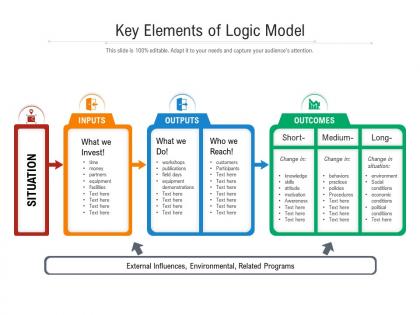
Key elements of logic model




Try Before you Buy Download Free Sample Product
 Impress Your
 Audience
 100%
100% Editable
 Save Hours
 of Time


Encourage accord with our Key Elements Of Logic Model. Get folks to engage in dialogue.
People who downloaded this PowerPoint presentation also viewed the following :
Key elements of logic model with all 2 slides:
Get folks to engage in dialogue with our Key Elements Of Logic Model. It will encourage accord.
FAQs for Key elements
So it goes inputs → activities → outputs → outcomes → impact, left to right. Inputs are your resources - funding, staff, materials. Activities are what you do with that stuff (workshops, services, whatever). Outputs are direct products like how many people you served. Outcomes are the actual changes in participants, and impact is the bigger picture societal stuff. Everyone mixes up outputs and outcomes initially - totally normal. Like, did you serve 100 people or did those 100 people actually improve? Different things. I'd honestly start by figuring out your end goal first, then work backwards through the whole chain.
Look, inputs are what actually fuel everything you're trying to do. Got limited cash or old equipment? Your activities will show it. More resources usually means you can do bigger things or help more people - pretty straightforward stuff. It's like trying to cook dinner when you only have random leftovers in the fridge, you know? The mix of what you've got also affects how good your programs can be. I always tell people to check their resources against what they're planning first. Otherwise you'll be scrambling later when reality hits.
Honestly, I'd start with the basic numbers - how many people showed up, products you delivered, sessions you ran. That stuff's pretty straightforward to track. But here's the thing - numbers only tell you part of the story. You'll want to grab some feedback too, like quick surveys or maybe just chatting with people about how things went. I usually do a mix of tracking stuff as it happens (attendance is super easy) plus bigger check-ins every few months. Oh, and don't just count what's convenient to count - pick metrics that actually matter for what you're trying to do. Start basic though, you can always get fancier later.
Honestly, outcomes are what prove your program actually works. They're the real changes happening to people - not just the stuff you produce (that's outputs). Picture it like this: short-term shifts in how people think, then behavior changes, then bigger life improvements down the road. Here's what I learned the hard way - start with your dream outcomes first, then work backwards. Way easier to design activities that'll actually get you there. Otherwise you end up with a bunch of busy work that doesn't move the needle. Your logic model should show that transformation journey, not just list what you're doing.
Definitely get stakeholders involved from day one - like, bring them into workshops where they're actually building the plan with you. People care way more when they help create something instead of just getting handed a draft to review. Have them tell you what'll really work and what outcomes are realistic from where they sit. Sticky notes, breakout sessions, whatever keeps everyone talking. Oh and seriously listen to your frontline people - they always know what's actually gonna happen versus what sounds nice in theory. Make sure everyone gets heard, not just the loudest voices in the room.
Know your audience first - that's everything. Funders want to see outcomes and ROI, so hit those hard. Community folks care more about the actual activities and what's in it for them. Your staff needs the full picture though, from inputs all the way through long-term goals so they get where they fit. Visually, keep it simple. Flowcharts work. Even sketching on a whiteboard beats walls of text every time. I've watched too many presentations where people just check out because the logic model looks like some engineering blueprint. Use normal language and always tie it back to what that specific group actually cares about.
Short-term stuff happens fast - like within months you'll see knowledge gains or attitude shifts. Behavior changes and policy shifts? Those are your intermediate outcomes, usually 1-2 years out. Long-term is the heavy hitter impact that takes forever to materialize. Here's what's tricky though - you can't really take full credit for those big long-term wins since a million other things influence them. But honestly, you still need them in your logic model or else what's the point? Figure out what you can actually measure during your program timeline first, then connect the dots backward from your dream impact.
Honestly, the two big mistakes I see are overcomplicating things and mixing up activities with actual outcomes. Keep it simple! Don't try mapping every little detail or you'll create something nobody can understand. Being too vague kills it too - like saying "improve community wellbeing" tells you nothing useful. Your arrows need to make sense logically, where each piece connects to the next. I always think working backwards from your end goals is way easier than starting from scratch. Oh, and definitely get your team involved instead of doing it alone - way better results that way.
A logic model is basically your program's GPS - maps out inputs, activities, outputs, and outcomes so you don't wander off track. Use it to check you're actually doing what you planned and putting resources where they'll make a difference. Monthly reviews work best during implementation. Ask yourself: hitting our activity targets? Seeing expected outputs? The thing I love about them is they catch bottlenecks early, before you're scrambling to fix everything. If outputs aren't matching what you mapped out, that's your cue to tweak activities. Honestly saved my butt more times than I can count.
Logic models are clutch for new program planning and grant writing - funders eat that stuff up when they see clear connections from activities to results. During strategic planning, they'll force your team to actually think through how things connect (which honestly most orgs just wing it). But for daily ops? Pretty useless tbh. I always tell people to start with your end goals and work backwards - makes way more sense than trying to build forward. Oh, and they're great ammunition when you need to prove impact to skeptical board members or donors.
Honestly, logic models are like your secret weapon for grant writing. Start there first, then build your whole proposal around it. They literally map out how you'll spend their money and what results they'll get back - funders eat that stuff up. You can pull your activities and outcomes straight from the model for your narrative and budget sections. The cause-and-effect chain shows you're not just throwing ideas at the wall. Plus it helps you figure out what data to collect for those annoying evaluation sections they always want. Way easier than trying to backwards-engineer everything later.
Honestly, start with what you've got time and money for. Literature reviews are super helpful - see if other research backs up your assumptions about how activities actually lead to results. Talk to people who know the program well through interviews or focus groups. They'll spot stuff you missed. If you can swing it, pilot testing is probably the gold standard since you're actually testing things out small-scale first. Historical data analysis works great too if you have that lying around. Expert consultation helps with the really technical assumptions. Even just casual conversations with stakeholders can save you from major assumptions that are totally off-base. Don't overthink it.
Honestly, logic models are game-changers for getting your team aligned. Everyone can actually see what you're working toward and how success gets measured. The upfront conversations about assumptions and outcomes? Total pain at first, but they save you from so much confusion down the road. Stakeholders buy in way easier when they see those clear connections between what you're doing and what you expect to happen. Plus it helps figure out who's collecting which data - though that part can get messy if people aren't clear on roles. I'd definitely use it as your guide throughout everything. Keeps things focused.
Honestly, I'd go with Lucidchart first - it's made for this stuff and won't drive you crazy learning it. Visio's solid too if you have access. Google Drawings is surprisingly good for being free, though the interface feels a bit clunky sometimes. PowerPoint actually works fine if you're already comfortable with it and don't want to mess with new software. Canva's pretty but feels like using a sledgehammer to hang a picture frame, you know? Just pick whichever one you can get your hands on easily.
Logic models are actually pretty adaptable - you keep the same basic flow of inputs → activities → outputs → outcomes → impact, but swap out the details for your specific program. Start by listing what your program actually does, then work backwards to figure out what success looks like. Health programs might track "fewer hospital readmissions" while education ones focus on test scores. The framework stays the same (which honestly saves me tons of headache when I'm juggling multiple projects), but the content changes completely. It's kind of like having a template that actually works, you know?
No Reviews