


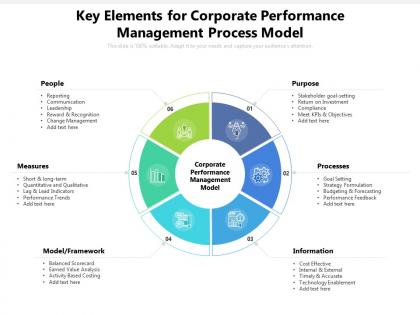
Key elements for corporate performance management process model




Try Before you Buy Download Free Sample Product
 Impress Your
 Audience
 100%
100% Editable
 Save Hours
 of Time


Our Key Elements For Corporate Performance Management Process Model are explicit and effective. They combine clarity and concise expression.
People who downloaded this PowerPoint presentation also viewed the following :
Key elements for corporate performance management process model with all 2 slides:
Give your audience a fulfilling experience. They will find our Key Elements For Corporate Performance Management Process Model elevating.
FAQs for Key elements for corporate performance
Key components include strategic goal alignment, performance metrics and KPIs, regular monitoring systems, feedback mechanisms, and continuous improvement processes. These elements work together by connecting organizational objectives to individual performance, enabling real-time tracking and adjustment, with many organizations finding that this integrated approach ultimately delivers enhanced accountability, operational efficiency, and competitive advantage across all business units.
Organizations can align their KPIs with business strategy by establishing clear strategic objectives, mapping measurable outcomes to each goal, and cascading metrics throughout departments. This strategic alignment enables companies to track progress effectively, identify performance gaps quickly, and make data-driven decisions, with many enterprises finding that integrated KPI frameworks ultimately deliver enhanced operational efficiency and competitive advantage.
Technology revolutionizes corporate performance management by automating data collection, enabling real-time analytics, streamlining reporting processes, and facilitating continuous monitoring across organizational levels. Through advanced dashboards and AI-driven insights, companies achieve faster decision-making, improved resource allocation, and enhanced strategic alignment, with many organizations finding significantly reduced manual workload and increased operational efficiency.
Data analytics enhances corporate performance management decision-making by providing real-time insights, predictive forecasting, identifying performance trends, and enabling evidence-based strategic planning. Through advanced analytics platforms, organizations streamline resource allocation, optimize operational efficiency, and accelerate response times to market changes, with many companies finding that data-driven approaches ultimately deliver competitive advantage and measurable performance improvements.
Common challenges in implementing performance management systems include resistance to change, lack of manager training, unclear performance criteria, inadequate technology integration, and insufficient employee buy-in. While these obstacles can initially slow adoption, organizations that address them through comprehensive training, clear communication, and phased rollouts ultimately deliver enhanced accountability, improved employee development, and stronger alignment between individual contributions and strategic business objectives.
Organizations ensure stakeholder buy-in by involving key stakeholders in planning processes, communicating clear objectives and benefits, and demonstrating early wins through pilot programs. Through transparent communication strategies and regular feedback sessions, companies build trust and alignment across departments, while showcasing measurable improvements in productivity and operational efficiency, ultimately delivering sustained organizational transformation.
Best practices for setting and revising performance metrics include establishing SMART criteria, aligning metrics with strategic objectives, ensuring stakeholder input, implementing regular review cycles, and maintaining data quality standards. These practices streamline decision-making by providing clear benchmarks, enhancing accountability, and enabling agile responses to market changes, with many organizations finding that quarterly metric reviews deliver improved performance visibility and competitive advantage.
Corporate performance management fosters continuous improvement by establishing regular feedback cycles, setting incremental goals, promoting data-driven decision making, and encouraging cross-functional collaboration. Through transparent performance metrics and consistent coaching, organizations create learning environments where employees proactively identify inefficiencies, with many companies finding that this approach significantly enhances innovation and operational excellence.
Employee engagement significantly impacts corporate performance management outcomes by driving productivity improvements, reducing turnover costs, and enhancing goal achievement across organizations. Engaged employees consistently deliver higher quality work, contribute more innovative solutions, and align better with strategic objectives, with many companies finding that strong engagement correlates directly with improved financial performance and competitive advantage.
Organizations measure ROI of performance management systems by tracking productivity improvements, employee retention rates, goal achievement percentages, and reduced administrative costs from automation. Through analytics dashboards and comparative studies, companies quantify benefits like faster review cycles, improved talent retention, and enhanced decision-making capabilities, ultimately delivering measurable competitive advantage and operational efficiency gains.
Corporate performance management trends include real-time performance analytics, AI-driven predictive insights, continuous feedback systems, personalized development pathways, and integrated ESG metrics. These technologies streamline decision-making by automating data collection, enhancing employee engagement, and delivering comprehensive business intelligence, with many organizations finding that strategic performance management ultimately drives competitive advantage and operational efficiency.
Regulatory requirements significantly influence corporate performance management by mandating specific metrics, reporting standards, compliance monitoring, and risk assessment frameworks. These regulations drive organizations to integrate governance controls, transparency measures, and accountability structures into their performance systems, with financial services, healthcare, and manufacturing sectors finding that regulatory alignment ultimately enhances operational efficiency and stakeholder trust.
Performance management contributes to risk management by establishing clear accountability frameworks, monitoring key performance indicators that signal potential issues, and ensuring compliance with regulatory standards through regular assessments. Through systematic performance tracking, organizations can identify operational vulnerabilities, financial irregularities, and compliance gaps early, while strategic goal alignment helps minimize reputational and strategic risks, ultimately delivering enhanced organizational resilience.
Performance management integrates sustainability and CSR metrics by incorporating environmental impact indicators, social responsibility scorecards, and governance benchmarks alongside traditional financial measures. This strategic combination enables organizations to track carbon footprints, community engagement outcomes, and ethical practices, with many companies finding that balanced scorecards ultimately deliver enhanced stakeholder trust and competitive advantage.
Benchmarking enables organizations to measure their performance against industry leaders, competitors, and best practices, identifying gaps and improvement opportunities across operations, financials, and strategic metrics. Through comparative analysis, companies streamline processes, enhance efficiency, and accelerate growth initiatives, with many organizations finding that systematic benchmarking ultimately delivers competitive advantage and measurable performance improvements.
No Reviews