


Performance Management Cycle Model Powerpoint Slides





Try Before you Buy Download Free Sample Product
 Impress Your
 Audience
 100%
100% Editable
 Save Hours
 of Time


Intensify the effort with our Performance Management Cycle Model Powerpoint Slides. Increase the degree of determination in folks.
People who downloaded this PowerPoint presentation also viewed the following :
Content of this Powerpoint Presentation
Description:
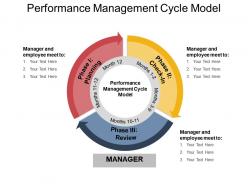
The image shows a PowerPoint slide titled "Performance Management Cycle Model," which illustrates a cyclical process that encompasses three key phases of employee performance management over a 12-month period. The cycle is visually represented by three curved arrows that form a circle around the word "MANAGER," indicating the central role of management in the cycle.
The three phases are:
Phase I:
Planning (Months 1-12) - This phase likely focuses on setting goals, expectations, and plans for the upcoming year.
Phase II:
Check-in (Months 3-9) - A period for ongoing communication between the manager and employee about progress and performance.
Phase III:
Review (Months 10-11) - Time allocated for formally reviewing the employee’s performance over the year.
Use Cases:
This type of slide can be utilized across various industries for multiple purposes:
1. Healthcare:
Use: Managing clinical staff performance.
Presenter: Department Manager.
Audience: Healthcare professionals.
2. Education:
Use: Evaluating teacher performance and development.
Presenter: School Administrator.
Audience: Educators, school board.
3. Information Technology:
Use: Tracking IT project progress and team contributions.
Presenter: IT Manager.
Audience: IT professionals, project teams.
4. Finance:
Use: Assessing financial advisors' client management and portfolio performance.
Presenter: Chief Financial Officer.
Audience: Financial advisors, analysts.
5. Retail:
Use: Reviewing sales targets and customer service metrics.
Presenter: Store Manager.
Audience: Sales associates, customer service staff.
6. Manufacturing:
Use: Monitoring production targets and efficiency.
Presenter: Plant Manager.
Audience: Production teams, supervisors.
7. Hospitality:
Use: Improving guest service and operational standards.
Presenter: Hotel Manager.
Audience: Hotel staff, service managers.
Performance Management Cycle Model Powerpoint Slides with all 5 slides:
Concentrate on critical aspects with our Performance Management Cycle Model Powerpoint Slides. It helps focus on important features.
FAQs for Performance Management Cycle
So performance management basically has four stages that connect to each other. First, you set goals and expectations with your employee. Then comes the monitoring part - regular check-ins throughout the year (seriously, this is where most managers mess up). After that, you do the formal review where you compare actual performance to those original goals. Finally, you handle rewards or figure out development plans. Oh, and document everything as you go - trust me on this one. The whole thing's cyclical too, so your review becomes the starting point for next year's planning.
Look, stick to the SMART framework - specific, measurable, achievable, relevant, time-bound. That part's basic. But here's what actually works: start with your company's big priorities, then break those down to team level. Sit with each person and hash out 3-5 objectives together. Don't just dictate a list - that's where most managers screw up. People need to buy into their goals, you know? Also, resist the urge to pile on a million objectives. I've seen teams try to track like 12 different things and nothing gets done well. Document what "success" looks like upfront so there's no confusion later.
Dude, ongoing feedback is a game changer. Your people can actually fix things as they go instead of getting blindsided at annual reviews. Think of it like GPS for their growth - way better than letting them drive around lost for months. Quick weekly chats work great, or just pull them aside when you notice something. The trick is being specific, not just saying "nice work." Honestly, most managers are terrible at this but it keeps people motivated and actually helps them improve. Real-time course correction beats those awkward yearly sit-downs every time.
Ask them to go first - what do they think went well, what sucked? Then you jump in with your take, but focus on actual stuff they did, not like "you're not a team player" or whatever. I always do compliment-feedback-growth opportunity thing. Works better than just dumping criticism on people. The whole vibe should be collaborative, you know? Both working toward the same thing. Oh and ask what they need from you instead of just listing what's broken. Write it all down after so nobody can say "that's not what we talked about" later. Makes everything way smoother.
Honestly, goal completion rates are where I'd start - they don't lie. Mix that with role-specific KPIs and you've got your numbers covered. But here's the thing, soft skills matter just as much. Get 360 feedback from their teammates and anyone they manage. Rate them on collaboration, problem-solving, that kind of stuff. Oh, and track whatever skills they're supposedly developing (though half the time people forget what they even committed to, lol). Pick maybe 4-5 metrics max that actually relate to their job. Hard data plus behavioral stuff = solid review.
Honestly, performance management software is a game changer for all that boring admin stuff. Goal tracking, feedback collection, review scheduling - it's all automated instead of you manually chasing people around. Your team can update their progress whenever instead of that awkward "wait, what did I even do in March?" moment we all have during reviews. The analytics are pretty solid too, gives you real data instead of just guessing how everyone's doing. Oh, and the automated reminders are clutch - no more missed deadlines or forgotten check-ins. Start simple though, don't go crazy with features right away.
Honestly, most companies mess this up by skipping the connection part. You've got to show people how their daily work actually ties to the big company goals - like, make it super obvious. SMART goals during reviews help, but here's what really matters: those regular check-ins throughout the year. Don't be like most teams who set goals in January then ghost until December. Dashboards are clutty but they work - people need to see their impact visually. Start simple though. Pick your top 3 priorities this quarter and literally map out how each person's role feeds into those. Makes a huge difference.
Look, engagement is honestly everything when it comes to performance reviews. Engaged employees will actually participate in setting goals and won't just nod along during feedback sessions. They genuinely want to improve instead of just going through the motions - which, let's be real, is painfully obvious during review time. The disengaged ones? They're checking boxes and totally ignoring any development plans you give them. But here's the thing - you can't just focus on engagement during review season and expect miracles. Keep it consistent throughout the year and your whole performance process will actually work like it's supposed to.
Honestly, role-playing works wonders - have them practice giving feedback in realistic scenarios first. Teach the SBI model (Situation-Behavior-Impact) so they're not being all vague and wishy-washy about things. Most managers just wing it because nobody actually trained them properly, which is crazy when you think about it. Regular coaching helps too. Make sure they learn active listening and how to make people feel safe during tough conversations. Oh, and give them simple frameworks they'll actually remember when they're stressed. Practice is everything - you don't want their first real feedback attempt to be a disaster.
Oh man, the worst thing managers do? They save everything for one big annual review - total nightmare for everyone involved. Inconsistent feedback is huge too, plus vague goals that nobody really understands. Bias creeps in way more than people realize. My advice: document stuff as it happens, don't trust your memory from six months ago. Set clear goals upfront and actually check on them quarterly. Train managers on bias (seriously, they need it). Monthly one-on-ones are a game changer instead of scrambling last minute. I learned this the hard way at my old job - wish someone had told me sooner!
Ditch the formal review thing - feedback needs to happen way more often. Get your managers asking "how can we do better?" instead of just obsessing over numbers. Honestly, if leadership isn't doing this themselves, you're screwed from the start. Try monthly check-ins or those quick project wrap-ups where people actually talk about what went wrong. Oh, and celebrate the screw-ups! That's where people learn stuff. The whole point is making it feel like a normal conversation, not some corporate interrogation. Start small though - maybe pulse surveys to get everyone used to the idea.
Okay so think of it as getting ahead of the game - you're telling your story before your boss writes it for you. Highlight your wins, own up to where things got messy, but don't throw yourself under the bus either. Most people just phone it in which is honestly such a waste. Your manager's probably gonna base half their review on what you write anyway. Be real about your struggles but also... like, don't forget to brag a little? You did good stuff this year. Oh and actually take time with your examples - I always rush mine and regret it later.
Honestly, you can't just use the same approach for everyone on your team. Ask each person how they like getting feedback first - some want everything written out, others need to talk it through face-to-face. It's crazy how different people are! Goal setting gets tricky when you've got different communication styles and career goals in the mix. I'd adapt how you deliver feedback during check-ins, but don't budge on your actual performance standards. Oh, and cultural backgrounds totally affect how people interpret objectives too.
Dude, recognition is everything for keeping your team motivated. People work so much harder when they actually feel appreciated - it's wild how simple that is but managers still miss it. Make sure you're specific though, not just throwing out random "great work!" comments. Honestly, I've seen teams completely turn around just from consistent acknowledgment. Even quick shoutouts during meetings make a difference. The timing matters too - don't wait weeks to recognize something good. Your performance reviews will be way smoother if you're already doing this stuff regularly throughout the year.
Stop obsessing over hours - what matters is results, not screen time. I'd set super clear goals and check in way more often since you can't just pop by their desk. Video calls for performance stuff is non-negotiable (seriously, feedback over Slack is the worst). Shared dashboards help everyone stay in the loop. The biggest thing though? You've got to be way more deliberate about talking to people. Schedule those one-on-ones religiously. Don't assume someone's crushing it just because they're meeting deadlines - they might be drowning and you'd never know.
-
Easily Editable.
-
Topic best represented with attractive design.