

Performance Management Cycle Powerpoint Ppt Template Bundles




Try Before you Buy Download Free Sample Product
 Impress Your
 Audience
 100%
100% Editable
 Save Hours
 of Time


Our Performance Management Cycle Powerpoint Ppt Template Bundles are topically designed to provide an attractive backdrop to any subject. Use them to look like a presentation pro.
People who downloaded this PowerPoint presentation also viewed the following :
Performance Management Cycle Powerpoint Ppt Template Bundles with all 17 slides:
Use our Performance Management Cycle Powerpoint Ppt Template Bundles to effectively help you save your valuable time. They are readymade to fit into any presentation structure.
-
Performance Management Cycle
-
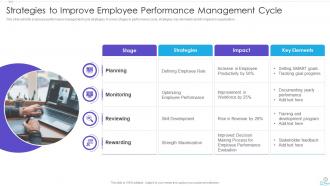
Strategies to Improve Employee Performance Management Cycle
-
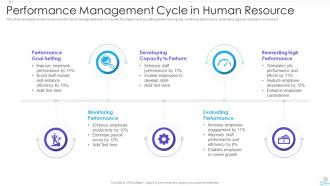
Performance Management Cycle in Human Resource
-
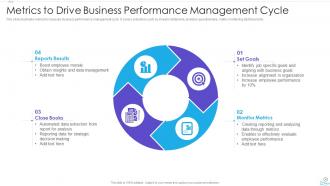
Metrics to Drive Business Performance Management Cycle
-
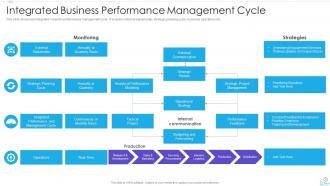
Integrated Business Performance Management Cycle
-
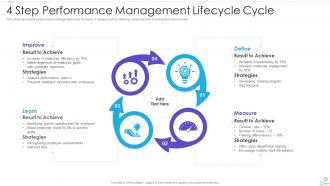
Performance Management Cycle
-
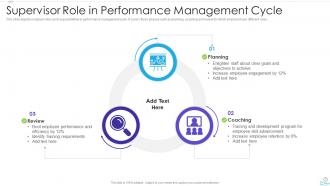
Supervisor Role in Performance Management Cycle
-
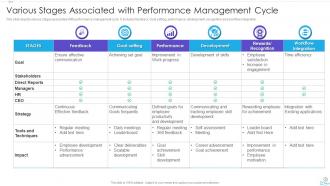
Various Stages Associated with Performance Management Cycle
-
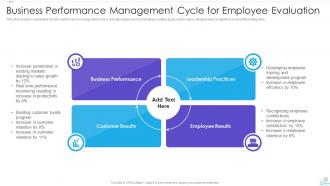
Business Performance Management Cycle for Employee Evaluation
-
Employee Performance Evaluation Management Cycle Icon
-
Performance Management Cycle Icon Showcasing Employee Growth
-

Thank You
-

-

-

-

-

FAQs for Performance Management Cycle Powerpoint
The key stages of the performance management cycle include goal setting, performance planning, ongoing monitoring and feedback, performance evaluation, and development planning. These stages work together by establishing clear expectations, tracking progress throughout the review period, and identifying growth opportunities, with many organizations finding that this structured approach enhances employee engagement and organizational productivity.
Setting clear objectives enhances performance management by establishing measurable expectations, aligning individual goals with organizational strategy, and creating accountability frameworks that drive focused execution. Through well-defined targets, managers can provide meaningful feedback, employees understand success metrics, and organizations achieve better resource allocation, ultimately delivering improved productivity and strategic alignment across all levels.
Continuous feedback accelerates employee performance improvement by providing real-time guidance, identifying skill gaps early, and reinforcing positive behaviors consistently. Through regular check-ins and coaching conversations, organizations enhance employee engagement, reduce performance surprises during formal reviews, and enable faster course corrections, ultimately delivering higher productivity and stronger talent retention across teams.
Organizations can effectively measure performance outcomes through key performance indicators (KPIs), regular performance reviews, 360-degree feedback, goal achievement tracking, and data analytics platforms. These measurement approaches streamline evaluation processes by providing quantitative metrics, qualitative insights, and comprehensive performance data, with many companies finding that systematic measurement enhances employee development and drives organizational success.
Effective performance appraisal techniques include setting clear objectives, conducting regular check-ins, using 360-degree feedback, documenting achievements throughout the year, and creating structured evaluation frameworks. These approaches enhance accuracy and fairness by combining multiple perspectives, reducing recency bias, and maintaining ongoing dialogue, with many organizations finding that consistent feedback cycles ultimately deliver improved employee engagement and stronger performance outcomes.
Remote performance management cycles emphasize digital documentation, virtual check-ins, and outcome-based metrics, while on-site cycles traditionally rely on direct observation, informal feedback, and presence-based assessments. Remote environments enable more structured tracking through digital tools and scheduled touchpoints, with many organizations finding that remote cycles actually enhance transparency and consistency, ultimately delivering more equitable performance evaluations across distributed teams.
Organizational culture significantly influences performance management effectiveness by shaping employee engagement, feedback receptivity, goal alignment, and accountability standards throughout evaluation processes. Companies with collaborative cultures often experience more meaningful performance conversations, higher goal achievement rates, and stronger development outcomes, while rigid cultures may limit honest feedback exchanges, ultimately affecting talent retention and organizational growth potential.
Technology facilitates performance management by automating goal tracking, enabling real-time feedback collection, and providing data-driven analytics for objective evaluations. Through AI-powered platforms and integrated HR systems, organizations streamline review processes, enhance manager-employee communication, and deliver actionable insights, with many companies finding that digital tools reduce administrative burden while improving performance outcomes.
Common challenges include inconsistent manager training, lack of clear performance metrics, infrequent feedback cycles, employee resistance to change, and inadequate technology systems. These implementation hurdles often result in reduced employee engagement and inconsistent evaluations across departments, with many organizations finding that investing in comprehensive training and robust digital platforms significantly improves adoption rates and overall effectiveness.
Employee engagement and motivation significantly influence performance by driving productivity, reducing turnover, and enhancing quality of work output across organizations. Engaged employees demonstrate higher commitment levels, proactive problem-solving abilities, and stronger collaboration skills, with many companies finding that motivated teams deliver superior customer experiences, accelerate project timelines, and ultimately contribute to sustainable competitive advantage in increasingly dynamic business environments.
Performance management aligns with business strategy by establishing clear strategic objectives, implementing cascading goals across organizational levels, and linking individual performance metrics to company priorities. Through strategic goal-setting frameworks, organizations streamline resource allocation, enhance operational efficiency, and accelerate decision-making processes, with many finding that this alignment ultimately delivers improved competitive advantage and measurable business outcomes.
**INPUT**: What tools or software are recommended for streamlining the performance management cycle? **OUTPUT**: Performance management software includes BambooHR, Workday, SuccessFactors, 15Five, and Lattice, along with goal-tracking platforms and feedback systems. These technologies streamline operations by automating evaluations, centralizing employee data, and enabling continuous feedback, with many organizations finding that integrated platforms ultimately deliver enhanced transparency, reduced administrative burden, and improved employee engagement across departments. *[Word count: 57 words]*
Managers can provide constructive feedback effectively by focusing on specific behaviors rather than personality traits, using the SBI model (Situation-Behavior-Impact), timing conversations appropriately, and creating psychological safety through two-way dialogue. This approach enhances employee development and performance outcomes, with many organizations finding that regular, structured feedback conversations improve retention rates, boost productivity levels, and strengthen manager-employee relationships significantly.
Training and development enhance employee capabilities, address skill gaps, and align competencies with organizational goals throughout the performance management cycle. These initiatives enable organizations to improve productivity, reduce turnover, and strengthen succession planning, with many companies finding that strategic development programs ultimately deliver higher engagement and competitive advantage.
Organizations ensure fairness and transparency in performance evaluations through standardized criteria, regular feedback sessions, multiple reviewer perspectives, documented goal-setting processes, and clear communication of evaluation methods. These approaches streamline assessment accuracy by eliminating bias, enhancing employee trust, and establishing consistent measurement frameworks, with many companies finding that transparent processes ultimately deliver improved engagement, reduced turnover, and stronger organizational culture.
-
Excellent design and quick turnaround.
-
Top Quality presentations that are easily editable.