


Steps Of Knowledge Management Process Cycle




Try Before you Buy Download Free Sample Product
 Impress Your
 Audience
 100%
100% Editable
 Save Hours
 of Time


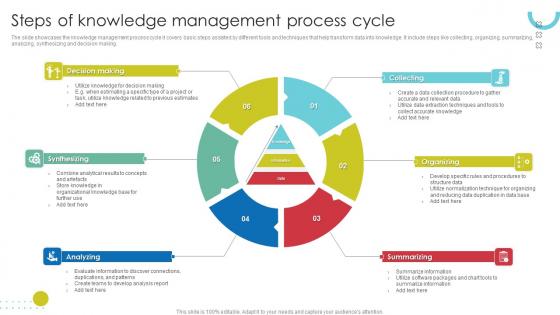
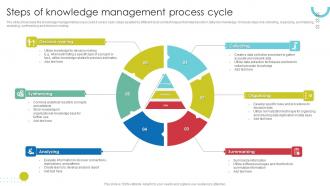
The slide showcases the knowledge management process cycle it covers basic steps assisted by different tools and techniques that help transform data into knowledge. It include steps like collecting, organizing, summarizing, analyzing, synthesizing and decision making.
People who downloaded this PowerPoint presentation also viewed the following :
Steps Of Knowledge Management Process Cycle with all 6 slides:
Use our Steps Of Knowledge Management Process Cycle to effectively help you save your valuable time. They are readymade to fit into any presentation structure.





FAQs for Steps Of Knowledge
The Knowledge Management Cycle includes knowledge creation, capture, organization, storage, sharing, and application stages, with each feeding into the next. These stages interrelate through continuous feedback loops, where applied knowledge generates new insights that restart the cycle, enabling organizations to build institutional memory, accelerate innovation, and maintain competitive advantage through systematic knowledge enhancement.
Organizations effectively capture tacit knowledge through structured interviews, mentoring programs, communities of practice, job shadowing, and storytelling sessions. These approaches enable experienced employees to transfer insights, problem-solving methods, and institutional wisdom to colleagues, while documentation systems and knowledge-sharing platforms preserve critical expertise, ultimately reducing knowledge loss and enhancing organizational resilience.
Technology streamlines the Knowledge Management Cycle by automating knowledge capture, enabling centralized storage, and facilitating seamless sharing across organizations through AI-powered search, collaborative platforms, and analytics tools. These systems enhance knowledge discovery, accelerate decision-making, and improve organizational learning, with many enterprises finding that integrated technology solutions ultimately deliver competitive advantage and operational efficiency.
Knowledge sharing within teams enhances productivity by reducing duplicated efforts, accelerating problem-solving processes, and enabling faster decision-making through collective expertise. This collaborative approach fosters innovation by combining diverse perspectives, facilitating cross-functional insights, and creating environments where creative solutions emerge, with many organizations finding that systematic knowledge exchange ultimately delivers improved project outcomes and competitive advantage.
Organizations measure Knowledge Management effectiveness through employee engagement surveys, knowledge usage analytics, innovation metrics, time-to-competency rates, and knowledge retention assessments. These measurement approaches enable companies to track knowledge sharing frequency, identify content gaps, and quantify productivity improvements, with many finding that systematic evaluation ultimately delivers enhanced decision-making capabilities and competitive advantage.
Common challenges during the Knowledge Management Cycle include resistance to knowledge sharing, inadequate technology infrastructure, lack of organizational culture supporting collaboration, difficulty capturing tacit knowledge, and insufficient leadership commitment. These obstacles can be overcome by implementing comprehensive training programs, investing in user-friendly knowledge platforms, creating incentive structures that reward sharing, and establishing clear governance frameworks, with many organizations finding that combining cultural change initiatives with robust technological solutions ultimately delivers enhanced innovation and competitive advantage.
Organizations create continuous learning cultures by establishing knowledge-sharing incentives, implementing collaborative platforms, encouraging cross-departmental mentoring, providing regular training opportunities, and recognizing employees who contribute to organizational knowledge bases. Through strategic communication and leadership modeling, companies like tech firms and consulting organizations streamline knowledge transfer processes while enhancing innovation capacity, ultimately delivering competitive advantage and improved employee engagement across all operational levels.
Effective knowledge management systems include cloud-based repositories, enterprise search platforms, collaborative wikis, document management systems, and AI-powered knowledge bases. These technologies streamline knowledge capture, organization, and retrieval through intelligent tagging, automated categorization, and semantic search capabilities, with many organizations finding that integrated platforms significantly enhance employee productivity and reduce time spent searching for critical information.
Leadership plays a crucial role in Knowledge Management success by establishing clear strategies, fostering collaborative cultures, and allocating necessary resources for knowledge-sharing initiatives. Strong leaders champion transparency, incentivize knowledge transfer across departments, and model collaborative behaviors, with many organizations finding that executive commitment directly correlates with improved innovation and competitive advantage.
Employee turnover significantly disrupts the Knowledge Management Cycle by creating knowledge gaps, reducing institutional memory, and interrupting knowledge transfer processes. When experienced employees leave, organizations lose critical insights, established workflows, and tacit knowledge that's difficult to document, with many companies finding that high turnover rates ultimately compromise operational efficiency and competitive advantage.
Communities of practice enhance the Knowledge Management Cycle by facilitating knowledge creation, sharing, and retention through collaborative networks of experts within specific domains. These groups streamline knowledge capture from experienced practitioners, accelerate organizational learning through peer-to-peer exchanges, and ultimately deliver improved innovation and reduced knowledge loss during employee transitions.
Organizations can ensure knowledge accuracy through validation protocols, subject matter expert reviews, regular content audits, version control systems, and peer verification processes. These methods work together by establishing quality checkpoints, maintaining current information standards, and enabling continuous updates, with many companies finding that structured validation workflows significantly enhance knowledge reliability and strategic decision-making capabilities.
Data analytics enhances the Knowledge Management Cycle by improving knowledge discovery through pattern recognition, optimizing knowledge organization via automated categorization, and enabling personalized knowledge delivery based on user behavior analysis. Through predictive analytics and usage tracking, organizations streamline knowledge sharing, reduce information silos, and accelerate decision-making processes, ultimately delivering more targeted insights and competitive advantage.
Lessons learned integrate into the Knowledge Management Cycle through systematic capture during project closure, validation and analysis for broader applicability, and storage in accessible repositories with searchable metadata. Organizations enhance this process by embedding lessons into training programs, decision-making frameworks, and project templates, ultimately creating institutional memory that prevents repeated mistakes while accelerating future project success.
Strategies include creating psychological safety through recognition programs, implementing mentorship structures, offering knowledge-sharing incentives, establishing collaborative platforms, and demonstrating leadership commitment to transparency. Organizations like consulting firms and healthcare institutions find that pairing formal reward systems with informal peer networks significantly reduces resistance, while regular knowledge-sharing sessions build trust and ultimately enhance organizational learning capacity.
-
I didn’t expect such a good service for the money I am paying. But, they exceed my expectations. Great work SlideTeam.
-
“I required a slide for a board meeting and was so satisfied with the final result !! So much went into designing the slide and the communication was amazing! Can’t wait to have my next slide!”