


Key Steps Involved In Vulnerability Management Process Flow





Try Before you Buy Download Free Sample Product
 Impress Your
 Audience
 100%
100% Editable
 Save Hours
 of Time


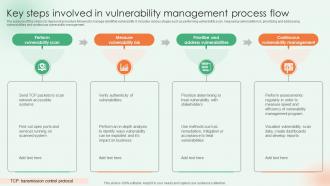
The purpose of this slide is to represent procedure followed to manage identified vulnerability. It includes various stages such as performing vulnerability scan, measuring vulnerability risk, prioritizing and addressing vulnerabilities and continuous vulnerability management.
People who downloaded this PowerPoint presentation also viewed the following :
Key Steps Involved In Vulnerability Management Process Flow with all 6 slides:
Use our Key Steps Involved In Vulnerability Management Process Flow to effectively help you save your valuable time. They are readymade to fit into any presentation structure.





FAQs for Key Steps Involved In Vulnerability
Key components of an effective vulnerability management program include asset discovery, vulnerability scanning, risk assessment, patch management, and continuous monitoring. These technologies streamline security operations by identifying weaknesses, prioritizing threats, and automating remediation processes, with many organizations finding that integrated vulnerability management ultimately delivers reduced security risks, faster incident response, and enhanced operational resilience.
Organizations can prioritize vulnerabilities by assessing CVSS scores, exploitability levels, asset criticality, threat intelligence, and business impact potential. Through risk-based vulnerability management platforms, security teams streamline assessment workflows, automate threat correlation, and focus resources on high-impact systems, while many enterprises find that combining automated scanning with contextual business analysis ultimately delivers faster remediation and reduced exposure windows.
Automation streamlines vulnerability management by accelerating threat detection, prioritizing critical risks, and orchestrating patch deployment across enterprise systems. Through automated scanning tools and response workflows, organizations minimize manual oversight, reduce remediation timeframes, and enhance security posture consistency, with many IT departments finding that automation delivers faster incident response and improved resource allocation efficiency.
Organizations should conduct vulnerability assessments continuously through automated scanning, with comprehensive manual assessments quarterly and critical system reviews monthly. This strategic combination enables businesses to identify emerging threats, prioritize remediation efforts, and maintain security posture, with many financial institutions and healthcare organizations finding that regular assessments significantly reduce breach risks while ensuring compliance requirements.
Key vulnerability management metrics include mean time to detection, mean time to remediation, vulnerability aging, patch compliance rates, and risk reduction percentages. These metrics enable organizations to streamline security operations by tracking exposure windows, measuring response efficiency, and demonstrating risk mitigation progress, with many enterprises finding that comprehensive measurement ultimately delivers improved security posture and regulatory compliance.
Businesses integrate vulnerability management by establishing continuous scanning protocols, prioritizing risks based on business impact, and aligning remediation timelines with operational requirements. This strategic combination enables organizations to allocate security resources effectively, reduce exposure windows, and maintain compliance standards, with many enterprises finding that integrated approaches deliver enhanced threat visibility and streamlined incident response capabilities.
Common vulnerability scanning challenges include false positives requiring manual verification, network disruptions during active scans, credential management complexities, overwhelming alert volumes, and integration difficulties with existing security tools. These obstacles can significantly impact scanning accuracy and operational efficiency, with many organizations finding that strategic scanner configuration, automated filtering processes, and phased deployment approaches ultimately streamline operations while maintaining comprehensive security coverage.
Threat intelligence enhances vulnerability management by providing real-world context about active exploits, prioritizing critical patches based on current attack campaigns, and identifying emerging threats before they impact systems. Financial institutions and healthcare organizations increasingly use threat feeds to focus remediation efforts on vulnerabilities actually being exploited, ultimately reducing response times and strengthening security postures.
Patch management is critical for vulnerability mitigation as it systematically addresses security gaps by deploying updates, closing attack vectors, and preventing exploitation of known weaknesses. Through automated patch deployment, organizations in banking, healthcare, and retail significantly reduce breach risks, maintain compliance standards, and ensure operational continuity, ultimately delivering enhanced security posture.
Regulatory requirements significantly shape vulnerability management through mandated security frameworks, compliance timelines, and documented remediation processes. Financial institutions must meet PCI DSS standards, healthcare organizations follow HIPAA guidelines, and government contractors adhere to NIST protocols, with non-compliance resulting in substantial penalties, ultimately driving organizations to adopt more systematic, audit-ready vulnerability management approaches.
Employee training strengthens vulnerability management by teaching staff to recognize phishing attempts, use strong passwords, apply security patches promptly, and follow incident reporting protocols. Through comprehensive security awareness programs, organizations significantly reduce human error vulnerabilities, enhance threat detection capabilities, and create a security-conscious culture, ultimately delivering faster incident response and stronger overall cybersecurity posture.
Effective vulnerability assessment tools include network scanners like Nessus and OpenVAS, web application scanners, penetration testing frameworks, automated code analysis platforms, and cloud security assessment tools. These technologies streamline identification by continuously monitoring systems, prioritizing critical weaknesses, and integrating with existing security infrastructure, with many organizations finding that combining multiple tools delivers comprehensive coverage and faster remediation across their entire attack surface.
Organizations should handle zero-day vulnerabilities through proactive threat monitoring, rapid incident response protocols, network segmentation, and strategic patch management prioritization. Financial institutions and healthcare providers increasingly deploy behavioral analytics and threat intelligence feeds to detect anomalous activities, while implementing compensating controls like access restrictions, ultimately minimizing exposure windows and maintaining operational resilience.
Businesses can balance patching urgency with operational continuity through risk-based prioritization, staged deployment schedules, comprehensive testing environments, and maintenance windows during low-traffic periods. Organizations in sectors like banking and healthcare increasingly implement automated patch management systems that assess vulnerability severity while minimizing downtime, ultimately delivering enhanced security without compromising critical business operations.
Vulnerability documentation best practices include detailed risk assessments, standardized classification systems, clear remediation timelines, stakeholder communication protocols, and comprehensive audit trails. These practices streamline security operations by enabling faster response times, improving compliance reporting, and facilitating strategic resource allocation, with many organizations finding that structured documentation ultimately delivers enhanced security posture and operational efficiency.
-
Presentation Design is very nice, good work with the content as well.
-
Fantastic collection. Loved how we can personalize these templates as per the requirements.