

6 circle venn diagram with different colour




Try Before you Buy Download Free Sample Product
 Impress Your
 Audience
 100%
100% Editable
 Save Hours
 of Time


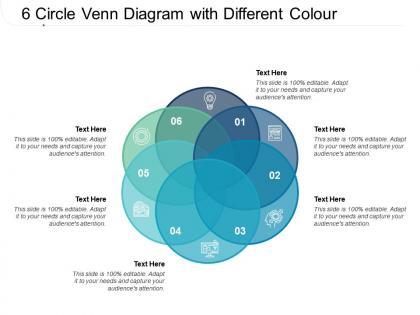
Incorporate this 6 Circle Venn Diagram With Different Colour PPT template to compare and contrast different variables. Bring out the relationship between places, things, subjects, and so on. This template provides the best visual aid to explain conflicting variables and their relationship with ease. Teachers can organize and present knowledgeable lessons with this Venn diagram template. This slide also caters to several other fields like explaining business processes, marketing sectors, skill sets of employees etc, as it helps in clarifying the points much better. Apart from this, the Venn diagram PowerPoint visual can be used to explain mathematical figures with ease, making them highly resourceful tools for students and learners alike. Furthermore, this PPT diagram is perfect for displaying an endless range of topics from general to specific. It also acts as an ideal tool to communicate your message across. Therefore, download this intuitively-designed template to visualize information with ease and precision.
People who downloaded this PowerPoint presentation also viewed the following :
6 circle venn diagram with different colour with all 5 slides:
Our 6 Circle Venn Diagram With Different Colour ensure you don't fly off the handle. They keep you always calm and controlled.
FAQs for 6 circle venn diagram
So basically you can map out how six different things overlap and interact - way more than those simple 2 or 3-circle ones everyone's used to. Perfect for stuff like market research or when you're trying to figure out how multiple systems connect. The downside? They get messy fast if you don't label everything clearly. I learned that the hard way in a presentation once, total disaster. But honestly, when you need to show complex relationships between that many variables, nothing else really cuts it. Just give people a heads up that it'll look complicated at first glance.
Look, 6-circle Venn diagrams are perfect for mapping complex stuff like customer segments or product features. Yeah, they look messy at first glance - total visual chaos honestly. But here's the thing: those crazy intersections where 3+ circles overlap? That's where you'll find patterns that basic charts completely miss. Definitely color-code different sections or your audience will get lost. I always sketch mine on paper first because it's way too easy to overcomplicate these things. Pro tip: focus on highlighting the specific overlaps that matter most to your point. The magic happens in those sweet spots where everything connects.
You'd use 6-circle Venn diagrams for really complex stuff - like genomics research where you're comparing gene expression across different tissues, conditions, and treatments all at once. They're perfect for interdisciplinary work too, mapping how six different theories or methods relate to each other. Fair warning though, they get messy fast. Sometimes that messiness is actually helpful when your data's genuinely complicated. You'll see them mostly in bioinformatics and systems biology - basically anywhere regular 2-3 circle diagrams fall short. I'd double-check your audience can read them first. Nobody wants to stare at a diagram that looks like abstract art.
Honestly, 6-circle Venn diagrams are a pain with regular drawing tools. I'd try the free online ones first - Venny or InteractiVenn work pretty well for multiple sets. Creately and Lucidchart are solid too but might cost you. If those don't cut it, you'll probably need to code it. R with the VennDiagram package gives you way more control over everything - colors, positioning, all that stuff. Python's matplotlib-venn works too. Fair warning though, some of the free generators get weird with that many circles overlapping.
Dude, you absolutely need color coding for 6-circle Venn diagrams. Trust me on this one - I made a grayscale version once and it was basically unreadable garbage. Pick distinct colors for each circle, but make sure they still look good when they overlap. The tricky part is those crazy intersections where like 4 circles meet - maybe try transparency or different patterns there? Oh, and definitely test it on someone else first. What looks obvious to you might be total confusion to everyone else. Short version: if people can't instantly tell which region belongs to what, you've failed.
Don't try cramming all 63 possible regions in there - trust me, it'll look like a hot mess. Also avoid making your circles wildly different sizes or the whole thing gets confusing. Keep your text short too. Nobody wants to squint at tiny paragraphs wedged into weird shapes. Honestly, sometimes you gotta admit a 6-circle Venn diagram just isn't gonna work for what you're doing. My take? Sketch it rough first and show someone else before you spend hours perfecting it. They'll spot issues you missed.
Honestly, a 6-circle Venn diagram is perfect for messy business decisions. Map out your six main factors - market opportunity, competitive edge, resources, risk tolerance, customer needs, regulations, whatever applies. Yeah it looks chaotic with all those overlaps, but that's where the magic happens. Those intersection points? That's where you find your sweet spots. I actually sketched one last month for a product launch and it saved me from missing obvious connections. The areas where most circles overlap usually show your best strategic moves. Try it next time you're stuck.
Dude, I've honestly never seen a 6-circle Venn diagram work well in real life. They're a nightmare - you get like 64 intersections and nobody can follow what's happening. Academic researchers sometimes try them when comparing tons of datasets, but even then it's rough. Strategic planning meetings too, I guess, when you're juggling 6 different factors. Keep your crowd tiny though, maybe 5-10 people tops. Seriously, just break it into smaller diagrams instead. Your audience won't hate you, and you'll actually get your point across. Sometimes simpler really is better.
Honestly, 6 circles is kinda overkill - way too many overlapping sections! I'd start with fewer and build up if you're presenting it. Make sure each circle is big enough so people can actually read the text in those cramped intersection spots. High contrast colors are your friend here, none of that pastel nonsense that all looks the same. Position the most important overlaps where they're easy to see, not squished into tiny wedges. Oh, and don't dump the whole thing on people at once - walk through it step by step or you'll lose them completely.
Oh dude, you'll definitely want clear labels on each circle - people get so confused without them. Color coding helps a ton since 6 circles look like chaos otherwise. I'd throw in some callout boxes for the main intersections because honestly, those tiny overlap sections are brutal to read. Maybe add a quick "how to read this" note at the bottom too? Better to over-explain than leave everyone squinting at your diagram trying to figure out what's what. Trust me on this one.
Honestly, those 6-circle Venn diagrams are perfect for this stuff. You'll see exactly which teams overlap and which ones are working in their own little bubbles. Makes it super easy to figure out who should actually be talking to each other instead of having those painful "sync meetings" that accomplish nothing. Look for teams that connect to multiple others - those are your key players. The ones sitting alone might need better integration. You can use it to assign liaisons between groups or restructure how info flows. Way more useful than I expected when I first tried it.
Okay so 6-circle Venn diagrams are actually pretty cool for complex topics. Students can see how six different ideas connect instead of just memorizing random facts. I thought they looked way too complicated at first - super intimidating! But they're perfect for lit analysis or science stuff where everything's messy and interconnected. Like, you can't really explain those relationships with just words, you know? Historical events work great too since nothing happens in isolation. Definitely try one next time you're teaching something multi-layered. Your kids will finally *get* the connections visually.
So there's actually solid research backing up why Venn diagrams work so well. Your brain processes visual and verbal info differently, and when you hit both channels at once, you remember way more. Mayer's dual coding theory explains this - basically you're creating multiple memory pathways. The spatial layout also helps reduce mental overload by chunking everything visually. Larkin & Simon found people spot relationships faster with diagrams than just reading through lists. Though honestly, 6 circles gets pretty chaotic if you don't design it right! I'd pair it with short explanations for each overlap section.
Yeah, this totally matters! People scan diagrams differently - like Western cultures go left-to-right but that's not everyone. With 6 circles you've got so much overlap anyway (honestly those diagrams get messy fast). Some cultures look at the big picture relationships first instead of diving into specific intersections. Color coding can backfire too since red means different things everywhere. I'd just walk through it step-by-step when presenting rather than hoping people follow the same visual logic you do.
So yeah, Venn diagrams are having a moment right now. Everyone's making them interactive with hover effects and animations - honestly looks way cooler than those boring static ones we used in school. Figma and Canva made it super simple, so now they're everywhere. Social media, presentations, you name it. The fancy ones show actual proportional data instead of just basic overlaps. Oh, and they do real-time comparisons now too which is pretty neat. If you're doing any presentations soon, definitely go for something dynamic. Trust me, nobody wants to stare at plain circles anymore.
No Reviews