


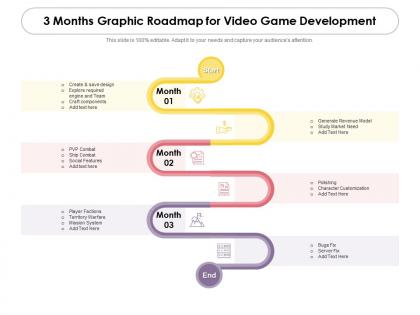
3 months graphic roadmap for video game development




Try Before you Buy Download Free Sample Product
 Impress Your
 Audience
 100%
100% Editable
 Save Hours
 of Time


A cohesive work plan is essential for achieving the desired target. Communicate your vision and lay a firm ground in front of your audience with our PowerPoint layout. Align your project milestones, budgets, deliverables, deadlines, and all the requisite information for a dynamic presentation by employing this amazingly designed 3 Months Graphic Roadmap For Video Game Development. Maximize team efficiency and streamline a work plan efficiently by introducing our ready made roadmap PowerPoint theme. You can quickly establish coordination between different activities across the organization and present an insight to your colleagues by utilizing this useful business tool. Color code specific tasks, prioritize, and keep a close eye on the deadlines with the help of our eye catchy PowerPoint template. Download our 3 Months Graphic Roadmap For Video Game Development for excelling at productive management.
People who downloaded this PowerPoint presentation also viewed the following :
3 months graphic roadmap for video game development with all 2 slides:
Give your audience a fulfilling experience. They will find our 3 Months Graphic Roadmap For Video Game Development elevating.
FAQs for 3 months graphic roadmap for
So there's basically three big chunks: pre-production, production, and post-production. Pre-production is all your planning - concept work, prototypes, figuring out what you're actually making. Production's where you build everything: assets, code, putting it all together. That's the grind part. Post-production handles testing, polish, launch, support after release. Here's the thing though - don't skip ahead to coding too early even if pre-production feels boring. I learned this the hard way lol. Each phase needs different stuff from your team. Seriously, that upfront planning saves you so much pain later when you're not rewriting half your game.
Honestly, just start with your vision and who you're making this for - saves you from going down rabbit holes later. I'd split it up: gameplay stuff, art direction, tech needs, and how you'll make money. Don't write a freaking novel though. I've seen GDDs that are like 50 pages of rambling nonsense. Keep sections short but give enough detail so someone else could actually build it. Throw in bullet points and flowcharts - visual stuff helps. Oh, and update it constantly because your game will change. Trust me on that one.
Honestly, prototyping is a lifesaver. Test your game mechanics early before you spend months building something that might suck. I've seen people skip this step and regret it big time. Paper prototypes work great - or throw together a super basic digital version. Even one day of testing can save you weeks down the road. You'll catch design problems fast and figure out if your gameplay loop actually works. Sometimes that "amazing" idea you had doesn't feel so amazing when people play it. Better to find out now than later, you know?
Honestly, constraints are where the magic happens. Don't see them as roadblocks - they're what force you to get creative. Early Pokemon is perfect proof of this - they turned the Game Boy's linking cable limitation into the whole trading mechanic that made the series huge. Prototype super early so you hit these walls before you fall in love with bad ideas. I always list my technical limits first thing, then brainstorm within those boundaries. Your GPU can't handle 1000 enemies? Cool, maybe that leads to a stealth game instead. Memory issues might push you toward procedural generation. Some of gaming's best innovations came from developers saying "well, we can't do X, so let's try Y."
Honestly, just get your communication sorted from the start. Git version control is non-negotiable - I've watched entire projects implode when someone accidentally nuked the main branch (nightmare fuel). Daily standups help too, plus something like Trello for tracking who's doing what. Write down your design choices and code structure, even if it feels tedious. Oh, and make a style guide early so your art/code/audio doesn't look like three different games smashed together. These basics will save you so much pain down the road, trust me.
Look, just pick whatever matches your team's actual skills first. Godot's awesome for 2D indie games, GameMaker too. Unity works for pretty much everything and honestly has the best tutorials - I swear there's a video for whatever weird thing you're trying to do. Unreal's super powerful but might be way too much if you're making something small. Also think about where you want to release it since some engines are better for mobile or console stuff. Don't obsess over fancy features you'll never use. Try building something tiny in whatever engine you choose before diving deep.
Track the obvious stuff first - crash rates, frame drops, load times. But here's what really matters: where players quit or get stuck. Those heat maps don't lie. Your QA team's catch rate vs what players find? Super telling metric that most people ignore for some reason. Session length and retention show if you've got something actually fun or just technically sound. Bug severity matters, but completion rates for different sections tell you more about real problems. Set up automated tracking for technical metrics so your testers can focus on gameplay instead of counting frame drops all day.
Dude, you gotta set boundaries from day one and actually stick to them. Make a "parking lot" doc for all those shiny new ideas - don't just shut people down, but save that stuff for later updates. Trust me, I got burned bad on my last project because we kept thinking "oh just one more feature" and ended up shipping half a year late. Any time someone wants to add something new? Cool, but what are we cutting that takes the same amount of work. Check in with your team regularly so you can spot scope creep before it kills you. And honestly - shipping beats perfection every damn time.
Start with accessibility from the beginning - seriously, don't wait until you're scrambling at the end. Colorblind palettes, subtitles, adjustable text, remappable controls. Motor stuff matters too. Skip those crazy button combos that'll frustrate people. Test with real users who have different needs, not just your dev team sitting around assuming what works. Oh, and get the Game Accessibility Guidelines website - they've got solid checklists that'll save you hours of guessing. Most devs think it's this huge pain but honestly? It's way more straightforward than you'd expect.
Mobile dev is way trickier than console, honestly. Battery life kills you, phones overheat, and every device has different specs - it's chaos. Console? You know exactly what hardware you're working with. Touch controls are a whole different beast from controllers too. People play mobile games in like 5-minute bursts while waiting for coffee or whatever, so you gotta design for that. My advice? Pick your platform first and build around those weird limitations from day one. Don't try porting later - you'll just hate yourself.
Your monetization choice literally shapes everything else about your game design. Free-to-play means you're building progression systems and engagement hooks to keep people spending over time. Premium games are way simpler - just focus on making a good experience without all the retention tricks. The thing is, this decision touches everything. UI complexity, level pacing, art style (do you need flashy skins to sell?), social features - it all stems from how you're making money. I learned this the hard way on my last project. Pick your monetization model first, then build around it. Don't try retrofitting later.
Honestly, everything's moving toward letting players shape their own stories now. Procedural generation is huge - levels, narratives, the whole thing adapts based on what you do. Games as a service changed everything too since devs can keep adding story content over time. Environmental storytelling is getting really clever - like, the world tells you what happened without boring cutscenes. My advice? Focus on reactive systems instead of just scripted stuff. That's definitely where things are headed, though I guess it's way harder to pull off well.
Definitely set up surveys and check forums regularly for feedback. When the same complaint keeps popping up, that's your red flag right there. I'd focus on those recurring issues first since multiple people complaining usually means it's legit. Don't go crazy trying to fix every wild suggestion though - some players have absolutely no clue what they actually want lol. Track your game metrics too so you can see if complaints match real player behavior. Oh and definitely tell players when you make changes based on their feedback. Builds trust and they'll keep helping you out.
Start posting teasers and dev blogs like 3-6 months out, not the week before launch (learned that one the hard way). Social media's obviously key - hit up wherever your players actually hang out. Streamers can be gold, but honestly? A smaller creator who genuinely loves your type of game beats some huge influencer who's just phoning it in. Beta testing gets people hyped and talking. Reply to comments, show behind-the-scenes stuff - that community thing really matters. Oh, and don't sleep on reaching out to gaming press for credibility.
Dude, you've got to start building your community way before you actually need the cash - that's the biggest mistake I see people make. Crowdfunding isn't just about money, it's proof people actually want your game. Plus those backers? They'll hype your game harder than you will sometimes, which is wild. Jump on Discord, Twitter, whatever - just start talking to people about what you're making. Honestly, the marketing side almost matters more than the funding because you're building real relationships. Kickstarter and similar platforms basically give you both at once if you do it right.
No Reviews