


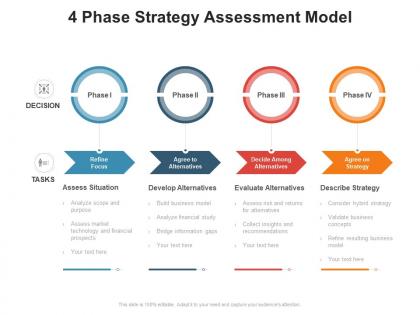
4 phase strategy assessment model




Try Before you Buy Download Free Sample Product
 Impress Your
 Audience
 100%
100% Editable
 Save Hours
 of Time


Our 4 Phase Strategy Assessment Model are topically designed to provide an attractive backdrop to any subject. Use them to look like a presentation pro.
People who downloaded this PowerPoint presentation also viewed the following :
4 phase strategy assessment model with all 2 slides:
Use our 4 Phase Strategy Assessment Model to effectively help you save your valuable time. They are readymade to fit into any presentation structure.
FAQs for 4 phase
So the 4 Phase Strategy Assessment breaks down pretty simply: Discovery is where you gather all your data and figure out what's actually happening right now. Then Analysis - you dig into that data to spot gaps and opportunities. Design comes next, where you build out your strategic options and recommendations. Finally Implementation, which is executing everything and keeping track of how it's going. Honestly, it's like having a roadmap so you don't do what most people do - jump straight to "solutions" without understanding what you're even solving. Each phase kinda builds on the last one. Start with Discovery and just document stuff as you move through it. Works way better than winging it.
So that 4 Phase model? It's basically SWOT and Porter's Five Forces but way more organized. Instead of doing your usual environmental scan, internal analysis, strategy stuff, and implementation in whatever order feels right that day, it makes you go step by step. Which honestly sounds boring but actually works better - I used to jump around and end up with tons of analysis but zero clue what to do next. The sequential thing fixes that mess. Try mapping what you're doing now against those four phases. You'll probably find some gaps you didn't notice before.
Okay so the metrics basically evolve as you go through each phase. Planning phase? You're just setting baselines and benchmarks - pretty straightforward stuff. Then implementation gets into the weedy stuff like adoption rates and training completion. Monitoring is honestly where things get messy because you're drowning in performance data and trying to spot early signals. My advice? Don't try to track everything right away. Pick like 2-3 key metrics per phase max. Evaluation phase wraps it up with ROI and long-term impact stuff. Oh and Phase 3 is where most teams completely lose their minds with data overload, just saying.
Oh totally! The framework works across different industries, you just gotta tweak the specifics. Tech companies will track totally different stuff than, say, healthcare or manufacturing - makes sense, right? But the basic structure stays intact. What changes are your KPIs, benchmarks, and how long each phase should actually take. Healthcare moves way slower than startups, for example. I'd honestly just grab the standard model first, then modify the metrics based on your industry's usual business cycles. Way easier than starting from scratch.
Honestly, getting everyone on board is the hardest part. Teams always want to skip the analysis phase and jump straight into doing stuff - drives me crazy. Resource allocation becomes a nightmare, especially when you need people from different departments who are already swamped. Oh, and the data? Half of it will be garbage, trust me. Stakeholders hate structured processes if they're used to winging it. I'd say start with something small first to show it actually works. Executive backing is crucial too - without it you're basically dead in the water from day one.
Look, stakeholders can totally make or break your whole project. Get them involved early when you're planning - they'll help you figure out what's actually realistic and what matters most. During data collection, they're the ones who know where to find stuff and can get you access to things you'd never reach on your own. Analysis gets weird without their input because honestly, you'll miss context that seems obvious to them. Implementation is where things really fall apart if people aren't already bought in. I've seen too many projects crash because someone tried to loop stakeholders in at the last minute. Map out who you need upfront - saves you so much headache later.
Data analysis is what separates real strategy from just throwing stuff at the wall and hoping it works. Track 3-5 metrics that actually matter to your goals - not vanity numbers that look pretty but mean nothing. Use the data to spot trends you'd miss otherwise and figure out what's genuinely working. Honestly, gut feelings will lie to you every single time. The numbers help you decide whether to pivot, keep going, or admit something's a total flop. Just stay consistent with tracking across all four phases, otherwise you're basically flying blind.
Get evaluators from different departments and levels - don't just use the same leadership people every time. Set up your scoring criteria beforehand so everyone's using the same standards. Anonymous feedback is honestly a game-changer because people will actually tell the truth when they're not worried about office drama. Mix up who runs each assessment phase too, otherwise one person's bias takes over everything. Document what you're doing so you can catch blind spots later. Oh, and build in some checks at each stage - it's way easier than fixing problems after the fact.
For your 4-phase assessment, I'd probably start with Miro or Mural - they're great when everyone's scattered and you need that visual workspace thing. Lucidchart works well if you want more structure, or honestly just customize some PowerPoint templates. I've watched teams crush it using nothing but Google Sheets (though that might drive you crazy if you're a visual person). If you're gonna do these assessments regularly, maybe look into Cascade or ClearPoint down the road. But don't overthink the tool choice - pick whatever won't have half your team struggling with new software. You can always switch later.
Quarterly check-ins are a good baseline, but honestly? It really depends on your industry. Fast-moving sectors need monthly reviews - that rigid annual planning thing is pretty much dead. The 4-phase approach works way better when you're cycling through it regularly instead of treating it like some dusty binder you pull out once a year. Block 90-day team meetings in your calendar right now. But stay ready to pivot if the market throws you a curveball or something big shifts. I've seen too many companies miss opportunities because they stuck to their schedule when they should've been adapting.
Yeah definitely works for both! Startups can move through the phases super fast since you're basically starting fresh - no baggage to deal with. Established companies? That's where it gets tricky. You'll be stuck in assessment forever because there's already so much existing stuff and people to wrangle. Honestly the politics alone can kill you. The cool thing with startups is you can pivot on a dime, but bigger orgs need way more hand-holding through changes. Just figure out where you are maturity-wise and jump in at that phase.
Honestly, rushing through assessment is like building a house without checking if the foundation is solid. You'll end up missing huge risks and making calls with half the info you actually need. I've watched teams try to "save time" this way - it always backfires. Their strategies look amazing on paper but completely crumble when reality hits because nobody thought about whether it was actually doable. The whole planning process gets messed up from there. Trust me, spending extra time upfront beats having everything fall apart later.
Look, the whole thing works because each phase feeds back into the others - no waiting around to pivot when stuff hits the fan. Last year's supply chain chaos? We jumped straight from implementation back to reassessing everything and honestly it saved our butts. Set up dashboards that actually alert you when your assumptions fall apart (trust me on this one). Each phase needs trigger points that automatically bounce you back to strategy mode. Don't think of it as some rigid checklist though. Monthly check-ins are clutch - they'll catch market shifts before your whole strategy goes sideways.
So that 4 Phase model basically forces you to question everything you're doing right now - which sucks but works. Assessment makes you dig into current processes and find the gaps. Analysis helps spot market opportunities you probably missed (I always miss obvious ones). Strategy development is where you get creative and brainstorm completely different approaches. Implementation lets you actually test ideas instead of just talking about them forever. Honestly, try asking "what if we flipped this whole thing?" at each phase. That's usually where the good stuff happens. Each checkpoint becomes a chance to challenge assumptions.
Honestly, feedback loops are what separate useful assessments from total wastes of time. You're basically flying blind without them after that first evaluation. Think GPS that recalculates when traffic hits vs just getting directions once and hoping for the best. Real data from changing conditions lets you actually refine your approach instead of guessing. Each phase builds on the last one - that's where the magic happens with iterative improvement. Oh, and set up regular checkpoints where you'll actually DO something with what you're learning, not just collect more data.
-
Excellent Designs.
-
Unique design & color.
-
Great designs, Easily Editable.
-
Very well designed and informative templates.
-
Out of the box and creative design.