


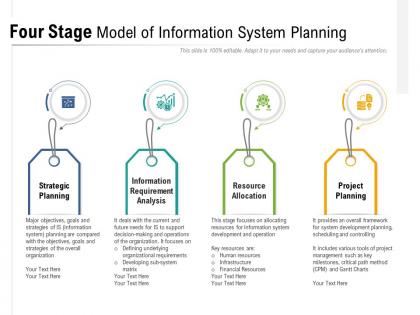
Four stage model of information system planning




Try Before you Buy Download Free Sample Product
 Impress Your
 Audience
 100%
100% Editable
 Save Hours
 of Time


Our Four Stage Model Of Information System Planning are topically designed to provide an attractive backdrop to any subject. Use them to look like a presentation pro.
People who downloaded this PowerPoint presentation also viewed the following :
Four stage model of information system planning with all 2 slides:
Use our Four Stage Model Of Information System Planning to effectively help you save your valuable time. They are readymade to fit into any presentation structure.
FAQs for Four stage model of
Honestly, start by figuring out if your IT plans actually line up with what the business needs - this gets screwed up way more than it should. Get everyone involved from day one: users, executives, the whole crew. Map your current systems first and spot the gaps before you go solution-crazy. Budget's huge because scope creep will destroy you. Don't skip the boring stuff either - risk planning, timelines, checking if your infrastructure can handle it. Oh, and stakeholder buy-in isn't just nice to have, it'll make or break the whole thing.
Here's my take - figure out what your business actually wants to accomplish first. I know it sounds basic, but IT teams constantly skip this part and jump straight to the tech stuff. Map your main business goals, then work backwards to see which systems actually support those things. Don't get caught up buying whatever trendy solution everyone's talking about (guilty of this myself). Get the business people involved early and check in regularly - are your systems actually helping with what matters? Focus on solving real business headaches, not just the technical puzzles that seem fun to fix.
Okay so stakeholder analysis is like mapping out all the people who'll either help or sabotage your IS project. You've got end users, management, IT team, sometimes customers too. Interview them early to figure out what they actually need and how much power they have. Trust me, the politics part matters more than anyone admits! Some will have way more influence than others, so you can't treat everyone the same. It helps you avoid those "oh crap, why didn't anyone tell me this earlier" moments. Plus you'll know which requirements to focus on first and who you need to keep happy.
Look, you've gotta bake risk assessment into your planning right from the start. Think about what could go wrong - cyberattacks, systems crashing, data breaches, compliance headaches. Figure out which ones would really mess up your operations and how likely they are. Honestly feels like fortune telling half the time, but whatever. Build your defenses into the actual system design and set aside money for security stuff, backups, and response plans. Oh, and don't just do this once - keep updating it as things change because they always do.
First thing - talk to actual users, not just the suits who think they know what's needed. Map out your current systems (yeah it's tedious but you'll thank me later). Get IT, finance, and ops involved early or they'll torpedo you later. Everything should connect back to real business goals. Honestly, piloting is where most people skip ahead and regret it. Test the big stuff first - catches problems when they're still fixable. Set up check-ins every few weeks since priorities always change. And actually validate your assumptions with data instead of just hoping you're right.
Honestly, just start by mapping out what you've got - all your systems and how data moves around. Yeah, it's boring but you'll thank me later. Grab performance numbers and ask people what actually sucks vs what works. Users will be brutally honest about what's broken, which is way more valuable than any fancy analysis. Check your infrastructure limits and security holes while you're at it. I'd throw everything in a basic spreadsheet first. The redundancies you find will probably surprise you - most companies are running like three different tools that do the same thing.
Honestly, it all comes down to what you're trying to achieve with the system. User adoption rates are clutch - are people actually using this thing? Then check your uptime and whether you're hitting those original business goals you set. User satisfaction is probably the biggest deal though. If everyone's complaining, your fancy metrics won't save you. Response times and error rates tell you if things are breaking behind the scenes. Oh, and definitely track ROI and cost-per-user or finance will be breathing down your neck. Pick like 3-5 metrics that actually matter for why you built it and obsess over those.
Yeah so new tech can totally mess with your timeline - sometimes you're halfway through a project and boom, something better drops. I try to stay flexible without chasing every trendy tool (which honestly gets exhausting). What works for me is budgeting specifically for testing new stuff - like AI tools or automation - and doing quarterly check-ins to see what's actually worth it. Don't abandon your roadmap completely though. Most "revolutionary" tech turns out to be overhyped anyway. Just make room for the real game-changers when they show up.
Honestly, the big headaches are always vague requirements, money running out, and getting everyone to agree on stuff. People change their minds constantly because they don't actually know what they want until you show them something - drives me nuts sometimes. Budget issues happen when you don't realize how complicated things really are, plus all those surprise costs nobody saw coming. Different departments wanting totally opposite things makes alignment basically impossible. What works though - interview stakeholders upfront, pad your budget for the unexpected, and set up regular check-ins with detailed roadmaps. Oh, and get end users involved early. They'll spot problems you'd never see.
Honestly, it's mostly about scale. Your small business? You can wing it with basic stuff - accounting software, customer management, maybe some cloud storage. Easy enough to switch things up if they don't work out. Big corporations are a whole different beast though. They've got enterprise systems, compliance headaches, data flowing between like 20 departments. Changes take forever because you're affecting thousands of people. I'd say just map out what you actually do day-to-day first. That'll show you what systems you really need instead of buying a bunch of fancy software that just sits there.
So for agile stuff, SAFe or enterprise agile planning works really well since you can plan in chunks instead of trying to figure out everything at once (which never actually happens anyway lol). Rolling wave planning is solid too - lets you pivot when things change. Honestly, skip the waterfall methods like traditional SDLC frameworks. They're way too rigid for what you're doing. Just start with your big picture roadmap, then chop it into smaller cycles that match your sprints. Way less headache that way.
Dude, figure out your compliance stuff right from the start - don't tack it on later like we did (nightmare). GDPR, HIPAA, whatever applies to your space, just map those requirements straight into your design. We literally had to rebuild half our system because we waited too long. Encryption, access controls, audit trails - build them as actual features from day one. Oh and definitely loop in your legal team early. They'll catch weird edge cases you never thought of. Honestly, just think of security as another user requirement instead of some separate thing you deal with later.
Dude, cloud computing totally flips IS planning on its head. Instead of buying servers and crossing your fingers on capacity, you're planning for services that scale instantly. Planning cycles shrink from years to months - way more flexible. The downside? You've got to be way more careful about data governance and security policies. Plus vendor lock-in is real (learned that one the hard way). You'll spend most of your time evaluating different SaaS options instead of messing with infrastructure setup. Honestly, just start by figuring out what you currently have that could migrate over.
Honestly, you've gotta weave UX into your planning right from the start - don't just slap it on at the end. Talk to real users during requirements gathering. Their headaches should shape how you build things, not just the tech stuff. I've watched so many teams skip this and then scramble later trying to fix everything. Map out those user journeys early on. Figure out where things need to be dead simple vs where users can handle a bit more complexity. Oh, and set aside budget for usability testing throughout the whole process. UX isn't optional anymore - it's basically table stakes.
Look, continuous improvement is what keeps your IS planning from becoming totally outdated. Technology moves fast - nobody wants to be stuck with systems from five years ago (learned that the hard way at my last job). You've got to build in regular check-ins and reviews right from the start. Get feedback from actual users, monitor how things are performing, and keep an eye on new tech that might be game-changing. Short reviews work better than massive overhauls. Don't treat it like an afterthought - make it part of your routine process or you'll always be playing catch-up.
-
Awesome use of colors and designs in product templates.
-
Nice and innovative design.
-
Really like the color and design of the presentation.
-
Unique and attractive product design.
-
Design layout is very impressive.