

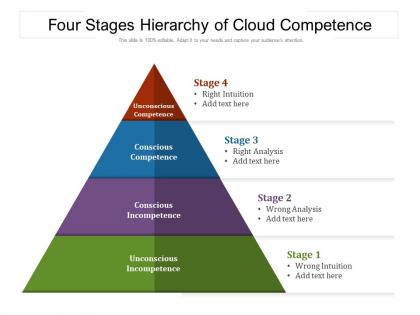
Four stages hierarchy of cloud competence




Try Before you Buy Download Free Sample Product
 Impress Your
 Audience
 100%
100% Editable
 Save Hours
 of Time


Our Four Stages Hierarchy Of Cloud Competence are topically designed to provide an attractive backdrop to any subject. Use them to look like a presentation pro.
People who downloaded this PowerPoint presentation also viewed the following :
Four stages hierarchy of cloud competence with all 2 slides:
Use our Four Stages Hierarchy Of Cloud Competence to effectively help you save your valuable time. They are readymade to fit into any presentation structure.

FAQs for Four stages hierarchy
Cloud competence hierarchy typically includes foundational infrastructure management, platform optimization, application development, data analytics, and strategic innovation levels. These levels progress from basic cloud migration and resource management to advanced capabilities like AI integration and digital transformation, with organizations finding that each tier requires increasingly sophisticated skills, strategic planning, and cross-functional collaboration to deliver competitive advantages.
Organizations assess their cloud competence position through comprehensive audits evaluating current infrastructure utilization, skill gaps, operational processes, and strategic alignment with business objectives. Many enterprises use maturity frameworks, third-party assessments, and benchmarking studies, with financial services and healthcare organizations finding that regular competency evaluations enable targeted improvements and accelerated cloud transformation initiatives.
Training serves as the primary catalyst for advancing through cloud competence levels, providing structured learning paths, hands-on labs, certification preparation, and real-world scenario practice. Through comprehensive programs covering technical skills, architectural principles, and business integration strategies, professionals systematically progress from basic cloud literacy to advanced specialization, with many organizations finding that structured training accelerates competency development and strategic cloud adoption.
The cloud competence hierarchy significantly influences adoption strategies by determining which cloud services organizations can effectively implement, from basic infrastructure needs to advanced AI and analytics capabilities. Businesses typically start with foundational services like storage and computing, then progressively adopt more sophisticated solutions as their teams develop expertise, ultimately enabling strategic transformation while minimizing implementation risks and maximizing operational efficiency.
**INPUT**: What competencies are essential for cloud architects at the top levels of the hierarchy? **OUTPUT**: Top-tier cloud architects require strategic vision, multi-cloud expertise, security architecture mastery, cost optimization skills, and organizational change management capabilities. These competencies enable architects to design scalable enterprise solutions, navigate complex regulatory requirements, and drive digital transformation initiatives, with many organizations finding that senior architects ultimately deliver competitive advantage through seamless integration and operational efficiency. [Word count: 58]
Businesses can leverage the cloud competence hierarchy by establishing foundational cloud literacy, developing specialized technical skills, and fostering strategic cloud thinking across teams. This structured approach enables seamless resource sharing, real-time collaboration tools, and scalable project management, with many organizations finding that systematic competence development ultimately delivers enhanced productivity, reduced operational silos, and competitive advantage.
Industry best practices for developing cloud competencies include establishing foundational infrastructure training, implementing role-based certification pathways, creating hands-on lab environments, fostering cross-functional collaboration, and maintaining continuous learning programs. These approaches streamline skill development by combining theoretical knowledge with practical application, structured mentorship with real-world projects, ultimately delivering scalable expertise and competitive advantage across organizations.
The cloud competence hierarchy directly influences security and compliance effectiveness, with foundational skills in access management, data encryption, and regulatory frameworks determining advanced capabilities like threat detection and automated compliance monitoring. Organizations with higher competence levels implement multi-layered security architectures, proactive risk assessment, and continuous compliance validation, while enabling faster incident response and ultimately delivering enhanced data protection and regulatory adherence across enterprise operations.
Organizations can measure cloud competence progress through metrics including cost optimization ratios, deployment frequency, system uptime percentages, security compliance scores, and automation coverage rates. These metrics enable businesses to track their advancement from basic cloud adoption to strategic optimization, with many enterprises finding that regular assessment across infrastructure efficiency, operational agility, and innovation velocity ultimately delivers measurable competitive advantage.
Cloud service providers can align their offerings by conducting comprehensive competency assessments, creating tiered service packages that match client maturity levels, and providing structured migration pathways with integrated training and support. Through strategic consultation and customized roadmaps, providers enable organizations to progress systematically from basic infrastructure services to advanced cloud-native solutions, ultimately delivering scalable growth and competitive advantage while minimizing implementation risks.
Companies face integration complexities when connecting legacy systems with cloud infrastructure, skills gaps requiring specialized cloud expertise, and cost management challenges during multi-phase migrations. These obstacles often involve cultural resistance to change, security concerns around data governance, and operational disruptions, with many organizations finding that strategic planning, comprehensive training programs, and phased implementation approaches help streamline transitions while maintaining business continuity.
A clear understanding of the cloud competence hierarchy improves project outcomes by enabling better resource allocation, reducing skill gaps, and ensuring appropriate expertise at each project phase. Organizations with structured competency frameworks experience fewer implementation delays, lower costs, and higher success rates, while teams can focus on strategic objectives rather than scrambling to fill knowledge gaps mid-project.
Leadership drives cloud competency development by establishing strategic vision, allocating resources for training, and creating accountability frameworks across organizational levels. Effective leaders champion cloud-first initiatives, invest in upskilling programs, and foster cultures of continuous learning, with many organizations finding that executive commitment accelerates adoption timelines and enhances cross-functional collaboration, ultimately delivering competitive advantage.
Organizations can effectively document cloud competence hierarchy knowledge through centralized knowledge repositories, competency mapping frameworks, role-based documentation systems, and collaborative platforms that capture best practices. These approaches streamline knowledge transfer by creating searchable databases, standardized skill assessments, and mentorship programs, with many enterprises finding that structured documentation accelerates team development and reduces onboarding time.
**INPUT**: What future trends should businesses anticipate that may affect the cloud competence hierarchy? **OUTPUT**: Businesses should anticipate edge computing integration, AI-driven automation, multi-cloud strategies, serverless architectures, and enhanced security protocols reshaping cloud competence requirements. These emerging trends demand evolved skill sets across data analytics, cybersecurity, and hybrid infrastructure management, with organizations increasingly finding that adaptive learning and cross-platform expertise deliver significant competitive advantages. [Word count: 53 words]
-
Best Representation of topics, really appreciable.
-
Great experience, I would definitely use your services further.
-
Great quality product.
-
Excellent Designs.
-
Innovative and Colorful designs.