


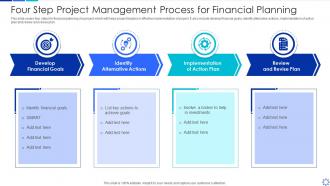
Four step project management process for financial planning





Try Before you Buy Download Free Sample Product
 Impress Your
 Audience
 100%
100% Editable
 Save Hours
 of Time


Our Four Step Project Management Process For Financial Planning are topically designed to provide an attractive backdrop to any subject. Use them to look like a presentation pro.
People who downloaded this PowerPoint presentation also viewed the following :
Four step project management process for financial planning with all 6 slides:
Use our Four Step Project Management Process For Financial Planning to effectively help you save your valuable time. They are readymade to fit into any presentation structure.





FAQs for Four step project management process
The key phases of project management include initiation, planning, execution, monitoring and controlling, and closing. These phases streamline project delivery by establishing clear objectives, defining resource allocation and timelines, implementing strategic activities, and ensuring quality control throughout, with organizations across industries finding that structured phase management enhances efficiency and delivers successful outcomes.
Effective stakeholder communication enhances project outcomes by ensuring alignment on objectives, managing expectations proactively, and facilitating timely decision-making throughout project lifecycles. Through regular updates, structured feedback loops, and transparent reporting, organizations streamline project delivery, minimize scope creep, and reduce costly delays, with many finding that consistent stakeholder engagement ultimately delivers higher success rates and stronger business value.
Risk management techniques in project planning include risk identification workshops, probability and impact matrices, Monte Carlo simulations, SWOT analysis, and contingency planning. These approaches enable project managers to proactively assess potential threats, quantify their likelihood and consequences, and develop mitigation strategies, with many organizations finding that systematic risk management reduces project delays by 30% and significantly improves budget accuracy.
Project scope creep significantly impacts deliverables and timelines by introducing unplanned requirements, extending development cycles, and straining allocated resources. Through inadequate change control processes, organizations experience delayed project completion, budget overruns, and compromised quality standards, with many finding that proactive scope management and stakeholder communication ultimately delivers better outcomes and maintains competitive project execution.
Project managers foster team cohesion by facilitating clear communication, establishing shared goals, resolving conflicts promptly, and creating collaborative environments where diverse skills integrate effectively. Through regular team meetings, transparent progress tracking, and strategic resource allocation, they enable stronger working relationships, improved productivity, and ultimately deliver enhanced project outcomes while building sustainable team dynamics.
Gantt charts improve project tracking by providing visual timeline representation, dependency mapping, resource allocation oversight, progress monitoring capabilities, and milestone identification in a single view. Through these comprehensive project visualization tools, managers can quickly identify bottlenecks, adjust schedules proactively, and communicate status updates effectively, with many organizations finding that Gantt charts significantly enhance team coordination and delivery predictability.
Agile methodology delivers enhanced flexibility, faster delivery cycles, improved stakeholder collaboration, reduced project risks, and increased team productivity through iterative development approaches. These frameworks enable organizations to respond quickly to changing requirements, accelerate time-to-market, and enhance customer satisfaction, with many technology companies and financial institutions finding significantly improved project success rates.
Project management software tools streamline workflow and communication by automating task assignments, centralizing project documentation, providing real-time progress tracking, and enabling instant team collaboration across departments. These platforms enhance operational efficiency through integrated dashboards, automated notifications, and seamless file sharing, with many organizations finding that centralized communication reduces project delays by up to 30% while improving overall team productivity.
Effective resource allocation strategies include capacity planning, skill-based matching, priority matrix frameworks, real-time monitoring systems, and cross-functional team optimization. These approaches streamline project delivery by maximizing talent utilization, minimizing bottlenecks, and ensuring critical tasks receive appropriate attention, with many organizations finding that strategic resource management reduces costs while accelerating project timelines.
Performance metrics can be established by defining clear KPIs aligned with project objectives, setting baseline measurements, and implementing regular tracking intervals through dashboards and reporting systems. Through project management software and stakeholder reviews, teams monitor progress against timelines, budget targets, and quality standards, while conducting weekly assessments and milestone evaluations, ultimately enabling proactive adjustments and successful project delivery.
Stakeholder engagement in initial project phases ensures clear requirements gathering, realistic expectation setting, and early buy-in that prevents costly scope changes later. Through structured stakeholder mapping and regular communication, project managers can identify potential risks, secure necessary resources, and build the collaborative foundation essential for project success, ultimately delivering higher satisfaction rates and smoother implementation across all organizational levels.
Feedback loops integrate into project management through regular stakeholder reviews, milestone assessments, team retrospectives, continuous monitoring systems, and iterative planning cycles. These mechanisms enable project managers to identify issues early, adjust timelines and resources dynamically, and enhance team collaboration, with many organizations finding that systematic feedback collection significantly improves project delivery rates and stakeholder satisfaction.
Common project closure challenges include incomplete deliverables, unresolved issues, inadequate documentation, stakeholder sign-off delays, and resource transition difficulties. These obstacles can be addressed by establishing clear closure criteria, conducting thorough quality reviews, creating comprehensive handover documentation, and implementing structured stakeholder approval processes, ultimately ensuring smooth project completion and organizational learning retention.
Lessons learned inform future planning by identifying successful strategies, common pitfalls, risk patterns, and resource optimization opportunities from previous initiatives. Organizations systematically capture these insights through post-project reviews and knowledge databases, enabling project managers to anticipate challenges, refine timelines, and enhance team performance, ultimately delivering more predictable outcomes and competitive advantage.
A project charter establishes clear project objectives, scope boundaries, stakeholder roles, and success criteria, serving as the foundational document that aligns teams and prevents scope creep. This strategic framework enables project managers to make informed decisions, secure stakeholder buy-in, and maintain focus throughout execution, ultimately delivering projects on time and within budget while minimizing costly revisions.
-
Unique research projects to present in meeting.
-
Excellent products for quick understanding.