

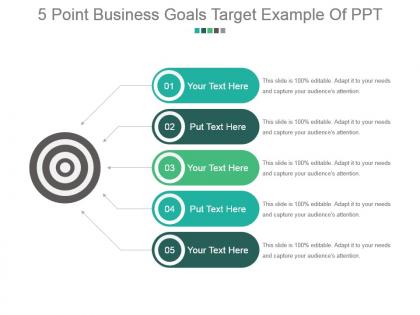
5 point business goals target example of ppt





Try Before you Buy Download Free Sample Product
 Impress Your
 Audience
 100%
100% Editable
 Save Hours
 of Time


Want to describe your company’s objectives to your audience? SlideTeam presents you pre-designed 5 point business goals target example of PPT. With the help of this PPT, you can easily describe your company’s objectives, vision, and mission. These organizational objectives PowerPoint slides will help you identify the steps a business should take in order to achieve targets. These PowerPoint templates can also be used to create a presentation on a business proposal, business plan, organizational goals, vision and mission, business case study, business plan development, business strategy, business management, business objectives and many more. Our organizational target PowerPoint PPT templates cover the instruction which will further help you make appropriate changes to the slides according to your needs and desire. So don’t wait for it, just click and download our 5 point business goals target example of presentation now. Excellence is inherent in our 5 Point Business Goals Target Example Of Ppt. The focus is always on achieving brilliance.
People who downloaded this PowerPoint presentation also viewed the following :
5 point business goals target example of ppt with all 5 slides:
Light the fuse with our 5 Point Business Goals Target Example Of Ppt. Blast the audience with the force of your ideas.
FAQs for 5 point business goals target
You need three main things: be super specific about what you want, make it measurable, and set a real deadline. Also, don't be delusional - doubling revenue in 30 days isn't happening unless you're selling miracle cures or something. But make it challenging enough that your team has to actually stretch. Someone needs to own each goal, and honestly? Most people's goals are way too vague when you actually write them down. Check yours - I bet half don't even have clear success metrics. Set regular check-ins so you can pivot if things go sideways.
SMART goals are a game-changer, trust me. You take something vague like "boost sales" and make it "increase Q4 northeast sales by 15% by Dec 31st." Boom - now there's zero confusion about what you're shooting for. Most people think they're setting goals but they're really just making wishes. The framework forces you to be specific, measurable, achievable, relevant, and time-bound. Your team can actually work backwards from the deadline instead of wandering around hoping things work out. Try it next time you're planning quarterly stuff - you'll be shocked how much clearer everything gets when there's real structure.
Honestly, market research is like a gut check for your business goals - shows you what's realistic vs. what you're daydreaming about. I'd start with customer surveys and checking out competitors before you lock in any big targets. The data reveals your actual market size, what problems people really have, and where you can price things. Plus it helps you figure out which customers to go after first. I skipped this step once and... yeah, don't do that lol. Without it you're basically guessing and hoping for the best, which rarely works out.
Honestly, the trick is getting super specific about what those big mission statements actually mean day-to-day. Like, don't let them just be fancy wall art - connect each goal to actual work your team does. I'd map out how each business objective ties back to your mission statement. Then check quarterly if you're still on track or if you've drifted (happens more than you'd think). The whole thing falls apart when it stays too vague and aspirational. Short version: make it concrete, review it regularly, and course-correct when needed.
Honestly, you've gotta repeat yourself like crazy - but in plain English, not that corporate BS nobody understands. Mix it up: meetings, dashboards, emails, whatever clicks with your people. The big thing is showing everyone how their boring Tuesday tasks actually connect to something meaningful. I'd do regular check-ins too (like, actually listen to what they say back). Oh and here's what most managers mess up - they think saying it once is enough. Nope. Keep hammering the same core message until it's stuck in their heads. Consistency beats creativity here.
Look, short-term goals are your quick wins - hitting monthly targets, shipping that feature users keep asking for. But your long-term stuff? That's what actually matters for where you'll be in 5 years. Here's what I've learned though - sometimes the short-term wins can totally screw you over later. Like slashing prices to hit this quarter's numbers, then realizing you've cheapened your whole brand. I've seen companies do this and regret it big time. The trick is making sure today's moves actually help tomorrow's vision. Quick wins should feed into the bigger picture, not fight against it.
Honestly, pick 3-5 metrics max or you'll drive yourself crazy trying to track everything. You want both types - leading ones that hint at future success (website traffic, pipeline stuff) and lagging ones showing what already happened (revenue, retention rates). Skip the vanity metrics though. Sure, 10k Instagram followers sounds cool, but does it actually move your business forward? Probably not. Each metric needs to be measurable and tied to real outcomes. I just use a simple dashboard I can glance at weekly - nothing fancy, but it keeps me honest about what's working.
Honestly, the biggest mistake is being way too vague - like saying "increase sales" instead of "boost sales 20% by March." Pick 3-5 specific goals max because I've watched teams completely crash trying to juggle a million things at once. Break huge goals into smaller chunks so you don't feel overwhelmed. Oh, and make sure they actually tie into your bigger strategy - otherwise you're just creating random busywork. Set clear deadlines and assign owners to each one. Don't forget regular check-ins either, or stuff just falls through the cracks.
Honestly, you've gotta watch your market like a hawk and stay ready to pivot. Customer behavior shifts? Competitors making moves? Time to figure out which goals still make sense. Some you can tweak, others need to die completely (trust me, I've been there - it sucks but you gotta do it). Figure out which goals are based on old assumptions first, then realign with what's actually happening now. The tricky part is moving fast without freaking out - panic pivots are almost worse than moving too slow. I'd set up regular check-ins so you're not blindsided again.
Honestly, Asana and Monday.com are pretty solid if your team likes visual dashboards - they make tracking goals way less boring. OKR tools like Weekdone or 15Five work better if you're doing the whole strategic planning thing. Google Sheets is fine for basic stuff, but trust me, it gets chaotic once multiple people start editing. Bigger companies usually stick with Salesforce or HubSpot since they already have everything integrated anyway. My advice? Just start with whatever project management tool you're already using - most of them have goal tracking built in these days.
Your employees see stuff you totally miss from up top. They know where things actually break down, what customers really gripe about, and honestly? Which goals are just creating pointless busy work. Leadership lives in spreadsheets while your team deals with reality every single day. Collecting their input regularly will shift your priorities in ways you wouldn't expect. I'd suggest quarterly feedback sessions focused specifically on goal-setting - you might end up completely changing direction based on what they tell you. It's wild how different things look from their perspective.
Dude, visuals are a game changer for stakeholder meetings. Nobody wants to stare at spreadsheet rows - that's just torture. But throw together some charts or a progress dashboard? Suddenly people actually pay attention. Your boring data becomes this whole story they can follow. Plus stakeholders can see where things stand without you having to explain every detail. Quick tip: make one simple visual for each major goal before your next meeting. Trust me, it'll completely change how engaged everyone is. Way better than talking through numbers for an hour.
Oh man, this stuff gets messy fast. Different cultures totally clash on goal-setting - like Americans want these super aggressive targets while Germans need everything planned out in detail. Japanese teams? They'll spend forever building consensus before deciding anything. Then you've got the hierarchy thing - some cultures expect goals handed down from above, others want everyone's input. Time's another issue too. Quick wins vs long-term thinking. I swear, managing all this feels impossible sometimes. Your best move is probably creating some flexible system that lets each region do their thing while still hitting the same business numbers.
Honestly, involving your team in goal-setting is a game changer. They'll actually care about hitting targets they helped create versus stuff just dropped on them from management. Your people know what's realistic too - they deal with the daily chaos you might not see from your level. I've seen this work really well because employees feel like their input matters. Goals become way more doable when they're based on what actually happens day-to-day. Plus engagement shoots up. Maybe test it with one team first? That way you can compare how they perform against the usual top-down method.
Honestly? Pick one person for each goal - not a whole team, but like an actual human who's gonna own it. Monthly check-ins are your friend here, and I mean with real numbers, not that "we're making progress" nonsense that means nothing. Put everything in a shared doc or whatever so people can't just pretend they're working on stuff. The trick is making it way more annoying to avoid the goal than to actually do the work. Oh and quarterly reviews work too if monthly feels like overkill - depends on your team I guess.
-
Commendable slides with attractive designs. Extremely pleased with the fact that they are easy to modify. Great work!
-
The Designed Graphic are very professional and classic.