

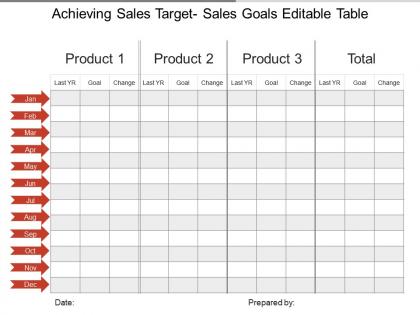
Achieving sales target sales goals editable table ppt design




Try Before you Buy Download Free Sample Product
 Impress Your
 Audience
 100%
100% Editable
 Save Hours
 of Time


Monitor the sales of your different buskins products with this achieving sales target PPT design. You can use this Sales PPT diagram to set the sales targets for your each product. Use this sales target achievement PowerPoint template design to build a comparative analyses for the budgeted targets with the actually achieved sale goals. It will help the management to build some effective business strategies which may results in bringing more sales to the company. You can also use this sales target achievement plan PPT template diagram to identify the high yielding product for your company. Thus, it helps in developing as well as implementing any changes in the sales of your other company products. This sales target setting PowerPoint slide template will further help in conducting an analysis of your business through the sales structure. It also helps in taking effective business decisions. Therefore, simply tap on the download option and starting customizing this sales goals PPT layout according to your business model. Get out of adversity with our Achieving Sales Target Sales Goals Editable Table Ppt Design. They enable you to take affirmative action.
People who downloaded this PowerPoint presentation also viewed the following :
Achieving sales target sales goals editable table ppt design with all 5 slides:
End the grumbling with our Achieving Sales Target Sales Goals Editable Table Ppt Design. Adequately address all complaints.
FAQs for Achieving sales target sales goals editable
Look at your past numbers first - that's your starting point. Make it specific: what you're selling, who's buying, exact deadline. SMART goals aren't just business school BS, they actually work. Realistic targets matter more than ambitious ones (trust me on this). Break annual goals into monthly chunks so you can pivot when things go sideways. Your goal should fit with what the company wants overall. Also check if you have the right resources and market conditions. Quick tangent - I've seen too many people set crazy high numbers just to impress their boss, then burn out chasing impossible targets. Don't be that person.
Honestly, start by figuring out what the company's actually trying to hit this quarter - revenue numbers, new markets, keeping customers happy, whatever. Work backwards from there. How do your sales activities connect to those big goals? I swear half the sales teams I know just chase random metrics without thinking about the bigger picture. Your quotas and territory stuff should all tie back to what leadership cares about. Oh and definitely grab 15 minutes with your VP to map this out together - way better than guessing what they want.
Honestly, your CRM dashboard is probably your best bet for tracking sales stuff. Weekly pipeline reviews work great too. Or just use spreadsheets if you're old school like me - nothing wrong with that. Leading indicators are where it gets interesting though. Calls made, demos booked, proposals sent - that data actually predicts what's coming way better than just staring at closed deals. Most people do monthly quota check-ins but miss this part completely. Set up some automated reports if you can. Manually pulling numbers every week gets old fast. Just start with whatever feels easiest and you'll figure out what works.
You definitely need both, trust me on this one. Those quick weekly wins keep you going when things get tough - we're all just chasing that little dopamine rush anyway, right? But here's the thing: long-term goals are what actually guide your decisions and show you where to put your energy. Short-term without the big picture? You're basically just busy for no reason. Long-term without quick wins? You'll burn out fast. I'd start with your yearly target, then chunk it down into quarterly and monthly pieces that don't make you want to hide under a rock.
Look, market research is your sanity check for sales goals. You need to know what's realistic based on market size, what competitors are doing, and actual customer demand. Otherwise you're basically guessing and hoping things work out - which they won't. The data shows you seasonal patterns, how price-sensitive people are, whether the market's already crowded. That way your targets push the team but aren't totally insane. I learned this the hard way tbh. Pull at least 6 months of market data before you lock in annual goals.
Check your sales goals every quarter for sure, but don't just stick to that schedule if things get weird. Market shifts happen fast - I learned that the hard way last year. Watch your pipeline velocity and win rates closely. When you notice consistent changes over like 4-6 weeks, that's when you need to move. Short bursts are just noise, but sustained trends? That's real data. Set up CRM alerts for the metrics that matter most so you're not constantly checking manually. Being ahead of problems beats scrambling to catch up every time.
Ugh, don't go for those crazy ambitious goals like "we'll triple revenue this quarter!" Complete fantasy. Vague stuff kills momentum too - saying "boost sales" means absolutely nothing. Your team will just stare at you confused. Keep goals simple enough that everyone gets what they're shooting for. Oh, and actually ask your team what they think when you're setting these! They know the real deal on the ground. I learned this the hard way - goals that ignore market reality or what you've actually done before? Recipe for disaster.
Dude, working as a team just makes everything easier. You're sharing leads, swapping stories about what actually works with customers, and nobody has to figure it out alone anymore. Divide up the big accounts so you're not stepping on each other's toes. When someone's stuck on a tough deal, boom - backup arrives. I swear the weekly check-ins are game-changers though, even if they feel pointless at first. Just have everyone share one thing they learned that week. You'll close deals faster because you're all getting smarter together instead of making the same mistakes over and over.
Track your big numbers first - revenue, closed deals, conversion rates. That's what actually matters for your quota. But here's the thing, activity metrics are clutch too because they tell you what's coming. Calls made, emails sent, meetings booked - all that stuff predicts your future pipeline. Don't forget deal size and cycle length either. Honestly, I'd build a simple dashboard showing current quarter progress plus these leading indicators. That way you can pivot early instead of scrambling at month-end like everyone else does.
Quarterly is the bare minimum, but I actually peek at mine every month. Markets move crazy fast now. Those quarterly check-ins let you pivot when seasons shift or when you're either killing it or... well, not. Monthly reviews help catch stuff early - way better than realizing you're totally off course three months later. Just don't become that manager who's always changing targets on people. Honestly? Block out 30 minutes right now on your calendar for regular number reviews. It's boring but it'll save your butt when things get weird.
Honestly? Your personal drive matters way more than anything else when it comes to sales targets. I've watched average reps with serious hunger absolutely demolish their quotas while "talented" people with zero motivation totally tank. Motivation changes everything - how many calls you make, your follow-up game, even how you bounce back from getting rejected (which happens constantly, btw). Find what gets you fired up. Maybe it's the money, maybe you're competitive as hell, or you want that promotion. Whatever it is, lean into that feeling hard when your targets feel impossible.
Dude, seriously try making your sales goals visual instead of just scribbling numbers somewhere. Your brain actually remembers pictures way better than text - it's wild how much of a difference it makes. I'm talking simple stuff like progress bars, milestone timelines, maybe those thermometer things that show how close you are. Honestly beats staring at boring spreadsheets all day. You'll spot patterns you'd totally miss otherwise. Keep it clean though - don't go overboard with fancy graphics. Just pick one visual for your next quarterly goal and watch how much clearer everything becomes. Trust me on this one.
Honestly? Start with what you've got - if you're already using a CRM like Salesforce or HubSpot, they're perfect for target tracking. Pipedrive's another good one that won't make your head spin. Excel dashboards work fine too, though I know that sounds boring. My old team spent months debating between fancy visualization tools like Tableau when a simple spreadsheet would've done the job. The real trick is finding something everyone will actually use daily. Don't overthink it - pick whatever meshes with how you're already doing sales, then upgrade once you figure out which numbers actually move the needle.
Figure out what's actually broken first - missing pipeline numbers? Bad close rates? Losing to competitors? Then build training around those specific problems. If deals are dying in final stages, hammer negotiation skills instead of wasting time on basic prospecting (though yeah, that matters too). Map each training piece to the exact behaviors that'll move your numbers. Oh, and track the right stuff afterward - otherwise you'll never know if any of this actually worked. Most teams skip that last part and wonder why nothing changes.
Honestly, SMART goals are a game-changer for sales because they stop you from just hoping things work out. You're forced to get super specific about what you actually want to hit. Like instead of "sell more stuff," you'd write "boost Q3 software sales to existing clients by 15% before September 30th." Way clearer, right? The measurable piece is clutch - you can check your progress weekly instead of guessing if you're doing okay. Makes everything feel less scary when it's broken down properly. I swear by this method for quarterly targets now.
-
The Designed Graphic are very professional and classic.
-
Use of icon with content is very relateable, informative and appealing.