


5 stages transformation journey for business success




Try Before you Buy Download Free Sample Product
 Impress Your
 Audience
 100%
100% Editable
 Save Hours
 of Time


Our 5 Stages Transformation Journey For Business Success arm you with all the gen. You will never make half baked attempts.
People who downloaded this PowerPoint presentation also viewed the following :
Content of this Powerpoint Presentation
Description:
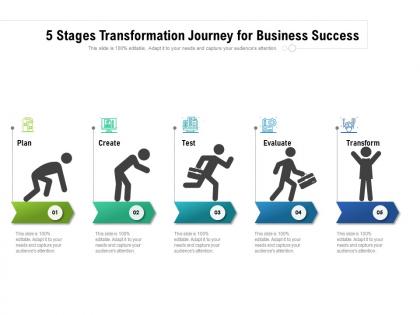
The image is a PowerPoint slide titled "5 Stages Transformation Journey for Business Success," which illustrates a step-by-step process in a company's transformation journey. Each stage is represented by a numbered step and an associated action:
1. Plan -
Depicted by a figure in a starting position, symbolizing the preparation phase.
2. Create -
Shown as a figure standing on a platform, indicating the development or creation stage.
3. Test -
A figure in motion represents the testing phase.
4. Evaluate -
Illustrated by a figure with a briefcase, reviewing and assessing the outcomes.
5. Transform -
A figure with arms raised, symbolizing successful change or transformation.
Use Cases:
This type of slide can be utilized across various industries for multiple purposes:
1. Consulting:
Use: Advising on business transformation strategies.
Presenter: Management Consultant.
Audience: Corporate clients.
2. Technology:
Use: Demonstrating software development lifecycle.
Presenter: IT Project Manager.
Audience: Development team.
3. Education:
Use: Teaching strategic management processes.
Presenter: Academic Instructor.
Audience: Business students.
4. Marketing:
Use: Outlining a marketing campaign's life cycle.
Presenter: Marketing Strategist.
Audience: Marketing department.
5. Financial Services:
Use: Explaining organizational changes for regulatory compliance.
Presenter: Compliance Officer.
Audience: Financial analysts.
6. Human Resources:
Use: Guiding through stages of organizational development.
Presenter: HR Director.
Audience: Company staff.
7. Manufacturing:
Use: Managing product innovation and manufacturing process.
Presenter: Operations Manager.
Audience: Production team.
5 stages transformation journey for business success with all 2 slides:
Our 5 Stages Transformation Journey For Business Success assure better assimilation. Air your views with compete clarity.
FAQs for 5 stages transformation journey
Honestly? Customer expectations are insane now - they want everything instantly and perfectly tailored. Digital stuff is forcing everyone to adapt or die. AI and automation can make you super efficient, but if you ignore it, you're screwed. Oh, and competition isn't just your usual suspects anymore - random companies are popping up everywhere. I'd say stay curious about what people actually want (not what you think they want) and try new things before you're backed into a corner. The speed everything changes is pretty nuts these days.
Honestly, just be straight up about what's changing and why it matters to them specifically. Nobody likes being kept in the dark. Get the biggest skeptics involved in planning it - sounds backwards, but they'll actually fight for something they helped create. Actually listen when people push back too. Sometimes they're pointing out real issues you missed. Try to score some easy wins early so everyone can see it's not a total disaster. Oh, and don't forget training - throwing people into something completely new without support is just mean. Makes a huge difference when people feel prepared instead of abandoned.
Honestly, tech is what makes real change happen at scale. Automation cuts through all the busy work, AI helps you make smarter calls, and cloud stuff means you can switch directions fast without dropping tons of cash on new systems. Data shows you what's actually moving the needle too - way better than just guessing. The cool part isn't just making old processes digital though. It opens up completely different ways to run your business. I'd start by figuring out where you're getting stuck the most, then find tech that fixes those specific headaches first.
Honestly? Your leadership style can totally make or break the whole thing. Go too heavy-handed and people just shut down - you'll get fake compliance but zero real buy-in. But if you're too hands-off, everything falls apart fast. I've watched that trainwreck happen more times than I can count. What works is finding that balance where you're collaborative but still decisive about where you're headed. Keep talking to people, get them involved in shaping stuff, but don't be afraid to make the hard calls. The way you handle it sets the vibe for everyone else. Maybe start by taking an honest look at how you're doing things now?
Honestly, the worst mistake is thinking you're communicating enough when you're not even close. Triple whatever you planned - people freak out when they're left guessing. Don't try changing everything at once either, you'll just overwhelm everyone. The culture shift is way harder than fixing processes, trust me on that one. Get your key people on board from day one, not when everything's already falling apart. Oh, and always explain the "why" behind changes. Start by figuring out where your communication totally sucks right now.
Dude, communicate like crazy - I'm talking way more than feels comfortable. Tell people what's happening and why, even if you don't have all the details yet. Uncertainty drives everyone nuts more than actual bad news does. Get your team involved somehow - surveys, feedback sessions, whatever works. When people feel like they have a say instead of just being dragged along, they'll handle the chaos better. Oh and celebrate the small wins as you go. Sounds cheesy but it actually helps when everything else feels like a mess.
You'll want to track both leading and lagging stuff. Leading ones like employee engagement scores and training completion rates give you early warning signals. The lagging indicators - revenue growth, customer satisfaction, efficiency improvements - those show real business impact but take forever to show up. Honestly? Don't stress about having perfect metrics from day one. Pick 3-5 that actually match your goals and refine later. I've seen people get paralyzed trying to measure everything. Just be consistent with whatever you choose and pivot when something's not working.
Honestly, culture will make or break your whole transformation thing. I've watched so many companies pour money into change initiatives that just die because nobody actually wants to change. People either fight it or wait for leadership to get distracted by something else (which, let's be real, happens a lot). But when you've got a culture that's actually cool with trying new stuff and learning from mistakes? That's when things take off way faster than anyone expected. First step is being brutally honest about whether your culture will help or hurt what you're trying to do.
So traditional transformation is just making what you already do work better - faster processes, lower costs, that stuff. Digital transformation? Completely different beast. You're rethinking your entire business model with tech at the center. Netflix didn't just speed up DVD shipping; they ditched it entirely for streaming. That's the mindset shift - instead of "how do we improve this?" you're asking "do we even need to be doing this anymore?" Honestly, most companies get stuck in optimization mode when they should be questioning everything from scratch.
Try telling a story instead of just listing goals - people actually remember narratives way better than bullet points. Paint the whole picture: where you're at now, the challenges ahead, and what winning looks like on the other side. I'd definitely include examples of other teams who've done similar transformations, especially the rough patches (those parts matter too). Make your team feel like they're the heroes driving this change, not just along for the ride. Then keep updating the story as you go. Small wins become plot points, setbacks become obstacles they've overcome. It's honestly more engaging than most corporate vision stuff.
Honestly, the failures taught me way more than any success ever did. You'll spot your weak points real fast when things go sideways. Big one I learned - if leadership isn't actually committed (like really committed, not just saying they are), you're screwed from the start. Communication breakdowns are brutal too. I watched a whole project implode because people had no clue what was happening day to day. Oh, and don't try changing everything at once - that's just asking for chaos. Pick small stuff first, see what sticks, then build on those wins.
Honestly, customer feedback is like having a roadmap instead of wandering around blind. You'll actually know what's broken from their perspective, not just what you think needs fixing. That helps you tackle the biggest problems first. When people see you're listening and making changes based on their complaints, they get way more on board with everything - which makes your life so much easier. Plus you catch stuff early before it turns into a disaster. I'd start setting up some kind of regular check-ins with your customers now. Surveys work, or just call a few of them. Whatever fits your situation.
Yeah, it totally does! Getting different teams to work together early on stops those stupid silos from blocking everything. You'll catch problems way sooner, and honestly, each department has insights the others would never think of - like IT knows what's actually possible tech-wise while marketing gets how customers will react. The trick is setting up regular check-ins and giving everyone shared goals instead of just their own department stuff. I'd start by figuring out which teams need to talk most, then create actual structured ways for them to connect. Way better buy-in when everyone's involved from the start too.
Honestly, the biggest mistake is treating transformation like a project with an end date. Build feedback loops into everything - talk to your team and customers constantly so problems don't blindside you. Weekly check-ins beat monthly ones if you can manage it. Celebrate the small stuff or people burn out fast. Oh, and pick some transformation champions who'll keep things moving when leadership gets distracted by the next shiny thing. Tie new behaviors to how you measure success. That's what actually makes changes stick - when they become just how you do business.
You've gotta look at what's actually happening in your industry first. Healthcare? Right now it's all compliance and patient data stuff. Retail companies are going crazy over omnichannel and supply chain fixes. Tech moves super fast, but banking and manufacturing have to be way more careful with all the regulations. Honestly, your competitors will show you exactly what to focus on - whether that's digital solutions, sustainability, or just getting operations to run smoother. Oh, and regulatory changes are huge signals too. I'd start by picking the top 3 trends hitting your space this year and work from there.
No Reviews