


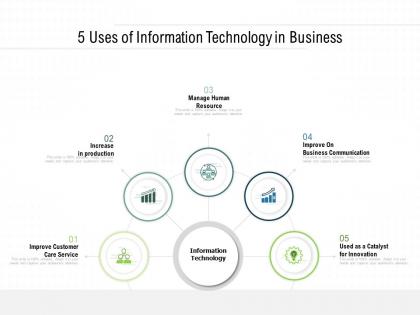
5 uses of information technology in business




Try Before you Buy Download Free Sample Product
 Impress Your
 Audience
 100%
100% Editable
 Save Hours
 of Time


Our 5 Uses Of Information Technology In Business create favorable conditions. You will begin with a big advantage.
People who downloaded this PowerPoint presentation also viewed the following :
5 uses of information technology in business with all 5 slides:
Grab the advantage our 5 Uses Of Information Technology In Business create. They ensure conditions in your favor.


FAQs for 5 uses of information
Cloud computing has revolutionized business operations by enabling remote accessibility, reducing infrastructure costs, streamlining data management, and enhancing collaboration across distributed teams. This technology delivers unprecedented scalability, with organizations seamlessly expanding resources during peak demands while minimizing overhead, ultimately providing competitive advantage through operational efficiency and faster market responsiveness.
Businesses leverage big data analytics by collecting vast datasets, applying predictive modeling, identifying customer behavior patterns, automating trend analysis, and generating real-time insights across operations. Through advanced analytics platforms, organizations streamline strategic planning, enhance risk assessment, and optimize resource allocation, with many retail and financial services companies finding significantly faster, data-driven decision-making delivers competitive advantage.
Cybersecurity risks include data breaches, ransomware attacks, insider threats, system vulnerabilities, and compliance violations. While these challenges require strategic planning and investment, businesses can mitigate risks through comprehensive security frameworks, employee training, and regular audits, ultimately enabling secure digital transformation that delivers competitive advantage and operational efficiency.
Small businesses can affordably integrate IT through cloud-based solutions, open-source software, Software-as-a-Service platforms, refurbished hardware, and phased implementation strategies. These approaches enable cost-effective automation, streamlined operations, and enhanced customer experiences without substantial upfront investments, with many small enterprises finding that strategic IT adoption delivers competitive advantages and operational efficiency comparable to larger organizations.
Artificial intelligence enhances customer experience by enabling personalized recommendations, automating support through chatbots, predicting customer needs, and delivering real-time solutions across touchpoints. Through machine learning and natural language processing, businesses streamline interactions, reduce response times, and anticipate preferences, with many retail and financial services companies finding significantly improved satisfaction and loyalty rates.
Information Technology streamlines supply chain management through real-time inventory tracking, automated demand forecasting, integrated vendor management systems, and predictive analytics for logistics optimization. These technologies enhance operational efficiency by reducing stockouts, minimizing carrying costs, and accelerating order fulfillment, with many manufacturing and retail organizations finding that AI-driven supply chain solutions deliver significant competitive advantages.
Businesses measure IT project ROI by comparing implementation costs against quantifiable benefits like increased productivity, reduced operational expenses, faster processing times, and enhanced customer satisfaction scores. Many organizations track metrics such as cost savings per transaction, employee efficiency gains, and revenue growth attributable to technology improvements, ultimately calculating percentage returns over specific timeframes.
Key components include cloud infrastructure, data analytics capabilities, automation technologies, cybersecurity frameworks, and change management processes. These elements work together by modernizing legacy systems, enabling data-driven decision making, and streamlining operations, with many organizations finding that strategic integration delivers improved customer experiences, operational efficiency, and competitive advantage in increasingly digital markets.
Mobile technology enhances employee productivity through remote access to applications, real-time collaboration tools, instant communication platforms, and automated workflow systems. These solutions enable flexible work arrangements, streamline task management, and facilitate seamless information sharing, with many organizations finding that mobile-enabled employees demonstrate higher engagement levels and deliver faster project completion rates.
Best practices for managing remote teams include implementing unified communication platforms, establishing clear digital workflows, utilizing project management tools, conducting regular video check-ins, and creating virtual collaboration spaces. These technologies streamline coordination by enhancing transparency, maintaining team connectivity, and tracking productivity metrics, with many organizations finding that strategic combination of communication and project tools ultimately delivers improved efficiency and stronger remote team performance.
ERP systems significantly enhance organizational efficiency by centralizing data management, automating routine processes, and streamlining cross-departmental workflows. Through integrated modules for finance, HR, supply chain, and operations, companies achieve real-time visibility, reduce manual errors, and accelerate decision-making, with many organizations finding substantial cost reductions and improved operational transparency.
Businesses should consider data privacy regulations like GDPR and CCPA, cybersecurity compliance requirements, intellectual property rights, software licensing agreements, and cross-border data transfer laws. These legal frameworks significantly impact implementation strategies, with many organizations finding that proactive compliance planning streamlines deployment while minimizing regulatory risks and potential penalties.
Collaboration tools enhance teamwork by enabling real-time communication, centralized document sharing, streamlined task management, and seamless remote coordination across departments and locations. These platforms significantly improve project delivery timelines, reduce email overload, and increase transparency, with many organizations finding that integrated collaboration environments ultimately deliver faster decision-making and higher team productivity.
Businesses should anticipate artificial intelligence integration, cloud-native infrastructure, cybersecurity automation, edge computing expansion, and sustainable technology adoption as dominant IT trends. These developments streamline operations by enhancing data processing capabilities, reducing infrastructure costs, and improving security protocols, with many organizations finding that early adoption delivers significant competitive advantages and operational efficiency.
Companies can ensure data privacy and compliance by implementing robust encryption protocols, conducting regular security audits, establishing clear data governance policies, training employees on privacy regulations, and deploying automated compliance monitoring systems. Through strategic combinations of technology and processes, organizations across sectors like healthcare, finance, and retail streamline regulatory adherence while enhancing customer trust, ultimately delivering competitive advantage in an increasingly regulated business environment.
No Reviews