


5 Year Strategic Plan For Banking Business




Try Before you Buy Download Free Sample Product
 Impress Your
 Audience
 100%
100% Editable
 Save Hours
 of Time


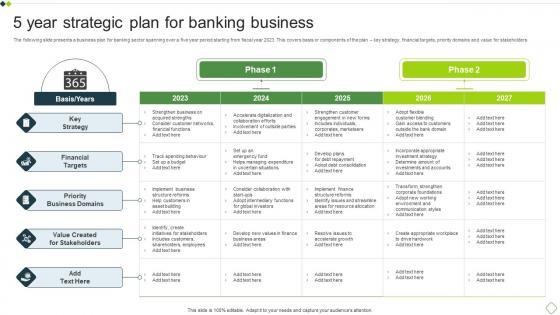
The following slide presents a business plan for banking sector spanning over a five year period starting from fiscal year 2023. This covers basis or components of the plan key strategy, financial targets, priority domains and value for stakeholders.
People who downloaded this PowerPoint presentation also viewed the following :
5 Year Strategic Plan For Banking Business with all 6 slides:
Use our 5 Year Strategic Plan For Banking Business to effectively help you save your valuable time. They are readymade to fit into any presentation structure.





FAQs for 5 Year Strategic Plan
Honestly, start with getting everyone in the same room first - alignment is everything. You'll need solid vision/mission work, plus scanning what's happening internally and externally. Goal setting with actual metrics matters too, not just fluffy objectives. Resource allocation is huge (obviously), but here's what I've learned the hard way - involve stakeholders throughout the whole process. So many strategic plans just collect dust because executives made them behind closed doors. Implementation timelines and review cycles keep things moving. The sweet spot? Being ambitious but not delusional about what your team can handle. Trust me on this one.
Honestly, if your team can't recite your core values, they're basically just fancy posters nobody reads. Here's what works - literally put your values sheet right next to your planning docs when setting goals. Ask yourself: does this goal actually match what we say we stand for? I've watched way too many companies chase money while completely ignoring their own principles. You can't treat values and strategy like separate things. Every big initiative should pass the values test first - otherwise you're just lying to yourself about what your company really cares about.
Honestly, stakeholder engagement can make or break your whole strategy. Get them involved early because they're either gonna support you or find sneaky ways to undermine everything later. These people usually know stuff you don't - like what'll actually work in the real world versus what looks good on paper. I learned this the hard way once. Map out who really matters first, then give them real ways to contribute (not just boring surveys). Their input helps you spot problems before they blow up and makes them feel invested in the outcome. Skip this step and you'll probably end up with another plan that nobody follows.
Honestly, SWOT only works if you actually DO something with it afterward. Don't just fill out the four boxes and call it done - I've watched so many teams waste hours on charts that never see daylight again. Get brutal about your weaknesses (that's the hardest part). Then connect the dots: which strengths can help you grab those opportunities? Where do your weak spots leave you exposed? Oh, and definitely get other people involved - you'll miss stuff on your own. The whole point is turning those insights into real action plans, not making a pretty diagram.
Track both financial stuff (revenue growth, profit margins, ROI) and the leading indicators that actually predict where you're headed. Customer satisfaction, employee engagement, market share - that kind of thing. Financial metrics are great but they're backward-looking, you know? Pick maybe 5-7 that really matter for your specific situation. Don't get caught up in vanity metrics that just make your reports look pretty. Oh, and set up quarterly check-ins to see how you're doing and pivot if needed. I've seen too many companies track like 20 different things and then wonder why nothing's getting better.
So competitive analysis is basically your secret weapon for making better business decisions. You can find gaps in the market that others totally missed and see what pricing actually works in the real world. Honestly, I think most people don't do this enough. It helps you figure out where to put your energy and resources too. Plus you'll catch threats early instead of getting blindsided later. Look at both direct competitors and the indirect ones - they're sneaky important. Then use all that info to stand out and time your moves right. It's like having insider knowledge without the sketchy parts.
Honestly, you've gotta bake flexibility right into your planning from day one. Set up quarterly check-ins to see what's shifting in your market. Draft a few "what if" scenarios beforehand - way better than panicking later. Track your key indicators, watch competitors, listen to customer complaints (that's where the real intel is). Make sure your team can flag changes fast without jumping through approval hoops. Oh, and pick three things that could totally mess up your current plan. Then figure out how you'd respond. Sounds obvious but most companies skip this step entirely.
Think of your vision statement as GPS for your whole strategy. Teams I've worked with before just end up doing random projects without one - like throwing darts blindfolded, honestly. You need something that helps you say "nope, that's not us" when shiny opportunities pop up. Otherwise you'll burn through months on stuff that doesn't actually move you forward. The key is making it specific enough to guide real decisions. Don't write some fluffy thing about "being the best" - that's useless. Your vision should immediately tell you which projects fit and which don't.
Honestly, ditch the gut feelings and use actual data for your strategic planning. Predictive analytics will show you market trends and customer patterns way before they smack you in the face. Dashboards are clutch for tracking KPIs - you'll know immediately if things are working instead of waiting months to realize you're screwed. AI can run those "what if" scenarios too, which is pretty cool since you can test ideas without the mess. Oh, and check what data you're already sitting on but totally ignoring. Most companies have tons they don't even use strategically.
Honestly? Most people get stuck overthinking the whole thing and end up with this massive 50-page plan that's basically useless. Don't do that. Also, huge mistake - don't plan everything alone in your office. Get the important people involved early or your strategy will just sit there collecting dust. Been there, seen it happen way too many times. Other stuff that kills plans: being super vague about what you actually want to achieve, pretending you have unlimited resources (you don't), and thinking you're done once it's written. Plans need updates! Keep yours simple and realistic - only commit to what you can actually pull off.
Honestly? Communication is what kills most strategic plans. People get confused about priorities and start doing their own thing when leadership doesn't explain the "why" clearly. I've watched perfectly good strategies crash because nobody understood what they were actually supposed to be doing differently. You can't just announce changes - you have to spell out how it affects each person's day-to-day work. Keep giving updates too, or momentum dies fast. My rule is always overcommunicate. Don't assume anyone "gets it" the first time. Schedule regular check-ins and actually verify everyone's on the same page.
SWOT analysis is probably your best starting point - just strengths, weaknesses, opportunities, threats. Super simple. Business Model Canvas works well too since it maps everything visually (my old manager was obsessed with it, but honestly it does help). You could also do scenario planning sessions where everyone brainstorms "what if" situations. OKRs are solid for connecting big-picture goals to actual numbers you can track. I'd pick whatever won't make your team's eyes glaze over first. You can always add more complicated stuff later once they're bought in.
Break your big plans into actual tasks with deadlines and owners. Seriously, I've watched so many companies create these beautiful strategy decks that just sit there collecting dust! Test stuff small first - don't blow your whole budget on assumptions. Be brutally honest about whether you actually have the people and money to pull this off. Check progress regularly because things will go sideways (they always do). Oh, and pick pilots that won't tank your whole operation if they fail. The organizations that succeed are realistic about their limits instead of pretending they're bigger than they are.
Look, your leaders are basically everything in strategic planning. They've got to champion the vision and get everyone on board. Without them backing you up with actual budget and people, your plan just sits there looking pretty on the wall - been there, seen that happen too many times. The trick is getting them to facilitate instead of just barking orders from the top. You want input flowing from all levels. Honestly, don't even bother starting if leadership isn't genuinely committed first. Save yourself the headache and make sure they're really in before you waste weeks planning.
Honestly, don't treat continuous improvement like some add-on task you'll get to "eventually." Build quarterly reviews right into your planning from the start. Create spaces where your team can mess around with new ideas - some will bomb, and that's totally fine. Track what works AND what doesn't, then actually do something with that info. The trick is making this feel normal, not like extra homework nobody wants. I'd set aside time each quarter (maybe over coffee?) to dig into: what's crushing it, what's dying a slow death, and what wild idea should we test next?
-
“Detailed and great to save your time.”
-
Understandable and informative presentation.