


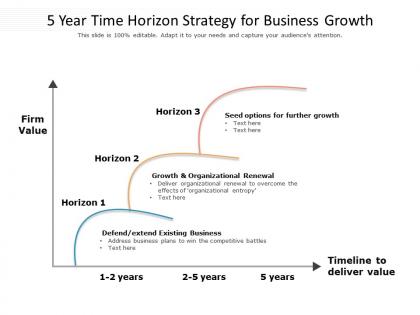
5 year time horizon strategy for business growth




Try Before you Buy Download Free Sample Product
 Impress Your
 Audience
 100%
100% Editable
 Save Hours
 of Time


Enjoy the feeling of abundance with our 5 Year Time Horizon Strategy For Business Growth. Experience the delight of having a host of choices.
People who downloaded this PowerPoint presentation also viewed the following :
5 year time horizon strategy for business growth with all 2 slides:
Experience the delight of having a host of choices with our 5 Year Time Horizon Strategy For Business Growth. Enjoy the feeling of abundance.
FAQs for 5 year time horizon strategy
Key components of an effective business growth strategy include market expansion, product diversification, strategic partnerships, operational optimization, and customer retention initiatives. These elements work together by identifying new revenue streams, enhancing competitive positioning, and streamlining resource allocation, with many organizations finding that this integrated approach ultimately delivers sustainable growth and market advantage.
Market research informs growth strategies by identifying customer needs, analyzing competitor positioning, assessing market size, and revealing emerging trends and opportunities. Through comprehensive data analysis, organizations can strategically target high-potential segments, optimize product development, and allocate resources effectively, with many companies finding that research-driven strategies deliver significantly higher success rates and sustainable competitive advantages.
Customer feedback serves as a critical foundation for growth strategy development by identifying market opportunities, revealing product gaps, guiding service improvements, and uncovering expansion possibilities. Through systematic feedback analysis, organizations can prioritize strategic initiatives, enhance customer experiences, and optimize resource allocation, with many companies finding that customer-driven strategies deliver higher retention rates, increased market penetration, and sustainable competitive advantage.
Businesses can leverage digital marketing for sustainable growth through SEO optimization, content marketing, social media engagement, email campaigns, and data-driven analytics. These strategies enable companies to reach targeted audiences, build lasting customer relationships, and optimize resource allocation, with many organizations finding that integrated digital approaches deliver measurable ROI and competitive advantage.
The most successful channels for scaling a business include digital marketing, strategic partnerships, referral programs, direct sales expansion, and e-commerce platforms. These channels streamline customer acquisition, enhance market reach, and accelerate revenue growth, with many organizations finding that combining multiple channels delivers competitive advantage, operational efficiency, and sustainable growth across diverse markets.
Partnerships and collaborations support growth objectives by expanding market reach, sharing resources and expertise, reducing operational costs, and accelerating innovation cycles. Through strategic alliances, companies access new customer bases, technologies, and distribution channels while minimizing risk, with many organizations finding that collaborative approaches deliver faster market entry and enhanced competitive positioning.
Businesses should track revenue growth rate, customer acquisition cost, customer lifetime value, market share expansion, and profit margin trends. These metrics collectively enable organizations to assess scaling efficiency, optimize resource allocation, and identify strategic opportunities, with many companies finding that monitoring both leading and lagging indicators delivers comprehensive insights into sustainable competitive advantage.
A company's value proposition directly shapes growth strategy by defining target markets, guiding resource allocation, and determining competitive positioning within specific industries. It influences expansion decisions, product development priorities, and customer acquisition approaches, with companies like Apple leveraging premium positioning for premium pricing strategies, while others focus on cost-effectiveness, ultimately driving sustainable scaling and market differentiation.
Aggressive growth strategies present risks including cash flow strain, operational complexity, quality control challenges, market overextension, and cultural dilution during rapid scaling. While these approaches can deliver competitive advantage, many organizations find that balancing expansion speed with infrastructure development, employee training, and customer service standards ultimately ensures sustainable growth and long-term market position.
Businesses maintain brand identity during rapid expansion by establishing clear brand guidelines, training all team members consistently, and implementing standardized processes across locations. Companies like Starbucks and McDonald's successfully preserve their core values through comprehensive documentation, regular audits, and strategic hiring practices, ultimately delivering consistent customer experiences while scaling operations efficiently.
Growth-oriented businesses benefit from equity financing, venture capital, business loans, revenue-based financing, and strategic partnerships. These funding sources enable rapid scaling through market expansion, product development, and operational enhancement, with many companies finding that combining multiple financing approaches delivers greater flexibility and reduced risk while maintaining strategic control over growth initiatives.
Innovation drives sustainable business growth by enabling companies to differentiate products, streamline operations, reduce costs, and create new revenue streams while adapting to market changes. Through strategic innovation initiatives, organizations across sectors like technology, healthcare, and manufacturing enhance customer experiences, optimize resource allocation, and maintain competitive advantages, ultimately delivering long-term profitability and market leadership.
Employee engagement serves as the foundation for successful growth strategy execution, directly impacting productivity, innovation, customer satisfaction, and retention rates across organizations. Engaged employees drive strategic initiatives more effectively, with companies like Google and Microsoft finding that high engagement levels correlate with faster market expansion, improved operational efficiency, and ultimately stronger competitive positioning in increasingly dynamic business environments.
Competitive analysis enhances growth strategies by identifying market gaps, benchmarking performance metrics, and revealing successful tactics used by industry leaders. Through systematic competitor evaluation, businesses can optimize pricing strategies, improve product positioning, and accelerate market entry, with many organizations finding that strategic competitive insights ultimately deliver faster expansion and sustained competitive advantage.
Common pitfalls include overexpansion without adequate infrastructure, neglecting core operations while pursuing new opportunities, insufficient market research, inadequate cash flow management, and failing to scale team capabilities. These challenges often emerge when businesses prioritize speed over strategic planning, with many organizations finding that sustainable growth requires balancing ambitious goals with operational excellence and financial discipline.
No Reviews