

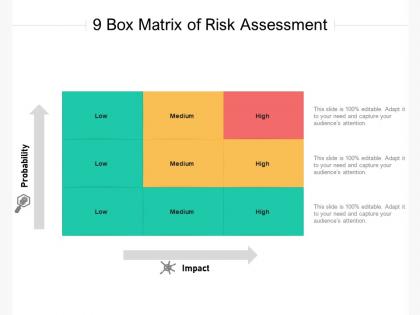
9 box matrix of risk assessment




Try Before you Buy Download Free Sample Product
 Impress Your
 Audience
 100%
100% Editable
 Save Hours
 of Time


Our 9 Box Matrix Of Risk Assessment are topically designed to provide an attractive backdrop to any subject. Use them to look like a presentation pro.
People who downloaded this PowerPoint presentation also viewed the following :
9 box matrix of risk assessment with all 2 slides:
Use our 9 Box Matrix Of Risk Assessment to effectively help you save your valuable time. They are readymade to fit into any presentation structure.


FAQs for 9 box matrix
So you'll want to start by figuring out what could actually go wrong - that's your hazard identification. Next comes the tricky part: analyzing how likely each risk is and what damage it might cause. Honestly, this step trips up most people since you're basically making educated guesses. Then you evaluate which risks you can live with versus the ones that need fixing ASAP. Control measures come last - that's where you actually do something about the high-priority stuff. Oh, and document it all because you'll forget otherwise. Review everything regularly too since risks shift as your business changes.
So basically, qualitative assessments use descriptive scales like "high/medium/low risk" while quantitative ones crunch actual numbers and probabilities. Qualitative is more like having structured conversations about what could go wrong - you're rating likelihood and impact based on gut feel and experience. Way faster, especially when you don't have much historical data. Quantitative gets into the weeds with statistical models, dollar amounts, Monte Carlo simulations... honestly can be overkill sometimes. It really comes down to what data you've got and how precise your stakeholders want things. Some people love those detailed probability charts, others just want to know if they should worry or not.
Oh definitely get stakeholders involved - they'll catch stuff you'd never think of. Finance knows where the budget's tight, operations sees the workflow issues, customers feel market changes coming. Each group has totally different blind spots they can help you avoid. Honestly, skip the surveys though. They're pretty useless for this kind of thing. Do actual interviews or workshops instead - you get way better info when people can bounce ideas off each other. Plus if you involve them early, they're more likely to actually support whatever risk plans you come up with later.
A risk matrix is your best bet here - just a simple grid plotting likelihood vs impact. High/high risks? Those need immediate attention. Low/low stuff can wait around. I know, sounds almost too basic but honestly it works great for getting teams aligned. Score each dimension 1-5 to keep things objective. The trick is staying realistic about both factors instead of obsessing over whatever sounds most dramatic. Oh, and don't let people inflate scores just because something feels scary - stick to actual data when you can.
So there's a bunch of different approaches you can use. Risk matrices are probably the most common - you just plot likelihood against impact. FMEA and fault tree analysis are solid too, though fault trees can be a pain to build from scratch. For bigger picture stuff, SWOT works really well. Monte Carlo simulations are powerful but honestly kind of overkill unless you're dealing with super complex scenarios. Bow-tie analysis is pretty cool for mapping out causes and effects visually. But if I were you? I'd just start with a basic risk register and heat map. Simple but gets the job done for most projects.
Honestly? Once a year minimum, but that's bare bones stuff. I do quarterly reviews at my company - works way better, especially if your industry moves fast. Major changes are when you really need them though. New software, process updates, regulations, incidents - basically anything that shifts how you operate. The calendar reminder thing is genius btw, I totally forget otherwise. Don't make it some big formal event either. Treat it like your other business reviews and just bake it into routine. Risks change constantly so you want to spot problems early rather than playing catch-up later.
Regulations are basically your rulebook for risk assessments. They tell you which hazards to check, what methods to use, how often to review stuff. Finance and pharma are brutal with requirements - feels like drowning in paperwork sometimes. But honestly? The structure helps you catch things you might miss otherwise. Your documentation standards, risk limits, assessment scope - most of that comes straight from regulatory requirements. Think of regs as your starting point, then build from there. Way better than trying to figure it all out from scratch.
So AI and machine learning are actually pretty cool for this - they catch patterns in huge datasets that you'd never spot manually. Real-time IoT sensors monitor equipment and environmental stuff constantly. Instead of those awful quarterly reviews, automation runs continuous scans. Predictive analytics forecasts risks before they smack you in the face, which honestly beats scrambling after things break. The whole point is flipping from "oh crap, fix it" mode to actually preventing problems. I'd say start with piloting one AI tool for a specific risk type first. See how it goes from there.
Honestly, the hardest part is getting leadership to actually fund it - they say it's crucial until they see what it costs. Data collection is a nightmare too. Different departments either don't track what you need or get weird about sharing info. Oh, and once you're done? Good luck keeping it current as things change. That part's almost harder than the initial assessment tbh. My take - pick one small area first and show them the value. Way easier than trying to tackle everything and burning out your team.
Dude, culture totally changes how companies think about risk. Some places are super cautious - like, they'll debate every possible thing that could go wrong before making any move. Others just go for it and see risk as part of innovating fast. I've watched this blow up at global companies where different offices clash over how aggressive to be. Your company's background, the industry you're in, leadership style - it all affects whether people see risks as scary threats or exciting chances. The trick is mixing different viewpoints when you're figuring stuff out so you don't get tunnel vision.
Dude, seriously don't skip the risk assessment part. I've seen projects completely implode because nobody bothered checking for problems upfront. Budget goes out the window, timelines get wrecked, and suddenly everyone's scrambling to fix stuff that should've been caught early. Your stakeholders will be pissed - like, really pissed. Compliance issues pop up out of nowhere too. Here's the kicker though: fixing problems later costs like 10x more than just preventing them from the start. Trust me, spend the extra time doing it right the first go-around.
Look at what actually scares your industry, not some generic checklist. Healthcare? Patient safety and HIPAA violations. Manufacturing focuses on equipment breaking down and worker injuries. Financial services worries about cyber attacks and getting slapped with regulatory fines. Honestly, most companies waste time on cookie-cutter risk templates that miss the point. Instead, check what disasters hit your industry last year - like the top 5 types. Build your whole assessment around those patterns. Your executives will thank you because you're addressing real problems they lose sleep over, not theoretical stuff that sounds good on paper.
Look at both leading and lagging indicators - that's your best bet. Leading ones are like percentage of risks caught early, completion rates, stakeholder participation. Lagging indicators? Your actual incidents, financial hits, how often you got the predictions right (spoiler: sometimes it's pretty humbling lol). Pick 2-3 metrics that match your biggest business headaches and stick with them. The whole point isn't just documenting problems - you want to actually prevent them. Short sentences work. But you'll also need some longer tracking periods to see if your assessments are doing their job.
Look, risk assessment is basically your early warning system for when things might go sideways. Before you dump money into new markets or big initiatives, you can actually see what could blow up in your face. Way better than crossing your fingers and hoping for the best, honestly. Map out your major risks every few months - sounds boring but trust me, it beats those panic meetings when everything's already on fire. You'll make way smarter calls about where to invest your time and money. Plus you can build backup plans instead of scrambling later.
Hey! So first, nail down what risks you're actually dealing with - be specific. Then rate each one for how likely it is and how bad it'd be if it happened. Use the same rating system for everything or you'll end up comparing apples to oranges. Don't just focus on the hard data either - those gut instincts matter more than people think. Write down your methodology and assumptions so someone can follow your logic later. Oh, and definitely get another person to review it before you call it done. You'll miss stuff you'd normally catch when you're too close to the work.
No Reviews