


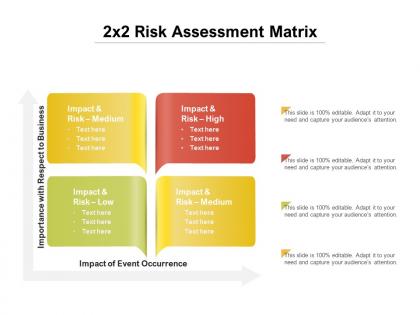
2x2 risk assessment matrix




Try Before you Buy Download Free Sample Product
 Impress Your
 Audience
 100%
100% Editable
 Save Hours
 of Time


Explore different avenues with our 2x2 Risk Assessment Matrix. They are good for conducting experiments.
People who downloaded this PowerPoint presentation also viewed the following :
2x2 risk assessment matrix with all 2 slides:
Explore our 2x2 Risk Assessment Matrix, get a brainwave. Find the best frequency to communicate.
FAQs for 2x2
So basically you've got four main things to handle: spotting risks, analyzing them, deciding what matters, and making your game plan. Start by figuring out what could actually go wrong - don't just wing this part. Then look at how likely each thing is and how badly it'd mess you up. Honestly, most people totally rush through this step and regret it later. Figure out which risks you actually need to stress about versus the ones that aren't worth losing sleep over. After that, pick your strategy for each one - avoid it, reduce it, pass it off to someone else, or just deal with it. Write this stuff down somewhere! Risks change constantly, so you'll need to revisit everything regularly.
So basically, qualitative risk assessment is when you sit around with your team saying stuff like "this risk is high, that one's medium" - you know, just talking it through. Pretty subjective honestly, depends on who's there that day. Quantitative is the opposite - you're crunching actual numbers, looking at historical data, calculating real probabilities and dollar amounts. Takes forever but way more accurate. My advice? Do qualitative first to spot your big risks fast, then get into the number-crunching for whatever scares you most. That combo works pretty well.
Honestly, stakeholders are like your secret weapon for risk assessments. They'll spot risks you totally missed and help figure out what actually matters vs what's just theoretical nonsense. Different people bring different angles - finance sees money stuff, IT sees tech vulnerabilities, operations knows where things break down daily. You need their buy-in too, otherwise your fancy mitigation plan just sits on a shelf collecting dust. Map out who you need early on and keep them in the loop throughout the whole thing, not just for some final dog-and-pony show presentation.
So basically, tech can crunch way more data than you ever could manually - like, we're talking massive amounts. Machine learning spots patterns you'd totally miss and gives you better probability calculations. The cool thing is it cuts out human bias (we all have those blind spots). Instead of just checking risks occasionally, you get continuous monitoring so nothing sneaks up on you. Honestly, the hardest part is just figuring out what data you're not using yet. Look into some analytics tools that'll plug into whatever system you've got now.
So there's basically three main types - qualitative stuff like risk matrices, quantitative methods (think Monte Carlo sims), and hybrid approaches. Different industries are obsessed with different tools though. Chemical companies swear by HAZOP, IT people go crazy for OCTAVE and ISO 27005. Finance uses VaR models, healthcare does FMEA. Manufacturing loves bow-tie analysis for some reason. Honestly, I'd just start simple with a basic risk matrix to figure out what you're dealing with first. Then you can get fancy with the industry-specific stuff once you know your compliance needs and how much risk makes you nervous.
At minimum, you'll want to do them yearly. But honestly? That's pretty bare bones. Any time something major shifts - new equipment, processes, regulations, or after an incident - you need another one. High-risk places often do quarterly assessments. The trick is weaving them into your normal routine instead of treating it like some annual chore you dread. Set up calendar reminders and make someone actually own the process. Oh, and definitely start by looking at your last assessment - what's different now? That'll save you time and give you a good starting point.
Honestly, I'd worry about three big things right now. Cybersecurity is brutal - ransomware attacks can literally shut you down for weeks, and hackers are getting scary good at this stuff. Supply chains are still a mess too (thanks COVID), and if one major supplier goes under, you're screwed. Regulatory compliance is the other headache. Data privacy laws keep changing depending on where you operate, which is exhausting to track. I'd start your risk assessment there since those three can hit your bottom line the hardest and fastest.
Look, risk assessments give you actual data instead of just guessing what might go wrong. You'll know which problems to tackle first and can budget way more realistically. Honestly, I've watched so many projects completely fall apart because someone thought they could skip this step - it's painful to see. Based on how likely and damaging each risk is, you can decide whether to avoid it, deal with it, pass it off to someone else, or just accept it. Oh, and definitely check your risk register before making any big calls. Those timelines will actually make sense for once.
Heat maps are probably your best bet - they show risk levels across departments super clearly. Those probability vs impact grids work well for presentations too. Dashboards are clutch if you need real-time tracking. Honestly, don't overthink it at first - even a decent Excel chart can work wonders when you're starting out. Power BI and Tableau are solid upgrades later if you want interactive stuff. I'd personally avoid the fancy GRC platforms unless you've got budget to burn. Start with whatever tools you already have, then see what your audience actually needs.
Culture totally runs the show when it comes to how teams handle risk. In hierarchical places, people just won't speak up about problems - honestly drives me nuts because you're basically flying blind. Then you've got cultures focused on individual vs group accountability, which changes everything about who owns what risk. Time horizons matter too - some cultures plan decades ahead while others focus on next quarter. Your org's tolerance for failure and uncertainty? That all traces back to these cultural values. You need to spot these blind spots in your assessments and make space for different voices to actually be heard.
Oh man, regulatory stuff varies SO much by region - that's your first nightmare. Europeans are usually way more conservative than your APAC teams, which creates this weird tension. Time zones don't help either, obviously. You'll also hit different data standards and compliance rules everywhere. Honestly? Start by getting everyone on the same risk definitions before anything else. Build some kind of shared taxonomy that local teams can actually map to their processes. Then do regular check-ins across regions to keep things aligned. Without that foundation, you're basically just hoping for the best.
Dude, you gotta match your audience. Execs want the quick version - risk ratings, business impact, done. Technical folks need all the nitty-gritty details and how to fix stuff. Honestly, throw in some visuals like heat maps because nobody's reading 50-page reports anymore. Talk money and compliance - that's what gets their attention. Be super clear about what's urgent and what comes next. I learned this the hard way, but if people can't figure out their next steps quickly, your whole assessment just sits there collecting dust.
Honestly, you really need people from different backgrounds looking at this stuff. Risks don't stay in neat little boxes - what looks fine to a tech person might make a lawyer panic, you know? Like, cybersecurity spots the technical holes, but psychologists see how people actually behave (spoiler: badly). Finance teams catch the money problems while ops people know what'll actually work in practice. I've seen some brilliant catches come from the weirdest combinations too. Just make sure you're getting these different perspectives early on, not scrambling to cover your bases after you've already decided everything.
Look, cyber threats are totally screwing up the old risk management playbooks. Traditional frameworks worked great for stuff you could predict and measure - earthquakes, market crashes, whatever. But cyber attacks? They're shapeshifters that stay invisible until BAM, your whole company's compromised. Here's the real problem: old-school risk assessment depends on historical data to forecast what's coming. With cyber threats, last month's intel is basically useless. You've got to start building in real-time threat monitoring and run through different attack scenarios. It's honestly exhausting but necessary.
So once you've done your risk assessment, there are basically four ways to handle what you found. You can completely avoid risky stuff by switching approaches, just accept low-impact risks, transfer them through insurance or contractors, or put controls in place to reduce them. Most people automatically go for controls and safeguards, but honestly? Sometimes avoiding the risk altogether is way easier. I'd start by listing your risks from worst to least bad, then figure out which strategy fits each one based on how likely they are and what you can actually afford to do about them.
No Reviews