

Abcde Strategic Planning Model




Try Before you Buy Download Free Sample Product
 Impress Your
 Audience
 100%
100% Editable
 Save Hours
 of Time


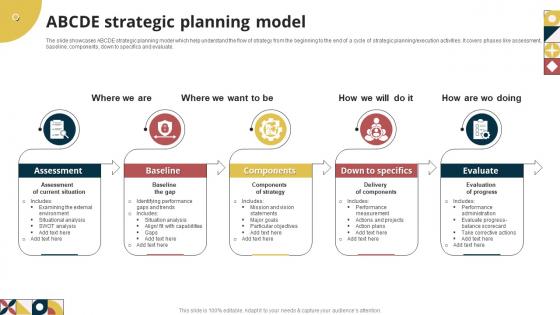
The slide showcases ABCDE strategic planning model which help understand the flow of strategy from the beginning to the end of a cycle of strategic planning or execution activities. It covers phases like assessment, baseline, components, down to specifics and evaluate.
People who downloaded this PowerPoint presentation also viewed the following :
Abcde Strategic Planning Model with all 6 slides:
Use our Abcde Strategic Planning Model to effectively help you save your valuable time. They are readymade to fit into any presentation structure.





FAQs for Abcde
So ABCDE stands for Adversity (what happened), Beliefs (your thoughts about it), Consequences (how you feel/react), Disputation (questioning those thoughts), and Energization (better outcomes). Honestly took me forever to memorize those letters lol. The whole point is that events don't actually make you upset - it's what you think about them that does. Like if your friend doesn't text back, thinking "they hate me" feels way worse than "they're probably busy." Once you challenge the dramatic thoughts, you end up feeling and acting better. I'd start by just noticing your beliefs and reactions to small daily stuff first.
Okay so the ABCDE thing is actually pretty solid for presentations. You grab **Attention** first, give some **Background**, make your **Case**, throw in **Details** to back it up, then wrap with a strong **Ending**. What I like about it is you're not just winging it anymore - there's a real flow that keeps people engaged. Each part connects to the next, so your audience doesn't zone out halfway through. I used to just dump info on slides and hope for the best (terrible strategy, btw). Now when I map everything to these five steps first, the whole thing feels way more convincing and organized.
Use ABCDE for the big stuff - board meetings, client pitches, anytime you need serious buy-in. Honestly saved my butt during a budget presentation last quarter when I was super nervous. Complex or controversial topics? Perfect for this framework. It keeps you from rambling when stakes are high (which I definitely do when I'm stressed). Short updates or casual info-sharing? Skip it. But when you're building a real argument step-by-step, this structure is gold. Try it next time something actually matters for your career.
The ABCDE model is way more structured than most presentation frameworks. You get these specific steps - Attention, Bridge, Criteria, Demonstrate, Execute - instead of just winging it with stories (which honestly can backfire if you're not great at them). It's more methodical than the basic "tell them what you'll tell them" thing. What I really like is that criteria step - it shows your audience exactly how you're evaluating things, which most problem-solution formats totally skip. Way more comprehensive. Oh, and it keeps you from rambling, which... guilty as charged sometimes. Try it next time you've got a big presentation coming up.
Honestly, audience analysis is everything with the ABCDE model. Like, you can't grab attention or build credibility if you don't know who you're talking to first. It's the foundation. Before crafting any message, dig into their demographics, pain points, and what they already know. Their communication style matters too - some people want data, others respond to stories. Each step of ABCDE should reflect what you learned about them. Without that insight, you're just throwing stuff at the wall and hoping it sticks. Makes the whole presentation way more targeted.
Yeah totally! ABCDE actually works great for virtual stuff. You gotta hook people way faster though - attention spans are brutal online. I'd front-load the benefits more than usual since people zone out quick. For credibility, throw in those trust signals early (testimonials, logos, whatever) because building rapport is trickier through a screen. The demo part is where you can really shine - screen sharing lets you control exactly what they see. Oh and the evaluation bit? People won't just jump in with questions like they would in person. You'll need to literally ask "any thoughts on this?" or they'll just sit there on mute. Build in way more pause points than feels natural.
Honestly, the worst thing you can do is rush A and B. Like, I get it - there's blood everywhere and broken bones sticking out, but if they can't breathe, none of that other stuff matters. People get so distracted by the dramatic injuries that they forget the basics. Also, don't just run through your checklist once and call it good. You've gotta keep cycling back because everything changes constantly. Had a guy last month who looked stable after we secured his airway, then crashed five minutes later. Stay systematic but keep reassessing - that's literally what saves lives.
Visual aids are clutch for the ABCDE thing - just match them to each part. Grab attention with bold slides, then use charts or infographics for your background setup. State your main point with clean visuals (not random stock photos - those are the worst). Data section's easy - graphs, tables, whatever actually backs up what you're saying. Oh, and your closing visual should hit hard and push them toward the action you want. Each one needs a job in your ABCDE flow. Don't just slap pretty pictures everywhere thinking it helps.
So with ABCDE, you gotta switch up your approach at each step. Start with shocking stats or bold claims to grab attention. Stories work magic for building belief - seriously, people eat that stuff up. Back up your confidence phase with real proof like testimonials. Paint that picture of success when you're building desire, and yeah, throw in some urgency too. Oh, and remove any friction when it's time for action. Make it stupid simple to take the next step. The whole thing is about reading where someone's head is at mentally and adjusting your strategy accordingly.
Honestly, feedback is what makes the whole ABCDE thing actually useful instead of just theory. You challenge your beliefs and try new thinking patterns, but how do you know if it's working? That's where feedback comes in. Your emotions and behaviors tell you if you're on the right track or if you need to circle back and examine what triggered you in the first place. It's kinda like debugging - you keep tweaking until something clicks. The tricky part is being real with yourself about what signals you're getting, then adjusting your approach next time.
Dude, they're literally everywhere! Steve Jobs nailed it with the iPhone launch - started with "today Apple reinvents the phone," showed off all the cool features, then boom, release date. Most TED talks follow this without even knowing it. Campaign speeches too. I swear once you notice the pattern, you can't unsee it. Even watching random product launches on YouTube, you'll catch yourself being like "oh there's the attention grab, there's the benefits part." It's kinda wild how predictable good presentations are. Just watch a few compelling ones and steal what works for yours.
So basically you teach kids the ABCDE thing - Activating events, Beliefs, Consequences, all that. Works great for test anxiety and when they're freaking out about hard math or whatever. I'd start with worksheets where they track their thoughts during stressful moments. Then show them how to challenge those "I'm terrible at this" beliefs. ABCDE journals work too - have them write about homework struggles. The trick is making it routine, not some random one-day thing. Honestly, middle schoolers pick this up way faster than you'd expect once they get the hang of it.
So basically, your thoughts shape how you feel way more than what actually happens to you - that's the whole premise behind this ABCDE thing. A is the event, C is how you react emotionally, but B (your beliefs about it) is what really drives everything. That's straight cognitive behavioral therapy right there. Then D and E let you challenge those automatic thoughts and get better results. Honestly took me forever to realize my brain was just making up stories half the time! Walk through each step when you're spiraling - it's weirdly effective at catching where your mind goes off the rails.
Track whether people actually do what you're asking for - that's your main win indicator. During the presentation, watch for engagement cues and questions. The desire piece is honestly weird to read in the moment, but you'll catch it later when they bring up your points unprompted. Post-presentation stuff matters too: conversion rates, follow-ups, whether they implemented your ideas. My favorite sign though? When someone mentions a specific benefit you talked about like a month later. That means it actually landed and wasn't just polite nodding.
Honestly, just stick with the basics - PowerPoint, Google Slides, or Canva all do the trick. Set up five clear sections for your ABCDE structure (Audience, Bridge, Content, Delivery, Evaluation). I'm kind of obsessed with simple bullet-point layouts over fancy stuff because they won't distract you from the actual flow. Before jumping into slides though, try mind mapping each section first - Miro's great for this, or grab a whiteboard if you're old school like me. Start basic and build from there. Trust me, clean templates beat flashy ones every time when you're trying to nail this framework.
-
“Love it! I was able to grab an exciting proposal because of SlideTeam.”
-
Great work on designing the presentation. I just loved it!