


Sobre mí





Try Before you Buy Download Free Sample Product
 Impress Your
Audience
 100%
Editable
 Save Hours
of Time


Presentación sobre una muestra de mi PPT. Este es un proceso de siete etapas. Las etapas de este proceso son perfil personal, logros, educación, información de contacto, pasatiempos. Este es un conjunto de diapositivas listo para usar en el que solo tienes que ingresar tu propia información para crear tu portafolio. Puedes describir brevemente sobre ti mismo en la presentación de PowerPoint completa. También puedes agregar tus fotos en las diapositivas. Puedes mencionar sobre los lugares que te gusta visitar, los juegos que te gusta jugar. También puedes hablar sobre el tipo de personas que te gustan o qué tipo de persona eres. Hay diferentes diapositivas para todos los diferentes subtítulos. Puedes hablar sobre tus pasatiempos e intereses. Esto puede cambiar tu cerebro en gran medida. También puede ayudarte al solicitar un trabajo, ya que puedes enviar el pase de diapositivas al empleador. En la última diapositiva también puedes mencionar tu información de contacto. Siéntete completamente galvanizado con nuestra Muestra de PPT Sobre Mí. Son excelentes para cargar tus cerebros.
People who downloaded this PowerPoint presentation also viewed the following :
Contenido de esta presentación de Powerpoint
Descripción:
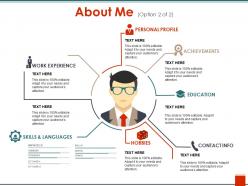
La imagen es una plantilla de diapositiva de PowerPoint diseñada para que una persona presente un perfil personal, típicamente utilizada en contextos profesionales o de networking. Esta diapositiva en particular está etiquetada como "Sobre mí (Opción 2 de 2)" y está estructurada para mostrar varios aspectos del trasfondo profesional y personal de alguien.
Aquí está un desglose de las diferentes secciones en la diapositiva:
1. Perfil Personal:
Ubicada en la parte superior derecha, está destinada a una breve introducción o resumen de la persona profesional del individuo. Este texto es personalizable, alentando al presentador a incluir una declaración concisa que capture su identidad profesional.
2. Experiencia Laboral:
Situada en el lado izquierdo de la diapositiva, esta sección está dedicada a enumerar empleos pasados y actuales. Es un lugar para resaltar roles, responsabilidades y logros profesionales.
3. Logros:
Adyacente al perfil personal, esta área es para mostrar logros notables, premios o reconocimientos que serían relevantes para la audiencia.
4. Educación:
Debajo de los logros, está diseñada para enumerar credenciales académicas, títulos o certificaciones que respalden la experiencia profesional del individuo.
5. Habilidades e Idiomas:
Ubicada en la parte inferior izquierda, esta parte describe el conjunto de habilidades del individuo y el dominio de idiomas, utilizando una escala de barras para representar visualmente los niveles de competencia.
6. Pasatiempos:
En el centro inferior, esta sección es para intereses personales o actividades que dan una idea de la personalidad del individuo fuera del trabajo.
7. Información de Contacto:
Ubicada en la parte inferior derecha, proporciona espacio para detalles de contacto como número de teléfono, correo electrónico o perfil de LinkedIn.
El centro de la diapositiva presenta una ilustración de una persona con gafas, simbolizando el sujeto de la diapositiva "Sobre mí". Los colores y gráficos son modernos y profesionales, haciendo que la diapositiva sea adecuada para una variedad de entornos profesionales, como entrevistas de trabajo, presentaciones personales en conferencias, eventos de networking o dentro de la sección 'Sobre mí' de una presentación de portafolio.
Cada sección está marcada con un icono que representa visualmente la categoría, por ejemplo, un maletín para Experiencia Laboral, un trofeo para Logros y un birrete para Educación, lo que ayuda a transmitir rápidamente la naturaleza del contenido a la audiencia. La nota repetida "Esta diapositiva es 100% editable" sugiere que la plantilla se puede personalizar completamente para adaptarse a la información y marca específicas del individuo.
Casos de Uso:
La plantilla de diapositiva "Sobre mí" es muy versátil y se puede adaptar para su uso en prácticamente cualquier industria. Aquí está cómo diferentes profesionales podrían usar esta diapositiva en varios sectores:
1. Tecnología e Informática:
Uso: Los profesionales de TI pueden usarla para resaltar sus habilidades técnicas, lenguajes de programación y experiencia en proyectos.
Presentador: Desarrolladores de software, Gerentes de TI.
Audiencia: Reclutadores, miembros del equipo, asistentes a conferencias.
2. Artes Creativas y Diseño:
Uso: Para mostrar un portafolio de trabajos de diseño, habilidades creativas y proyectos o exposiciones notables.
Presentador: Diseñadores gráficos, Artistas, Fotógrafos.
Audiencia: Clientes, dueños de galerías, directores creativos.
3. Negocios y Finanzas:
Uso: Para resumir logros profesionales, experiencia financiera y progresión de carrera.
Presentador: Analistas financieros, Consultores empresariales.
Audiencia: Posibles empleadores, inversionistas, socios comerciales.
4. Academia y Educación:
Uso: Para detallar credenciales académicas, investigación, publicaciones y filosofía de enseñanza.
Presentador: Profesores, Investigadores, Asesores académicos.
Audiencia: Comités académicos, participantes de conferencias, estudiantes.
5. Salud y Medicina:
Uso: Los médicos y profesionales de la salud pueden enumerar sus especializaciones, certificaciones y experiencia clínica.
Presentador: Médicos, Enfermeras, Administradores de atención médica.
Audiencia: Juntas médicas, administración hospitalaria, asistentes a conferencias.
6. Mercadotecnia y Ventas:
Uso: Para resaltar campañas de marketing, logros de ventas y habilidades específicas de la industria.
Presentador: Representantes de ventas, Gerentes de marketing.
Audiencia: Equipos de ventas, departamentos de marketing, clientes potenciales.
7. Ingeniería y Manufactura:
Uso: Los ingenieros pueden enfatizar sus habilidades técnicas, experiencia en gestión de proyectos y certificaciones de la industria.
Presentador: Ingenieros, Gerentes de producto.
Audiencia: Firmas de ingeniería, empresas manufactureras, asociaciones profesionales.
Sobre mí Slide 1: Mi nombre es [Nombre] Tengo [Edad] años Soy de [Ciudad, País] Slide 2: Mis pasatiempos son: - [Pasatiempo 1] - [Pasatiempo 2] - [Pasatiempo 3] Slide 3: Mis fortalezas son: - [Fortaleza 1] - [Fortaleza 2] - [Fortaleza 3] Slide 4: Mis objetivos a corto plazo son: - [Objetivo a corto plazo 1] - [Objetivo a corto plazo 2] - [Objetivo a corto plazo 3] Slide 5: Mis objetivos a largo plazo son: - [Objetivo a largo plazo 1] - [Objetivo a largo plazo 2] - [Objetivo a largo plazo 3]
Asegure que las diferencias individuales dejen de existir con nuestro Ejemplo de PPT Sobre Mí. Ponga fin a la dicotomía.


FAQs for About me
Ugh, I see this all the time at networking stuff - super smart people just completely bomb their intros. Like, they freeze up or ramble about job titles nobody cares about. It's brutal to watch honestly. Most people either wing it or straight up avoid these situations instead of just... preparing? There's barely any good advice out there that doesn't sound totally fake. So I started paying attention to what actually works in real conversations. Here's what I figured out: frame your intro like you're showing someone how you can help them, not reciting your resume. Way more natural that way.
Honestly, stories just stick better than boring facts about yourself. Our brains are wired for narrative - way more than lists of achievements anyway. When you tell a quick story about solving some problem or how you got into your field, people actually *see* who you are instead of just hearing generic stuff. Keep it short though, and make sure it connects to why you're talking to them in the first place. The situation-action-result thing works pretty well for structure. Way better than just rattling off your resume, you know?
Okay so hit the basics first - name, what you do for work, maybe one quick thing you're good at that matters to whoever you're talking to. I always add something personal but not weird, like where I'm from or some hobby I'm into. Honestly, skip college unless it's actually relevant - nobody cares most of the time. Keep it short, like 30 seconds max when you say it out loud. The trick is reading the room and matching your vibe to the setting. Oh, and end with something that gives people an easy way to keep the conversation going instead of just awkward silence.
So basically the template keeps you from standing there like "uh... hi, I'm Sarah and I... work places." You know? It breaks everything into chunks - name, what you do, something actually interesting about yourself, plus what you want from whoever you're talking to. Most people just wing these things and end up talking about their commute or whatever random thing pops into their head. Having a structure means you hit the good stuff without oversharing your entire life story. You can practice it once, then just tweak it for different situations. Honestly, try it at your next networking thing - you'll feel so much more confident walking up to people.
Oh man, the worst thing people do is overshare their entire backstory OR just say "Hi I'm Sarah, I'm an accountant" and call it done. Both are terrible honestly. You can't just dump your life story on someone, but being super bland makes you invisible. Plus most people don't adjust based on where they are - like what you'd say at happy hour isn't what you'd say meeting your friend's parents, you know? Here's what actually works: match the vibe, throw in one interesting thing about yourself, then ask them something real. Don't just wait for your turn to talk.
Props and slides can totally make your intro way more memorable. Bring something meaningful - like a photo timeline of your career or an object that tells your story. I've seen people use childhood pics, tools from their job, even weird random stuff (honestly those are the ones you remember). Just don't let it become a distraction. Practice the timing beforehand so you're not awkwardly juggling things while you're trying to talk. Oh and keep it simple - you want people focused on your story, not wondering what the hell you're holding.
Dude, your body language matters SO much when meeting people. Like, you could have the perfect intro line but if you're slouching and staring at your shoes? Total fail. Make eye contact - not creepy intense, just normal human contact. Stand up straight, give a decent handshake (not limp fish, not bone crusher). Smile like you actually want to be there. I swear, practicing in the mirror sounds dorky but it works. You'll catch yourself doing weird things you didn't even realize. Your body and words should match up, you know?
Honestly, introductions are so tricky across cultures! Americans are super direct and casual, but that can totally backfire in places where people expect more formality and indirect communication. Eye contact, handshakes, sharing personal details - it's all over the map depending on where you are. I learned this the hard way in Japan once, yikes. Your safest move is watching how locals introduce themselves first, then matching their vibe and formality level. Don't just bulldoze in with your usual style.
Okay so first thing - have a few conversation starters ready so you're not just standing there like 🦗. Practice talking about yourself briefly, maybe mention what you do or something you're into. Open-ended questions are your best friend because then they do the talking lol. Show up early if you can, it's way less intimidating than walking into a packed room. Oh and here's the thing that actually helped me - most people are worried about how THEY sound, so they're not analyzing every word you say. Takes so much pressure off once you realize that!
Honestly, you gotta tailor it to whoever you're talking to. At networking stuff, jump straight into your job and what you're hunting for. Academic crowd? Lead with your research or whatever credentials you've got. Social events are way more chill - talk about hobbies, where you grew up, random stuff like that. It's kinda like picking different outfits, you know? Same person, just emphasizing different parts of yourself depending on the vibe. I'd prep like 2-3 versions ahead of time so you're not standing there going "uhhh" when someone asks.
Honestly, a good intro is like having a secret weapon for networking. People actually remember you when you nail that first 30 seconds, and I swear I've watched someone land a job months later just because their introduction stuck with people. You want folks walking away curious about your work, not zoning out while you recite your LinkedIn headline. Practice something short that shows what makes you different - your unique angle, not just "I'm a marketing manager" or whatever. The whole point is getting people excited to introduce you to their contacts. Takes practice but it's so worth it.
Honestly, just keep it light and don't try too hard to be the office comedian. Make a joke about your third cup of coffee or some silly industry thing everyone deals with - you know, stuff that makes you seem normal without looking incompetent. I'd avoid anything remotely political or too personal though. You're going for that friendly "warm smile" vibe, not trying to get people cracking up. Test it on someone you trust first! Then watch how people react and dial it up or down from there. Self-deprecating usually works better than anything else.
Honestly, it depends on your field but there's a pattern. Tech people want to hear about problem-solving and what languages you know. Sales is all about numbers - like "I boosted revenue 40% last quarter." Creative industries? They're looking for personality and cool projects you've done. Healthcare folks should mention patient impact and certifications. Finance is ROI and risk management wins (obviously). The trick is figuring out what your specific audience cares about most. Always start with your biggest win that's actually relevant to them. Then - and this part matters - connect it to how you'll help solve whatever they're dealing with right now.
Update it every 6-12 months or when something big happens career-wise. I'm terrible at this - mine sits unchanged for like two years until I suddenly need it and panic! Your achievements change, goals shift, maybe you got promoted or want to highlight leadership more now. Set a phone reminder every few months to tweak it. Way better than starting from zero when you're rushing to apply somewhere. Even small changes help - new project, certification, whatever you're proud of lately. Trust me, future you will thank present you for staying on top of it.
Honestly? Just use your phone to record yourself talking - sounds weird but you'll actually hear what you sound like (prepare to cringe a little lol). Try practicing with family or friends first. Toastmasters is pretty solid if there's one nearby, or check out some LinkedIn Learning courses. The mirror thing actually works for nailing your body language, even though it feels ridiculous at first. Pick whatever feels right and just do your 30-second pitch every day for a week. You'll be surprised how much better you get.
-
eyes catching and very clear to see
-
great
-
Excellent
-
Good
-
Good and helpful template. Thanks.
-
Good template. Thank you.
-
Excelente trabajo realizado en diseño de plantillas y gráficos.
-
excellent and helpful powerpoint
-
Really a great Slide
-
love it -simple and great look and feel
