

About me powerpoint presentation examples





Try Before you Buy Download Free Sample Product
 Impress Your
 Audience
 100%
100% Editable
 Save Hours
 of Time


Cast a positive impression on your audience and build their confidence with our About Me PowerPoint Presentation Examples. Use this PPT slide to highlight your personal profile, education, and work experience in a well-organized and attractive format. Show clarity in your thoughts and ideas with our well-formulated PPT theme. Utilize this PPT layout to give a clear account of your skills, hobbies, languages known, and contact info. Garner the attention of your audience by exhibiting your awards and achievements in this informative yet attractive PPT layout. You can make an impressive and lasting impression on your customers by employing our PPT presentation. To gain investors, customers, or a job; a clear and concise PowerPoint presentation is a necessity. Employ this PPT template and showcase to your audience the professionalism and efficient work management you offer. Therefore, download our adaptable and editable about me PPT visual and convey your message with clarity and comprehensiveness.
People who downloaded this PowerPoint presentation also viewed the following :
Content of this Powerpoint Presentation
Description:
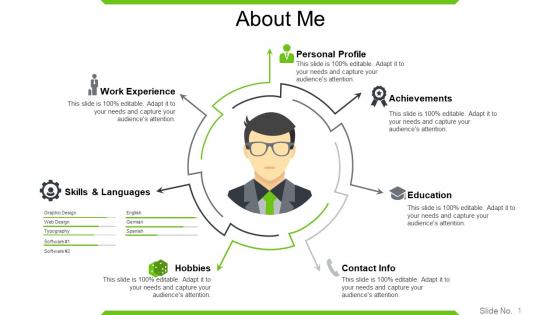
The image is a PowerPoint slide template titled "About Me," which is designed to give a comprehensive personal introduction, possibly for a professional or academic setting.
The slide is segmented into six key areas, each represented by an icon and a title, surrounding a central illustration of a person, presumably the subject of the presentation. These sections are:
1. Work Experience:
Indicates where the presenter can list their professional background. It is symbolized by a briefcase icon.
2. Skills & Languages:
Outlined by a gear icon, this section is for showcasing the presenter's professional skills and language proficiencies.
3. Hobbies:
Represented by a palette icon, suggesting the presenter can list personal interests or activities they enjoy in their leisure time.
4. Contact Info:
Marked by a telephone icon, this section is for providing contact details such as phone number, email, or social media handles.
5. Education:
Accompanied by a graduation cap icon, here the presenter can detail their educational qualifications.
6. Achievements:
This section, with a trophy icon, is where honors, awards, or other notable accomplishments can be highlighted.
The template is visually balanced, with a color scheme and icons that are professional yet engaging. It's suitable for a variety of settings, such as job interviews, professional networking events, or academic presentations, where a personal introduction with a blend of professional and personal details is appropriate.
Use Cases:
About Me slides are versatile tools for personal introductions in various fields, conveying a presenter's background, skills, and interests effectively.
1. Information Technology:
Use: Personalizing job interviews, networking events, or project presentations
Presenter: IT Professionals
Audience: Hiring Managers, Colleagues
2. Healthcare:
Use: Introducing medical professionals, sharing qualifications, and expertise
Presenter: Healthcare Practitioners
Audience: Patients, Colleagues
3. Creative Arts:
Use: Presenting artists' portfolios, showcasing skills and artistic style
Presenter: Artists and Designers
Audience: Art Exhibitions, Potential Clients
4. Academic:
Use: Personalizing lectures, conferences, or academic presentations
Presenter: Professors and Researchers
Audience: Students, Fellow Academics
5. Business:
Use: Enhancing networking at conferences, seminars, or pitch presentations
Presenter: Entrepreneurs and Business Leaders
Audience: Investors, Partners
6. Education:
Use: Facilitating parent-teacher meetings, showcasing teaching qualifications
Presenter: Educators and Teachers
Audience: Parents, School Administrators
7. Non-Profit:
Use: Personalizing donor meetings, conveying the impact of charitable work
Presenter: Non-Profit Leaders
Audience: Donors, Supporters
About me powerpoint presentation examples with all 5 slides:
Create circumstances beneficial to you with our About Me Powerpoint Presentation Examples. Get the flow in your favor.
FAQs for About me
Honestly, just be yourself but be intentional about it. Figure out what you're actually good at and lean into that - don't try to be everything to everyone because that never works. Then make sure you're showing up the same way everywhere... your LinkedIn, emails, how you talk in meetings, all of it should feel cohesive. I cringe when I see people putting on this fake professional persona that's nothing like who they really are. Pick one thing you want to be known for instead of spreading yourself thin. Ask yourself this: when someone mentions your name, what's the first thing you want them to think? Start there and build around it.
Honestly, your slide design is like your visual fingerprint. Pick 2-3 colors and stick with them religiously. Same goes for fonts - find clean ones you like and don't mess around. I've literally watched people guess who made a deck just from the design aesthetic, which is kinda wild but also exactly what you want. It's like how you spot a Nike ad without seeing their swoosh, you know? When you keep that template structure consistent across everything, people start connecting that polished look directly to you. Your presentations become part of your brand without you even trying.
Honestly, social media is like your personal branding megaphone. You control how people see you professionally. LinkedIn's obviously the main one, but Twitter works too if that's your vibe. The trick is staying consistent with your voice and actually talking to people - not just posting random stuff. I learned this the hard way by trying to be everywhere at once. Pick maybe 1-2 platforms max. Show your expertise, share what you think about industry stuff, let your personality come through. Just show up regularly instead of spreading yourself too thin across every platform that exists.
Think about what you're actually good at first, then what problems you genuinely enjoy tackling - that combo matters more than people realize. Ask your coworkers what they always come to you for help with. Look back at your biggest career wins too and see what connects them. Honestly, most people skip this reflection part but it's where the magic happens. Your sweet spot lives where your natural skills meet something the market actually wants. Oh, and write it down as one sentence you'd comfortably say in a normal conversation - not some corporate mission statement nobody understands.
Honestly, just pick 2-3 platforms where your people actually are and commit to showing up daily. LinkedIn's obvious for most industries, but don't sleep on Twitter or niche forums. I thought weekly posts were fine until I started engaging every day - totally different results. Share stuff that's actually useful, not just promotional garbage. Comment on other people's posts like you're having real conversations. Maybe start a newsletter or guest post somewhere? Oh, and podcasts are huge right now if you can swing it. The whole "be everywhere" thing is BS though. You'll burn out fast trying to manage ten platforms.
Honestly, skip the whole "I'm great at X" thing and just tell actual stories instead. Like that project where everything completely fell apart? That's your gold right there. Pick 2-3 stories that really show what you're about - the messier the challenge, the better honestly. Structure them with what went wrong, what you did, and how it turned out. Then just... use them everywhere. LinkedIn posts, interviews, random coffee chats. People forget bullet points instantly, but they'll remember the story about how you saved that disaster project. Practice telling them until they don't sound rehearsed anymore.
Your personal brand needs to stay consistent across all your socials - that's what builds trust and makes you memorable. Picture how you instantly spot a Coca-Cola ad anywhere, right? Same concept applies to you. I've watched people totally confuse their followers by going full corporate mode on LinkedIn then switching to super casual vibes on Twitter. It's honestly jarring. Stick with your core messaging and visual style everywhere, but tweak how you deliver it for each platform. When people know what to expect from you, they're way more likely to engage and remember you.
Getting feedback from peers is honestly like looking in a mirror - you see how you actually come across instead of how you think you do. Your coworkers can catch those gaps between what you're trying to project and what's landing. Maybe you think you're being a "collaborative leader" but it's reading more like micromanaging? Yeah, that stings but it's usually the most helpful stuff. Here's what I'd do: ask 3-5 people you trust to give you three words describing your professional rep, then see how that matches up with what you want to be known for. Sometimes the disconnect is... eye-opening.
Honestly? Most people mess up by being all over the place online. Like your LinkedIn screams "serious marketing pro" but then your Twitter's just random food pics (I mean, unless you're going for that food-marketing angle). Don't overshare drama either - nobody needs your work beef on Instagram. And please don't try being everyone's cup of tea. It's exhausting and fake. Here's what actually works: go look at all your profiles right now. Pick maybe 2-3 things you want to be known for professionally and stick with those. Consistency beats trying to be perfect at everything.
Track your follower growth and engagement rates, but don't get obsessed with vanity metrics. Website traffic's useful too. The real test? Better opportunities showing up in your inbox. Speaking gigs, job offers, collaborations - that stuff matters way more than likes. Google Alert yourself (sounds weird but trust me) to see what people are saying. Also pay attention to how many folks reach out saying they discovered you through your content. Oh, and track mentions/tags across platforms. Numbers lie sometimes, but quality opportunities don't.
Honestly, just keep it simple and make it actually mean something to you. Your logo needs to work tiny on a business card or huge on a billboard, so don't overcomplicate it. I'd stick with 2-3 colors max - any more and it gets messy fast. Some of the best personal brands? They're literally just clean initials or a nice wordmark. Nothing fancy. Think about what makes you different - your personality, your industry, whatever visual vibe people associate with you. Start by sketching stuff by hand first (I know, old school). Then ask people who actually know your work if it feels like "you." That's the real test. Move to digital once you've got something that clicks.
Honestly, networking is just showing people who you really are professionally. Listen way more than you talk - that's where the magic happens. Don't be that person collecting business cards like they're rare collectibles or something. Instead, actually help people when you can and share what you know. Pick maybe 2-3 events or online groups in your field and show up consistently. People need to walk away knowing what you're about. The follow-up matters too - send a real message, not some generic "nice meeting you" thing. It's really about building actual relationships over time.
Honestly, I'd start with LinkedIn since that's where the magic happens professionally. Buffer's been my go-to for scheduling posts - way easier than trying to remember to post every day. Canva is clutch for making graphics that don't look like garbage (I'm terrible at design). You could also check out Notion for keeping your content ideas organized, though I'll admit I sometimes just use random notes on my phone lol. BuzzSumo's solid for finding what's trending in your field. But seriously, pick like 2-3 max to start - I made the mistake of trying everything once and it was chaos.
Dude, you literally can't fake being genuine - people see right through that BS, especially online where everything already feels so fake. I learned this the hard way when I tried copying other people's styles. It's exhausting keeping up an act! The crazy thing is, when you're actually yourself, you attract way better opportunities. Like, people who actually get you and want to work with you for real reasons. Figure out what makes you weird or different, then just... own it? Don't try being someone else's version of successful.
Honestly, professional development is like investing in yourself - every course or certification becomes something new to talk about. You'll naturally meet cool people at workshops and conferences too (I swear networking happens way easier when you're actually learning something together). The trick is picking stuff that actually matters for your goals, then don't be shy about sharing what you picked up. Post about it on LinkedIn, bring it up in meetings, whatever. I see too many people just hoarding certificates without telling anyone what they learned or how they're using it. That's such a waste.
-
great
-
Excelente!
Obrigada por compartilhar este material fantástico! -
Best Representation of topics, really appreciable.
-
Perfect template with attractive color combination.