


Acknowledgement group project letter with regards designation and company





Try Before you Buy Download Free Sample Product
 Impress Your
 Audience
 100%
100% Editable
 Save Hours
 of Time


Highlight iconic achievements with our Acknowledgement Group Project Letter With Regards Designation And Company. Explain the important benefits generated.
People who downloaded this PowerPoint presentation also viewed the following :
Content of this Powerpoint Presentation
Description:
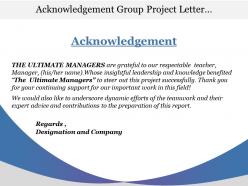
The image contains a template for an acknowledgement letter typically used in academic or professional group projects. The letter is addressed to "THE ULTIMATE MANAGERS" and begins with a statement of gratitude towards a teacher or manager, whose name is meant to be inserted into the placeholder "(his/her name)."
The body of the letter praises the recipient's "insightful leadership and knowledge" which assisted the group, referred to as "The Ultimate Managers," in successfully steering the project. There is an expression of thanks for continued support in the team's important field of work.
Further, the letter highlights the dynamic efforts of the team, mentioning "expert advice and contributions to the preparation of this report," suggesting that the group project culminated in a report.
The closing of the letter is formal with the word "Regards," followed by placeholders for the sender's "Designation and Company," indicating where the sender(s) would add their own professional details.
This type of template is used to formally recognize the contributions of individuals who play a pivotal role in the success of a project. It is customizable, allowing for personalization according to the specific context of the project and the contributors involved.
Use Cases:
Acknowledgement letters like the one in the template are a professional courtesy across various sectors, recognizing contributions and expressing gratitude for support and collaboration.
1. Academia
Use: Thanking faculty advisors for guidance on research projects.
Presenter: Research Students.
Audience: Professors and Academic Mentors.
2. Information Technology
Use: Acknowledging team effort post-project delivery.
Presenter: Project Managers.
Audience: Development Teams and Stakeholders.
3. Healthcare
Use: Recognizing collaborative efforts in medical research.
Presenter: Lead Researchers.
Audience: Research Contributors and Sponsors.
4. Non-Profit Organizations
Use: Expressing gratitude for volunteer support and donor contributions.
Presenter: Program Directors.
Audience: Volunteers and Donors.
5. Engineering
Use: Citing collaborative work on engineering projects.
Presenter: Engineering Team Leads.
Audience: Project Team Members and Consultants.
6. Publishing
Use: Acknowledging authors and contributors in book projects.
Presenter: Editors.
Audience: Authors, Co-authors, and Researchers.
7. Construction
Use: Thanking project stakeholders post-construction.
Presenter: Project Supervisors.
Audience: Contractors, Subcontractors, and Clients.
Acknowledgement group project letter with regards designation and company with all 5 slides:
Jog their brains with our Acknowledgement Group Project Letter With Regards Designation And Company. Get folks to exercise their faculties.
FAQs for Acknowledgement group project letter with regards
So acknowledgment letters are just you confirming you got whatever someone sent - job apps, complaints, orders, whatever. Pretty simple stuff. The whole point is so they know their thing didn't vanish into some black hole (because let's be honest, that happens way too often). Quick turnaround is key though - shoot for 24-48 hours max. You don't need anything fancy either. Something like "Got your application, we'll get back to you by Friday" beats leaving people hanging. It's also good for your own records and shows you've got your act together. Honestly beats awkward follow-up emails later.
Oh this is easy! Acknowledgment letters are basically just "yep, got your stuff" - like when HR emails you that they received your resume. Super formal and quick. Thank-you notes are different - they're for showing you actually appreciate something someone did. Way more personal. Timing's different too. Acknowledgments go out immediately as proof you received whatever. Thank-yous can be whenever, though sooner is obviously better. Honestly, acknowledgments feel more like business transactions while thank-you notes actually build relationships. If you're unsure which one to write, just think: am I confirming I got something, or am I grateful for what they did? That'll tell you everything.
Start with the obvious stuff - clear subject line, date, who you're writing to. Be specific about what you're acknowledging (complaint, application, whatever it is). Here's what I always mess up: actually giving them a timeline for what happens next. People hate being left hanging. Toss in your contact info and any reference numbers they might need later. The tone should match your relationship - don't get all formal with someone you email regularly. Oh, and send it within a day or two while everything's still fresh. Nobody wants an acknowledgment email three weeks later.
Yeah, definitely some basic stuff to follow. Put a clear header saying it's an acknowledgment letter, add the date, and address it right. State what you're acknowledging - documents, complaints, whatever. Keep it professional but don't stress too much about making it fancy. Reference numbers go in if you have them. Oh, and definitely mention next steps or when they can expect action if needed. Honestly, once you make a template you can just tweak it each time instead of starting from scratch. Way easier that way.
Honestly, acknowledgment letters are such a game-changer for building trust with people. When you formally recognize someone's help or effort, they actually feel valued - and trust me, people don't forget that kind of thing. It shows you're professional and detail-oriented too, which makes others want to collaborate with you again. Plus there's the bonus of creating a positive paper trail that could help both of you later. I always send them after big projects or when someone really goes the extra mile. Takes five minutes but pays off for years.
Honestly, you'll need these more than you think. Job applications and resumes are obvious ones - people want to know their stuff actually made it through. Same goes for contracts, legal documents, that kind of important paperwork. Complaints and donation acknowledgments are pretty standard too. After interviews, I always send a quick note. Makes you look put-together. Oh, and meeting requests or proposals - definitely acknowledge those. Nobody wants to wonder if their email got lost in someone's spam folder, you know? Keep a basic template saved somewhere. Trust me, it'll save you time when you're scrambling to respond to something urgent.
Oh man, culture makes such a huge difference with acknowledgment letters! Japan and Germany? You need formal language and proper titles. Australia or the US? Way more relaxed and personal works fine. I totally bombed once sending a super casual "thanks so much!" to a Korean business partner - felt awkward for weeks. Asian cultures usually want longer, more elaborate thank-yous. Scandinavian countries are the opposite - keep it short and direct. Honestly, just ask someone local about the right formality level before you send anything. Saves so much embarrassment.
Oh man, acknowledgment letters are lifesavers in project management! They're basically your proof that everyone agreed to something. Use them when you get deliverables, change project scope, or need to document that stakeholders know what they're supposed to do. Honestly, they've saved my butt so many times when people try the whole "I never said that" thing later. Keep them short but specific about what you're confirming. I always send them after big milestone meetings or scope talks - trust me, future you will thank present you when drama starts brewing.
Oh yeah, they use them all the time! Mostly for application confirmations, thesis stuff, conference proposals - you know, the big important things where people panic if they don't hear back. Universities love sending them for transcripts and financial aid too. Honestly, it probably cuts down on like half the frantic "did you get my email??" messages hitting their inboxes. When you write one, just be clear about what's next and when they'll actually hear something. Nobody wants to sit there wondering if their stuff disappeared into the void.
Just be straightforward about what you got and when you'll get back to them. Clear subject lines are clutch - something like "Received: Your job application" works perfectly. Honestly, those super formal acknowledgments always feel weird to me. Keep it professional but don't be robotic, you know? Drop in specific details like dates or reference numbers so people feel heard. And please proofread - typos in the first response? Yikes. Don't promise timelines you can't hit either. I'd create a template for the basic structure but tweak it for each person. Saves you time while still feeling personal.
Templates are seriously a game-changer for acknowledgment letters. You get the whole structure already mapped out, so no more staring at that blank page forever. Just drop in the names, dates, whatever you're acknowledging. They're clutch for remembering stuff like proper tone or legal wording - I've totally blanked on important details before when winging it. You can tweak them for different situations too. Oh, and they keep everything looking professional and consistent, which honestly matters more than people think. Just don't make them sound like a robot wrote them, you know?
Dude, you'll seriously burn bridges if you don't respond to important stuff quickly. When people send you job offers or business emails, they expect a fast acknowledgment - like within 24-48 hours max. Otherwise you look disorganized or uninterested. I've seen people lose opportunities because they took forever to reply and the sender just moved on to someone else. It's honestly such a simple thing but makes a huge difference in how professional you seem. Plus you might miss deadlines for next steps. Quick responses show respect and keep you in the running for whatever they're offering.
Dude, just use email templates - they'll save you so much time. Set them up to auto-fill names and addresses, plus you get read receipts so you know people actually opened them. Document management software is clutch for tracking everything in one spot. Who got letters, when they responded, follow-up dates. Some platforms even send automatic reminders if someone's being slow to reply (which honestly happens more than it should). Start basic with email templates first. If you're drowning in volume later, then look into the fancier workflow stuff.
Oh man, skip "Dear Sir/Madam" completely - sounds like a robot wrote it. Start with something like "Thanks for reaching out about this" or "Got your message about..." You want them knowing right away that you actually read what they sent. For wrapping up, I usually go with "We'll keep you posted as we figure this out" or something about staying in touch. Honestly the whole thing just needs to feel like there's a real person behind it, you know? The sweet spot is professional but not stiff. Make them feel like their complaint actually landed somewhere instead of disappearing into the void.
Honestly, acknowledgment letters are perfect for making sure you actually heard everything right. I write up what we discussed and send it over - gives them a chance to jump in if I totally missed the point. Creates a decent paper trail too, which has saved me when people "forget" what they agreed to do. The weird thing is, just writing it out helps me catch my own confusion half the time. You'll be surprised how often you think you understood something but didn't really. Throw in a casual "did I miss anything?" at the end and people will usually speak up if needed.
-
Attractive design and informative presentation.
-
Informative presentations that are easily editable.