


Swot Analysis Digital Marketing Company Profile Ppt Powerpoint Presentation File Templates




Try Before you Buy Download Free Sample Product
 Impress Your
 Audience
 100%
100% Editable
 Save Hours
 of Time


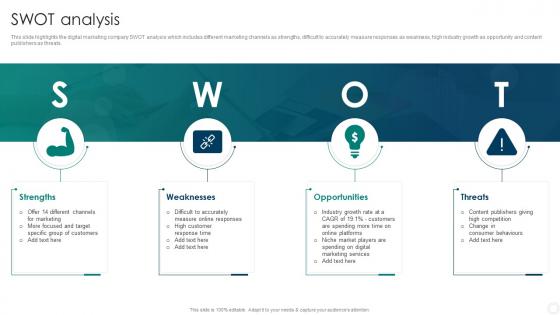
This slide highlights the digital marketing company SWOT analysis which includes different marketing channels as strengths, difficult to accurately measure responses as weakness, high industry growth as opportunity and content publishers as threats.
People who downloaded this PowerPoint presentation also viewed the following :
Swot Analysis Digital Marketing Company Profile Ppt Powerpoint Presentation File Templates with all 6 slides:
Use our Swot Analysis Digital Marketing Company Profile Ppt Powerpoint Presentation File Templates to effectively help you save your valuable time. They are readymade to fit into any presentation structure.





FAQs for Swot Analysis Digital Marketing Company Profile Ppt Powerpoint
SWOT analysis delivers comprehensive strategic insights by identifying internal strengths and weaknesses alongside external opportunities and threats, enabling organizations to make informed decisions. This systematic evaluation enhances resource allocation, competitive positioning, and risk management, with many businesses finding that regular SWOT assessments streamline planning processes and ultimately deliver better strategic outcomes.
SWOT analysis helps identify emerging market opportunities by systematically evaluating strengths that can capitalize on new trends, weaknesses that need addressing before market entry, external opportunities in untapped segments, and competitive threats that could impact timing. Through strategic assessment, organizations can align internal capabilities with market gaps, evaluate resource requirements for expansion, and develop competitive positioning strategies, ultimately enabling data-driven decisions about which emerging markets present the strongest potential for sustainable growth and profitability.
Stakeholder feedback enhances SWOT analysis by providing diverse perspectives on internal capabilities, market positioning, competitive threats, and growth opportunities that internal teams might overlook. Through comprehensive stakeholder input, organizations gain deeper insights into customer perceptions, supplier relationships, and competitive dynamics, while identifying blind spots and validating strategic assumptions, ultimately delivering more accurate assessments and stronger strategic decisions.
Businesses can effectively prioritize weaknesses by assessing their impact on competitive position, customer satisfaction, and operational efficiency, while considering resource requirements and implementation timelines for addressing each weakness. Many organizations find that ranking weaknesses by urgency and strategic importance, especially those affecting customer experiences or market positioning, enables targeted improvement initiatives that deliver measurable results and strengthen overall business performance.
SWOT analysis integrates seamlessly with strategic planning tools like Porter's Five Forces, balanced scorecards, scenario planning, and business model canvas frameworks. These combinations enhance organizational decision-making by connecting internal capabilities with market realities, competitive positioning, and performance metrics, with many companies finding that integrated approaches deliver more comprehensive strategies and measurable competitive advantages.
Company culture significantly influences SWOT analysis outcomes by shaping how teams identify strengths, acknowledge weaknesses, recognize opportunities, and assess threats through their collective mindset and values. Organizations with open, collaborative cultures tend to produce more honest, comprehensive assessments, while hierarchical or risk-averse cultures may minimize weaknesses or overlook emerging threats, ultimately affecting strategic decision-making accuracy.
Metrics for evaluating SWOT-based actions include revenue growth, market share expansion, cost reduction percentages, customer satisfaction scores, operational efficiency improvements, and competitive positioning indicators. These measurements enable organizations to track strategic progress across sectors like retail, healthcare, and manufacturing, with many companies finding that quarterly assessments of these key performance indicators ultimately deliver measurable competitive advantage and strategic alignment.
SWOT analysis effectively applies to personal development by evaluating strengths, weaknesses, opportunities, and threats within career planning, skill development, and goal setting. This strategic approach enables individuals to identify competitive advantages, address skill gaps, and leverage market opportunities, with many professionals finding that structured self-assessment ultimately delivers clearer career direction and enhanced strategic positioning.
Organizations should conduct comprehensive SWOT analyses annually, with quarterly reviews of key elements and immediate assessments during major market shifts or strategic initiatives. This regular cadence enables businesses to adapt swiftly to changing competitive landscapes, identify emerging opportunities, and address weaknesses before they impact performance, ultimately maintaining strategic agility and competitive positioning.
Common pitfalls include treating SWOT as static rather than dynamic, overemphasizing internal factors while underestimating external market forces, and failing to prioritize findings based on strategic impact. Organizations should avoid generic assessments without sector-specific context, ensure cross-functional input to prevent bias, and resist creating lengthy lists without actionable implementation plans, ultimately transforming insights into measurable competitive advantages.
Technology streamlines SWOT analysis by automating data collection, enabling real-time collaboration, and providing advanced analytics for deeper insights. Cloud-based platforms allow distributed teams to contribute simultaneously, while AI-powered tools analyze market trends, competitor activities, and internal performance metrics, ultimately delivering faster, more comprehensive strategic assessments and enhanced decision-making capabilities.
Market research significantly enhances SWOT analysis accuracy by providing data-driven insights into competitive positioning, customer preferences, industry trends, and market opportunities rather than relying on internal assumptions. Through comprehensive market intelligence, organizations can identify genuine strengths versus competitors, recognize overlooked threats, and uncover strategic opportunities, ultimately delivering more precise strategic planning and competitive advantage.
Small businesses can adapt corporate SWOT methods by simplifying data collection processes, focusing on local market conditions, and leveraging digital tools for competitive analysis. While larger corporations use extensive research teams, small businesses can gather insights through customer feedback, social media monitoring, and industry networking, ultimately delivering strategic clarity that enables focused resource allocation and competitive positioning in their specific market segments.
Visual tools like graphs, charts, and interactive dashboards transform SWOT analysis presentations by making complex strategic information more digestible, memorable, and actionable for stakeholders. These visual elements enable organizations to quickly identify patterns, prioritize strategic initiatives, and facilitate collaborative decision-making, with many companies finding that visual SWOT presentations increase stakeholder engagement and accelerate strategic planning processes.
SWOT analysis facilitates better communication within cross-functional teams by creating a shared framework for discussing strategic factors, establishing common terminology across departments, and encouraging diverse perspectives from different functional areas. This structured approach enables teams to systematically evaluate organizational position while breaking down silos, with many companies finding that collaborative SWOT sessions enhance mutual understanding and alignment.
-
Good research work and creative work done on every template.
-
Innovative and Colorful designs.