


After action review matrix questions text boxes




Try Before you Buy Download Free Sample Product
 Impress Your
 Audience
 100%
100% Editable
 Save Hours
 of Time


Arrive at conclusions acceptable to all with our After Action Review Matrix Questions Text Boxes. It helps decide on disputes.
People who downloaded this PowerPoint presentation also viewed the following :
Content of this Powerpoint Presentation
Description:
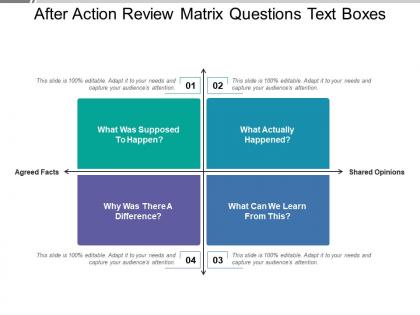
The image shows a slide titled "After Action Review Matrix Questions Text Boxes," which is a template for an After Action Review (AAR) process. The AAR is a structured review or debrief used for analyzing what happened, why it happened, and how it can be done better by the participants and those responsible for the project or event.
There are four text boxes in the image, each representing a question central to the After Action Review process:
1. "What Was Supposed To Happen?":
This box is meant for listing the objectives and plans that were in place prior to the action or event. It's essential for setting the context of what was expected.
2. "What Actually Happened?":
Here, the actual outcomes and events are documented. It contrasts with previous expectations, sometimes leading to valuable insights.
3. "What Can We Learn From This?":
This box encourages reflection and identification of lessons learned, which can inform future actions and decisions.
4. "Why Was There A Difference?":
This is the analytical core of the AAR process, examining the reasons for discrepancies between planned and actual outcomes, and exploring both the successes and shortcomings.
Use Cases:
This slide can be versatile and applicable across various industries:
1. Military:
Use: Debriefing after missions, training exercises, or operations
Presenter: Military officers or training staff
Audience: Service members and unit personnel
2. Healthcare:
Use: Reviewing medical procedures or patient care outcomes
Presenter: Healthcare administrators or clinical leads
Audience: Medical staff and care teams
3. Information Technology:
Use: Post-implementation review of IT projects
Presenter: IT project managers or systems analysts
Audience: Project team members, stakeholders, and IT staff
4. Education:
Use: Evaluation of academic programs or courses
Presenter: Educational leaders or program coordinators
Audience: Faculty, staff, and education consultants
5. Emergency Services:
Use: Analysis of response to emergencies or crises
Presenter: Emergency management officials or senior responders
Audience: First responders and support teams
6. Manufacturing:
Use: Performance review of production processes
Presenter: Operations managers or process engineers
Audience: Production teams and line managers
7. Event Management:
Use: Assessment of events, conferences, or exhibitions
Presenter: Event planners or project managers
Audience: Event staff, vendors, and stakeholders
After action review matrix questions text boxes with all 5 slides:
Focus further with our After Action Review Matrix Questions Text Boxes. Delve deeper into every aspect.


FAQs for After action review matrix
So you need the basics covered - what was planned, what actually went down, and where things diverged. But here's the thing: most teams totally blow past the "why" discussion, which is honestly where you find the good stuff. Create space where people won't get thrown under the bus for being honest. Focus on events, not calling out specific people. Document real lessons you'll actually use (not just feel-good nonsense). Oh, and make sure someone owns implementing those changes afterward - otherwise this whole exercise is pretty pointless.
Honestly, just match whatever vibe your team already has. If they're super formal and hierarchical, structure your AARs that way - clear roles, documented stuff, the works. But if your culture's more chill and collaborative? Make it conversational where everyone gets to talk. Some teams are total data nerds and want metrics. Others prefer the storytelling approach - which I personally think works better for most people. Quick standup chats work for some groups, full workshop sessions for others. Really depends on how comfortable everyone is with being vulnerable and direct. I'd just ask your team how they like giving feedback first, then build around that.
Dude, your AAR lives or dies based on leadership. If they don't create that safe space where people can actually talk, you're screwed. The good leaders? They go first - admit their own screw-ups before asking anyone else to. Otherwise people just clam up or give you that diplomatic BS nobody wants to hear. I've noticed the best facilitators ask curious questions, not defensive ones. They talk about fixing systems instead of pointing fingers at people. Honestly, most AARs are garbage because leaders can't handle criticism. Try having your boss share what they'd change first next time - it completely shifts the dynamic.
Honestly, going digital with your AARs is a total game-changer. Record your sessions on Zoom or Teams so you can actually go back and catch stuff you missed. Miro's sticky note feature is weirdly addictive - perfect for mapping out lessons learned visually. Templates in SharePoint or Notion keep everything organized and searchable later. Remote teammates can jump in easily too, which is clutch. My buddy started just recording his AARs instead of scribbling notes and couldn't believe how much more he caught. Try it once and you'll see what I mean.
Oh man, the worst thing you can do is turn it into a blame fest - people just clam up. Don't rush through it either, like checking a box. I've seen way too many where the loudest person (usually someone senior) just talks over everyone else. You'll want to focus on what went wrong with the process, not who screwed up. Also? Don't try fixing everything right there in the meeting - that's tempting but defeats the point. Set some ground rules first and actually write down what you learned afterward, or honestly it's all just wasted time.
Look, without real action items and deadlines, your AAR just turns into another useless meeting. Been there way too many times. Break your findings into quick fixes vs. bigger changes that'll take months. Someone needs to own each item - not the whole team, but like one actual person. Build this stuff into your regular processes and SOPs so it sticks. The companies that nail this? They assign follow-ups to specific teams and check progress in their normal meetings. Honestly, just treat it like any other project with real deadlines and accountability, not some wishful thinking exercise.
Honestly, the biggest sign your AARs are working? People actually complete those action items afterward. Track that religiously. Also watch if you're making the same mistakes on similar projects - if yes, your process sucks. Participation matters too. Nobody talking usually means they don't trust it won't bite them later. I always survey the team afterward about whether it felt useful. Oh, and pay attention to engagement levels during the actual meeting. The real win is when your team starts asking for AARs instead of rolling their eyes when you schedule them.
Do them right after big events or milestones - don't wait weeks or everyone forgets the details. Monthly or quarterly works for ongoing stuff, but honestly depends on your team's rhythm. My old team did them after every major deliverable which was probably overkill, but better than never. The trick is finding that sweet spot where you catch problems before they snowball but don't make it feel like another pointless meeting. Start with doing them when things go wrong or after key moments, then figure out what timing actually works for your group.
So AARs are great because they let everyone speak up without getting shut down - even the new guy can question what leadership did. Everyone wins and loses together, which builds that team feeling instead of the blame game BS. Honestly, those moments when you collectively figure out what went sideways? Pretty satisfying. Just keep it focused on fixing processes, not roasting people. Oh, and rotate who runs them - gives everyone a chance to practice facilitating without it getting stale.
Honestly, you've got to be way more intentional about getting everyone to talk. Do the round-robin thing first - literally go around the room and make each person share what worked and what sucked before opening it up for discussion. Some people just won't dive into chaos, especially when you have those coworkers who never shut up (you know exactly who I mean). Try anonymous feedback too - sticky notes or whatever digital thing works. People are way more honest when they don't have to say it out loud. It's wild how much better feedback you'll get this way.
Timing makes a huge difference here. AARs happen right after stuff wraps up when everyone still remembers the details - not weeks later when it's all blurry. They're quick team conversations focused on "what would we do differently?" instead of formal reports that just sit in a file somewhere. Honestly, most traditional evaluations are more about checking boxes than actually improving anything. With AARs you look at wins AND mistakes together, which gives you the full story. Try doing one within 48 hours next time - you'll get way better insights.
Oh, definitely do video calls - faces help people be more honest with feedback. I'd set up a shared doc beforehand so everyone can dump their thoughts there first. Then use breakout rooms for small groups before the main discussion. Honestly? Virtual AARs can be better sometimes since people aren't as intimidated - they'll type stuff they might not say out loud. Record everything though, and send clear action items after via email or whatever tool you use. You just have to be way more intentional about keeping people engaged since reading the room is basically impossible online.
Psychological safety is huge - nobody's gonna be honest if they think they'll get thrown under the bus. I always start by saying we're looking at what happened, not who screwed up. Ask stuff like "what went well?" instead of leading them toward blame. Don't make it too rigid though - sometimes the random tangents give you the best info. Push your quiet people to speak up too, they usually see things differently. And honestly? If you don't actually follow through on the action items, people will just phone it in next time.
Honestly, the trick is making sure people actually *see* the lessons instead of burying them in some massive report. Pick your top 3 takeaways and get creative - maybe do a quick video or infographic, whatever fits your team's vibe. Share it everywhere: meetings, Slack, newsletters, wherever people hang out. Tell the story of what happened, not just bullet points. I've seen too many AARs die in someone's shared drive folder. The repetition part is huge - hit them from different angles. Oh, and this is crucial: assign actual owners to implement stuff. Otherwise you're just making really expensive documentation that nobody will remember in six months.
Dude, AARs literally save lives in places like hospitals and airlines. Every time there's a close call or screw-up, they tear it apart to figure out what went wrong. The key thing is people can't be scared to speak up - no blame games. Aviation's probably the best at this (they're kind of obsessive about it, honestly). That's why plane crashes are so rare now compared to like, the 80s. Hospitals do the same thing to cut down medical errors. If your company has any safety risks at all, copy what airlines do. Their error rates dropped like crazy once they made learning from mistakes the norm instead of firing people.
-
Understandable and informative presentation.
-
Awesome use of colors and designs in product templates.