


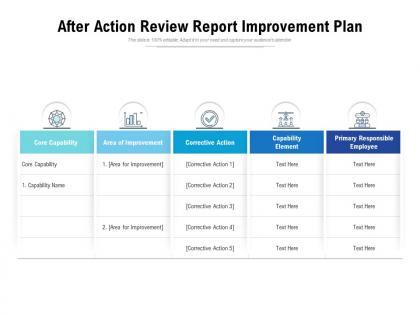
After action review report improvement plan




Try Before you Buy Download Free Sample Product
 Impress Your
 Audience
 100%
100% Editable
 Save Hours
 of Time


Activate the brains of children with our After Action Review Report Improvement Plan. They will bring out the genius in them.
People who downloaded this PowerPoint presentation also viewed the following :
After action review report improvement plan with all 2 slides:
Be good for the challenge with our After Action Review Report Improvement Plan. They allow you to accept the gauntlet.
FAQs for After action review
Honestly, it's pretty simple - figure out what worked, what bombed, and why. Don't just rush to the next project like everyone does. You want real takeaways your team can actually use, not some report that'll collect digital dust. Be brutally honest about wins AND failures so you can repeat the good stuff and dodge those same mistakes later. Oh, and do it within a week while people still remember what actually happened. Trust me on that timing thing - wait too long and everyone's memory gets fuzzy about the details that matter most.
So AARs are basically forcing your team to actually pause and figure out what just went down - good and bad. Most teams never do this because everyone's rushing to the next deadline, but it's honestly game-changing. You sit down for like 15 minutes after big projects and dig into what worked, what bombed, and why. The trick is making people feel safe to be real about mistakes. Otherwise you just get corporate BS answers. It builds up this shared knowledge over time so you're not making the same dumb errors repeatedly. Trust me, try it once and you'll see what I mean.
Honestly, the worst thing you can do is rush through them just to say you did it. People turn these into blame games where everyone gets defensive - total waste of time. Don't make them super formal either, nobody wants to sit through some 2-hour meeting. Oh, and actually follow up on what you learn! I've seen teams have the exact same discussion three months later because nothing changed. Keep it simple: what went wrong, why it happened, how to fix it next time. Skip the "who messed up" part entirely. Set aside real time for these and actually do something with the feedback.
Definitely need a good facilitator who won't let it drag on forever. I always make everyone go around the room - one win, one challenge each. Way better than waiting for volunteers because otherwise it's just the loudest people talking. Ask specific stuff like "what would you actually do different next time?" instead of those generic "how did we do?" questions. Oh and keep it focused on fixing things, not pointing fingers at who screwed up. The key thing though? Don't leave without real action items and someone's name attached to each one. Otherwise you'll just have the exact same problems next month.
Oh man, emotional intelligence is huge for AARs. People won't give you real feedback if they don't feel safe - they'll just nod along and say what they think you want to hear. You've gotta watch body language too. Someone getting defensive? Time to switch up your approach before they completely check out. The hardest part is honestly keeping your cool when people criticize stuff you did. Stay curious instead of getting all judgy - way easier said than done though. And don't pretend emotions aren't happening in the room, just acknowledge them when they pop up.
Honestly, digital tools make remote AARs so much easier. Miro or Mural are game-changers for mapping out wins and failures - way better than the sticky note chaos over Zoom. I always record sessions so people can catch up later and still contribute. Anonymous surveys beforehand help too, since people share stuff they'd never say out loud. Oh, and shared docs are clutch - everyone can type at once instead of awkward turn-taking. Don't overthink it though. Pick one tool first and see how it goes.
Honestly, I just focus on a few key things that actually matter. First - are people showing up and participating? Then I check if the action items we agreed on actually happen (spoiler: they often don't). The big one though is whether the same mistakes keep happening project after project. I'll survey people afterward too - did they think it was worth their time? Do they feel safe speaking up? Sometimes I track how fast we solve problems now versus before. But here's the thing - don't try measuring everything or you'll go crazy. Pick maybe 2-3 metrics max that your team cares about and stick with those.
Set clear ground rules from the start and actually stick to them. Make it obvious this is about learning, not pointing fingers - nobody gets punished for honest mistakes. Ask open questions and listen without cutting people off. Here's what really works: if you're leading it, admit your own screwups first. Trust me, it changes everything. Focus on what went wrong with processes instead of making it personal. Jump on any defensive BS right away though - that stuff spreads fast. Your team won't be real with you unless they know you've got their back later.
So basically, AARs happen right after stuff goes down while performance reviews are those scheduled meetings months later. Regular reviews are all about judging you individually - ratings, documentation, the whole nine yards. But AARs? Totally different energy. Everyone sits down together asking "what actually happened here and how do we not mess it up next time?" No blame game, just figuring out what worked and what didn't. Honestly, I way prefer AARs because nobody's getting graded. You're just talking through decisions as a team instead of defending yourself. Next time you wrap up a project, try doing a quick one - you'll notice how much more relaxed everyone is.
AARs work great in any industry, but you'll want to adjust them for your specific situation. Healthcare teams run them after patient cases or emergencies - they focus on protocols and communication gaps. Construction crews do them after project phases, looking at equipment issues and coordination problems. The basic questions are always the same (what worked, what didn't, why, what's next). Honestly though, the real win comes from tailoring the details to your field. Figure out where things typically go wrong in your industry and what success looks like. That's where you'll get the most out of these reviews.
AARs are legit game-changers. Military units analyze what went sideways on missions and completely rework their tactics - saves actual lives. Hospitals do something similar with those mortality conferences when things go wrong. Toyota basically built their whole improvement thing around this concept too. You'd be shocked what comes up when teams sit down for just 15 minutes after a project wraps. The trick is getting people comfortable enough to be real about their screwups - otherwise you're just wasting time. Even on smaller projects, weird patterns emerge that you totally missed in the moment.
Turn your AAR insights into actual tasks with owners and deadlines. Otherwise it's just another useless meeting, honestly. Break feedback into three buckets: quick fixes, process tweaks, and training stuff. Put everything in a shared tracker so people can't pretend they forgot. Here's what I've learned - stick to 2-3 action items max. When you try fixing everything at once, nothing gets done. Go for the easy wins first to get momentum rolling. The bigger systemic problems can wait a bit. Don't let perfect be the enemy of progress here.
For AAR facilitation, you'll want training in three main areas. Learn how to guide discussions without taking over - asking good questions while keeping things factual instead of turning into a blame game. Also get familiar with the actual AAR process and those four core questions everyone uses. Conflict resolution is huge too because honestly, people get pretty defensive when dissecting failures. Most companies run 1-2 day workshops covering this stuff. I'd definitely practice on smaller, less dramatic scenarios first. Nobody wants their first time facilitating to be some massive project meltdown where everyone's already on edge.
Do it after every big project, seriously. I used to skip these thinking they were a waste of time - huge mistake. Figure out what "big" means first though, like anything over X budget or timeline. Schedule it within 2-3 days max while people actually remember what went wrong (or right). Details disappear crazy fast otherwise. Short projects, long ones, doesn't matter. Honestly? Just put a recurring reminder on your calendar so you don't forget. Make it automatic. Once it's routine, your team won't even question it anymore.
Get your AAR written up within 48 hours - trust me on this one, details fade fast. Keep it simple: what worked, what sucked, and who's doing what by when. I've watched way too many teams write these epic novels that just collect dust. Make it visual if you can, but definitely keep it short. The real work starts after though. Check back at 30 and 90 days to see if people actually did their action items. Share it with whoever missed the meeting, maybe throw key stuff in your team wiki. Oh, and make sure someone's actually tracking the follow-through - otherwise it's just another meeting.
No Reviews