


Agile release train with program increment




Try Before you Buy Download Free Sample Product
 Impress Your
 Audience
 100%
100% Editable
 Save Hours
 of Time


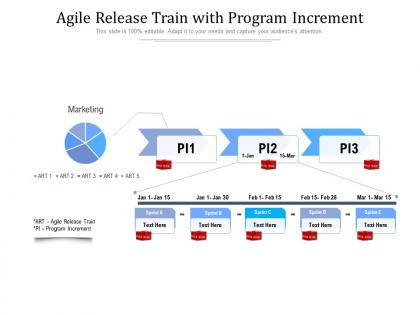
Agile Release Train With Program Increment is a useful tool to present PI planning. Provide information on executing program increment for agile release train. Take the assistance of the value stream PPT theme and showcase how the agile release train is executed. Illustrate the role of people involved in the agile team by utilizing our content-ready agile release train PPT template. Present the benefits of a cross-functional agile team with the help of this easy-to-use agile team PPT template. Utilize our modern-designed and attention-grabbing release train PowerPoint infographic to identify the steps of an operational value stream. Take advantage of the scaled agile framework PPT theme to mention the steps in value stream mapping. There are various high-grade icons present in the slideshow to make your presentation attention-grabbing and meaningful. Highlight value stream mapping by using this agile release train PPT visual. Steps to launch agile release train can also be depicted by downloading our visual attention-grabbing agile PPT template.
People who downloaded this PowerPoint presentation also viewed the following :
Agile release train with program increment with all 2 slides:
Give your audience a fulfilling experience. They will find our Agile Release Train With Program Increment elevating.
FAQs for Agile release train
So ART is all about getting teams on the same page first - shared goals, customer focus, that whole thing. Quality gets baked in from the start instead of scrambling to test everything later. PI planning is honestly where the magic happens, keeps everyone synced up every few months. Making progress visible to everyone matters too, so nobody's working in the dark. The execution part focuses on actually delivering stuff predictably. My take? Don't overthink it - just get your teams talking regularly and planning together. Once that rhythm clicks, everything else falls into place way easier.
Start by figuring out which teams should work together on actual value streams instead of keeping those old department walls up. Get everyone on the same 8-12 week rhythm - honestly, it's like herding cats at first but worth it. You'll need dedicated product owners and scrum masters for each team in your train. The PI Planning thing might feel like chaos the first time (ours definitely was), but just do it anyway. Way better than sitting in more planning meetings about planning meetings, if you know what I mean. That hands-on experience teaches you more than any playbook ever will.
So you've got the Release Train Engineer - they're basically the mega Scrum Master keeping all teams coordinated. Product Management owns the big picture stuff like vision and roadmaps. Then there's the System Architect making sure teams don't build things that completely break when integrated (trust me, this matters more than you'd think). Each team still has their usual Product Owners, Scrum Masters, and devs. The RTE runs PI planning and tackles blockers at scale. Product Management handles feature prioritization. My advice? Figure out who's doing what in your ART first. Makes collaboration way smoother when you actually know who to bug about different things.
So basically an ART gets everyone on the same schedule with regular ceremonies - like those PI Planning sessions where all the teams hash out dependencies together. You'll get way better visibility through shared backlogs and synchronized sprints. Those first planning sessions are honestly a bit of a mess, but teams start coordinating naturally once they actually understand what everyone else is working on. The system demos help too since teams show their integrated work regularly. It's all about that shared rhythm - when everyone's moving at the same pace, collaboration just happens instead of being forced. Start by syncing up your PI timelines first.
For ART performance, start with Miro or Mural for PI Planning - they're lifesavers for remote collab. Jira Align gives you that cross-team view you're missing. Don't skip inspect-and-adapt workshops, seriously. I learned that the hard way. System demos keep everyone on the same page, and dependency boards catch blockers before they wreck your sprint. Oh, and shared metrics across teams? Total game-changer. Use your retro data to actually fix stuff instead of just complaining about it. Start small with one tool though - don't try to implement everything at once.
So for ART metrics, I'd focus on velocity and predictability first - like, are teams actually hitting what they say they'll deliver each PI? Lead time matters too, from idea to shipped product. Don't forget defect rates and customer satisfaction scores. Quality stuff is honestly critical because shipping broken features just creates more work later. Team health is big - check employee engagement and what comes up in retros. You want that balance between moving fast and not burning people out. Start with maybe 3-4 metrics tops. Trust me, tracking too much just turns into analysis paralysis.
Honestly, executive buy-in is everything here - without it you're screwed from the start. Pick one value stream and get that working before you try scaling everywhere. The program increment planning stuff matters, but what really kills teams is not understanding how they depend on each other. Release Train Engineers and Product Managers need proper training since they're doing all the coordination work. Don't rush it either - I've seen so many companies skip the coaching support and then wonder why everything falls apart. Oh, and make sure these roles are actually dedicated people, not someone juggling five other things.
So PI planning is where your whole ART gets together every 8-12 weeks to hash out what's next. Two days of figuring out dependencies and calling out risks - honestly gets pretty chaotic but you end up with solid objectives everyone actually agrees on. The best part? Teams start talking through their blockers in real time instead of discovering them later when it's too late. Oh, and definitely prep your capacity numbers beforehand. You don't want to be that team scrambling to figure out what you can commit to while everyone's watching.
So here's the thing - ARTs basically force you into this constant improvement cycle. Every 8-12 weeks you're doing PI planning and retrospectives where teams actually stop and go "okay, what's broken?" The cross-team stuff is where the magic happens though - people are always bouncing ideas off each other and solving problems together. Those inspect and adapt workshops at the end of each PI? Pure gold for finding bottlenecks. I've watched teams completely flip how they work just from one of those sessions. Don't just show up and check out during retrospectives - that's honestly where the real improvements come from.
Don't try jamming too many teams together right off the bat - alignment has to come first. Cross-team communication needs way more investment than people think. ART ceremonies aren't just bigger Scrum meetings either, they serve totally different purposes. The cultural shift is honestly the hardest part. Teams used to working in silos will hate the interdependence at first. Your Product Management and System Architecture folks better be really solid because if they're weak, everything falls apart quickly. I've seen it happen. Start small with fewer teams and build up slowly instead of trying to do everything at once.
Don't make stakeholder engagement an afterthought - weave it right into your ART ceremonies. Get key stakeholders into PI planning so they see priorities and can weigh in on trade-offs. Demo sessions every iteration are honestly where you'll see the biggest wins because people react to actual working software, not boring status updates. Set up feedback loops through quick surveys or casual check-ins between PIs. Oh, and assign someone as the stakeholder liaison - relationships need tending. Start small though: pick your top 3 critical stakeholders and get monthly touchpoints scheduled this week.
So ARTs handle changing requirements pretty well actually. PI Planning happens every 8-12 weeks - that's when teams can totally pivot based on new priorities. You've also got backlog refinement sessions to tweak features as you go. Breaking features into small stories is clutch because you can swap stuff out without wrecking entire epics. Those PI boundaries work like natural checkpoints for feedback and market shifts. Oh, and inspect-and-adapt workshops help you course-correct when things aren't clicking. Honestly, PI Planning sessions are where the magic happens for managing changes. Don't sleep on those.
Honestly, start with the basics - get everyone trained on SAFe fundamentals or you'll be lost. PI Planning facilitation is huge, plus backlog refinement and getting teams to actually work together. The culture change is what'll kill you though, way harder than learning the mechanics. Your Product Owners and Scrum Masters need extra attention since they're basically running the show. Oh, and don't skip the coaching support during your first few PIs - trust me on that one. Leadership has to be on board first, then train everyone else. It's a lot but totally doable.
So ARTs basically get everyone on the same page every 8-12 weeks through Program Increments - way better than teams doing their own thing and trying to piece everything together later (spoiler: that never works). You'll see faster delivery because priorities and dependencies get sorted upfront. The feedback comes quicker too. Market shifts? You can actually pivot without losing months of work. Honestly, the predictable rhythm is huge - stakeholders aren't constantly asking "when will this be done?" Map your current timeline against PI schedules and you'll spot where you're gonna save time.
So adding DevOps to your ART will seriously speed up your delivery pipeline. No more painful handoffs between dev and ops - that alone is worth it. You'll catch bugs way earlier when they're actually cheap to fix, plus all the automation means your team stops doing mind-numbing manual stuff. Honestly, the collaboration piece from planning to production eliminates so many "works on my machine" disasters. I'd start by automating whatever manual process makes you want to scream, then expand from there. Much better than trying to boil the ocean right away.
No Reviews