

AI Powered Storytelling To Create Interactive Experiences Powerpoint Presentation Slides Ppt Example





Try Before you Buy Download Free Sample Product
 Impress Your
Audience
 100%
Editable
 Save Hours
of Time


Our comprehensive guide, AI-Powered Storytelling to Create Interactive Experiences, showcases how AI integration helps in content development, from generating ideas to creative personalized narratives that help enhance user engagement and business. This complete deck begins with analyzing current challenges in the storytelling market, such as lack of personalization, innovation, and adaptation. It emphasizes the need for businesses to integrate AI to craft compelling stories. Further, it presents steps for planning the integration, including goals, team, budget, and market preferences and trends analysis. This PPT further implements steps for generating AI-powered storytelling Narratives. It includes defining story elements, choosing right AI-powered storytelling tool, starting the storytelling process, collaborating with AI, iterative editing and refinement, and exporting and sharing the tales. At last, it measures the effectiveness of AI integration through customer engagement, ROI, and customer sentiment analysis. Download this PPT today to transform the traditional storytelling process and captivate the audience with new and engaging experiences.
People who downloaded this PowerPoint presentation also viewed the following :
Content of this Powerpoint Presentation
Slide 1: This slide showcase title AI-Powered Storytelling to Create Interactive Experiences. State Your Company Name.
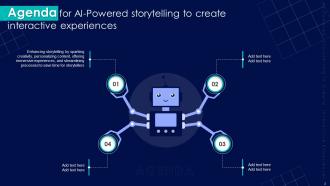
Slide 2: This slide showcase title AGENDA for AI-Powered Storytelling to Create Interactive Experiences
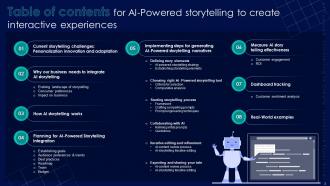
Slide 3: This slide exhibit Table of content.
Slide 4: This slide exhibit Table of content that is to be discuss further.
Slide 5: This slide showcases the major challenges faced by businesses in storytelling market.
Slide 6: This slide exhibit Table of content that is to be discuss further.
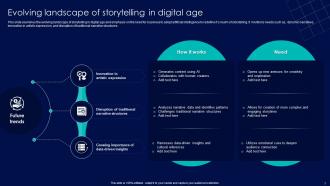
Slide 7: This slide examines the evolving landscape of storytelling in digital age and emphasis on the need for business to adopt artificial intelligence to redefine it’s realm of storytelling.
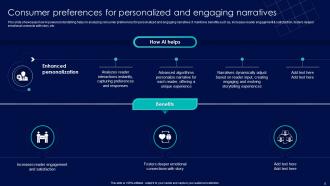
Slide 8: This slide showcases how AI powered storytelling helps in analyzing consumer preferences for personalized and engaging narratives.
Slide 9: This slide showcases the potential impact of AI in enhancing storytelling for business objectives, such as marketing, brand engagement, and customer experience.
Slide 10: This slide exhibit Table of content that is to be discuss further.
Slide 11: This slide explains the underlying working mechanisms of AI-powered storytelling.
Slide 12: This slide exhibit Table of content that is to be discuss further.
Slide 13: This slide helps in identifying storytelling goals and objectives aligned with business strategies.
Slide 14: This slide conducts market research to understand audience preferences and trends around storytelling.
Slide 15: This slide presents practices for crafting a compelling AI story involves weaving together various elements to engage the audience and convey the message effectively.
Slide 16: This slide presents a timeline highlighting strategic steps for developing AI-powered stories.
Slide 17: This slide map outs internal content marketing team structure, highlighting who will be handling all of the different aspects of publishing great content.
Slide 18: This slide allocates the budget for implementing steps for generating AI-powered storytelling narratives.
Slide 19: This slide exhibit Table of content that is to be discuss further.
Slide 20: This slide presents an AI-powered storytelling strategy a critical step that shapes the entire narrative.
Slide 21: This slide presents seven elements of effective story-telling that helps in engaging audience.
Slide 22: This slide exhibit Table of content that is to be discuss further.
Slide 23: This slide presents a strategy to help make informed decision, when selecting right AI-powered tool.
Slide 24: This slide compares four major AI-story telling tools such as open AI GPT 4, Novel AI, storywizard.ai to helps select the one that best suits organization needs.
Slide 25: This slide exhibit Table of content that is to be discuss further.
Slide 26: This slide present strategies to input initial parameters and provide AI with the framework to generate effective storyline.
Slide 27: This slide presents strategic actions to create an engaging and specific prompt that guides the AI while allowing for creative freedom in storytelling.
Slide 28: This slide presents prompt engineering techniques to refine AI storytelling.
Slide 29: This slide exhibit Table of content that is to be discuss further.
Slide 30: This slide showcases key actions of an iterative process that help review the ai-generated content, provide feedback, and refine the story together.
Slide 31: This slide presents a checklist for harnessing AI powered storytelling guidelines in a way, narratives can be improved, making them more complex.
Slide 32: This slide exhibit Table of content that is to be discuss further.
Slide 33: This slide presents steps to establish a robust ai-generated content review process.
Slide 34: This slide presents steps for iterative editing and refinement essential step in AI powered storytelling, ensuring that the narrative is polished and cohesive.
Slide 35: This slide exhibit Table of content that is to be discuss further.
Slide 36: This slide showcases appropriate story-telling format that aligns with sharing platform.
Slide 37: This slide presents various types of sharing platforms to reach target audience.
Slide 38: This slide exhibit Table of content that is to be discuss further.
Slide 39: This slide analyses the improvement in content engagement metrics after integration of AI-powered storytelling.
Slide 40: This slide analyses the return on investment of integrating AI-storytelling in organization.
Slide 41: This slide exhibit Table of content that is to be discuss further.
Slide 42: This slide presents a dashboard to measure sentiment analysis and determine customer intentions & attributes.
Slide 43: This slide exhibit Table of content that is to be discuss further.
Slide 44: This slide presents case-studies of real world applications of AI story telling strategies implemented by various organizations.
Slide 45: This slide exhibit Table of content that is to be discuss further.
Slide 46: This slide is titled as Additional Slides for moving forward.
Slide 47: This slide showcases Magnifying Glass to highlight, minute details, information, specifications etc.
Slide 48: This slide contains Puzzle with related icons and text.
Slide 49: This slide shows Post It Notes for reminders and deadlines. Post your important notes here.
Slide 50: This is a Timeline slide. Show data related to time intervals here.
Slide 51: This is Our Vision, Mission & Goal slide. Post your Visions, Missions, and Goals here.
Slide 52: This slide displays Mind Map with related imagery.
Slide 53: This is a Thank You slide with address, contact numbers and email address.
AI Powered Storytelling To Create Interactive Experiences Powerpoint Presentation Slides Ppt Example with all 61 slides:
Use our AI Powered Storytelling To Create Interactive Experiences Powerpoint Presentation Slides Ppt Example to effectively help you save your valuable time. They are readymade to fit into any presentation structure.












FAQs for AI Powered Storytelling To Create Interactive Experiences Powerpoint Presentation
Honestly, it's still the same storytelling basics - character development, solid structure, emotional stuff that hits. AI's pretty good at keeping track of complex plots and world-building details without losing the thread. Sometimes it goes completely sideways (which can actually be brilliant). I'd give your AI really clear character motivations and story goals from the start. That helps a ton. Oh, and definitely edit everything - think of it more like a writing buddy than doing all the work for you. The key is not letting it ramble into weird territory unless that's what you want.
So basically AI stories work because they adapt to what your audience actually wants in real-time. You can test different endings, switch up the tone mid-story, or even weave in user data to make characters feel more personal. The cool part? You'll never hit writer's block like us humans do. Scale is where it gets interesting though - imagine A/B testing thousands of story variations across different audience groups. I'd start simple, maybe just try AI-generated character descriptions or alternate endings first, then track which ones get people more engaged. Way easier than writing everything from scratch.
So AI basically watches everything you do - your reading history, where you pause or skip ahead, ratings you give. Pretty neat how it catches subtle stuff too, like whether you're into fast-paced action or slower character development. It notices if you bail on descriptive paragraphs but stay glued to dialogue scenes. Honestly, the more variety you give it in terms of what you like, the better it gets at nailing your vibe. Though sometimes I wonder if it knows my preferences better than I do at this point!
So AI is totally changing how we tell stories now. You can create these branching narratives where readers actually influence what happens next - it's pretty cool stuff. The tech moves crazy fast too. Instead of writing one story for everyone, you can generate different versions that adapt to whoever's reading. Plus you can track what hits different with various groups and adjust your style. Honestly, the whole shift from static to dynamic storytelling is kind of mind-blowing. Definitely mess around with some AI writing tools to see how they'd work with your projects.
Look, the whole AI storytelling thing is tricky right now. First off - just tell people when you've used AI help. Readers have a right to know, and honestly it builds trust. The scarier problem is bias though. These models learn from whatever data they're fed, so they can spit out some pretty problematic stereotypes if you're not careful. Also don't let it copy specific authors' styles too closely - that's getting into sketchy legal territory. I feel like we're all figuring this out as we go, but definitely review everything before you publish. Some of the output can be... yikes.
So basically you feed the AI info about your target audience - age, background, that stuff - and it'll automatically tweak character names, cultural references, even how complex the language gets. Pretty cool actually. You can also train it on stories that worked well for different groups to spot patterns. Though honestly, don't expect it to be perfect right away - I'd definitely test a few versions first. The trick is being super specific about who you're writing for upfront. Way better than guessing what'll resonate.
So basically, ML trains on tons of existing stories to figure out how plots usually work. It picks up on patterns like the hero's journey and how characters develop over time. Pretty crazy how it catches those subtle narrative flows, honestly. The algorithms learn which story beats typically follow others and keep themes consistent throughout. Oh, and cause-and-effect stuff between events too - that's huge for coherence. If you're building storytelling AI, just feed it diverse, well-structured narratives. Better training data = way better story flow. Trust me on this one.
Oh totally! AI can nail emotionally complex characters if you dig into the psychological stuff. Instead of just describing how they look, ask things like "what's their biggest fear?" or "what lie do they keep telling themselves?" I've been blown away by some AI characters recently - way more depth than I expected. Give them contradictions and messy backstories. The AI's actually really good at keeping those emotional threads consistent once you establish them. Honestly, start with one major character flaw and let everything else branch out from there. Works every time.
So NLP is what helps AI actually get how language works - you know, grammar, context, when something's supposed to be funny or sad. Without it? Your stories would sound super robotic. But good NLP means the AI can spot storytelling patterns and keep characters consistent. It learns from tons of well-written stuff to figure out natural dialogue and smooth plot flow. Honestly, the difference is huge. When you're picking AI writing tools, definitely check if they mention their NLP tech - it's worth asking about.
Ugh, AI just loves recycling the same tired plots it's seen a million times. You'll get another "chosen one saves the world" story because that's what feels safe to the model. Super annoying, right? What works for me is getting really specific with prompts - like weirdly specific. Push it toward stuff it hasn't done before by mixing random genres together or throwing in strict rules that force it to think differently. The constraints thing actually works better than you'd think. Just don't let it fall back on familiar territory.
So I've been playing around with AI storytelling lately and it's pretty solid for making personalized content without losing your mind. Pick one campaign first - maybe email or social posts. The AI can spin your brand story different ways for different audiences, which saves tons of time honestly. Customer journeys, product backstories, testimonials that actually match who's reading them. I'm still testing it against my regular stuff to see what works better, but the interactive website thing is where it gets interesting - stories that change based on what people click on. Worth trying if you're drowning in content requests.
Netflix's recommendation system is insane - it doesn't just suggest shows, it actually creates personalized little stories about why you'd love them. Same thing with Spotify Wrapped. Everyone goes nuts sharing those year-end stories about their music taste. The AP uses AI for thousands of earnings reports and sports stuff, which sounds super boring but whatever - frees up real writers for better work. Oh, and if you're thinking about trying this yourself, start small. Maybe use AI to write different versions of the same story for different audiences? That's probably the easiest way to test it out.
Oh man, this is huge actually. AI basically learns from whatever stories it's fed, right? So if most training data comes from Western sources, you'll get those typical three-act structures and lone hero narratives. But tons of cultures do storytelling completely differently - like circular plots or focusing on the community instead of one person. What's funny in Japan might bomb in Brazil. Same with endings people find satisfying. I'd definitely test your AI tools with diverse audiences before launching, and try to include stories from all over when you're training it. Otherwise you risk creating something that only clicks with one specific group.
Honestly, AI storytelling is a game changer for making content accessible. You don't need to be some amazing writer anymore - it'll help translate stuff, break down complex stories into simpler language, and even create audio descriptions. The speed is ridiculous too. Language barriers? Not really an issue when AI can adapt your content for different audiences. Oh, and it generates captions automatically which is clutch. Best part is you're not dropping tons of money on a whole team. I'd say pick whatever accessibility thing your audience struggles with most and start there.
So feedback loops are how your AI figures out what's actually working with readers. Users rate stories, point out plot holes, mark their favorite parts - then the system tweaks its approach based on that data. It's honestly like having a writing group that never gets tired of giving notes, just way faster. The AI picks up on patterns about what clicks with different audiences and adjusts storytelling style, pacing, themes, all that stuff. I'd start with basic rating systems first - don't overcomplicate it right away. You can always add more detailed feedback collection later once you see what kind of responses you're getting.
-
Thanks to SlideTeam, we have an ideal template to present all the info we need to cover. Their slides give our numbers and projections a more clear and enchanting look.
-
SlideTeam is my go-to resource for professional PPT templates. They have an exhaustive library, giving you the option to download the best slide!