

Aims And Objectives Relevant Business Plan Planning Process Requirement





Try Before you Buy Download Free Sample Product
 Impress Your
 Audience
 100%
100% Editable
 Save Hours
 of Time


Use our Aims And Objectives Relevant Business Plan Planning Process Requirement to effectively help you save your valuable time. They are readymade to fit into any presentation structure.
People who downloaded this PowerPoint presentation also viewed the following :
Aims And Objectives Relevant Business Plan Planning Process Requirement with all 18 slides:
Our Aims And Objectives Relevant Business Plan Planning Process Requirement provide you with a vast range of viable options. Select the appropriate ones and just fill in your text.


FAQs for Aims And Objectives Relevant Business Plan
Key components of a business plan objective include specific goals, measurable outcomes, realistic timelines, target markets, and resource requirements. These elements work together by providing clear direction for strategic decision-making, enabling stakeholders to track progress effectively, and ultimately delivering focused execution that drives sustainable growth, with many organizations finding that well-defined objectives significantly enhance operational efficiency and competitive positioning.
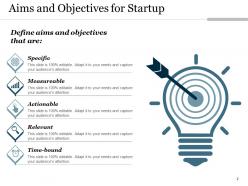
SMART criteria ensure business plan objectives are specific in scope, measurable through clear metrics, achievable with available resources, relevant to strategic goals, and time-bound with defined deadlines. These frameworks help organizations establish concrete milestones, track progress effectively, and maintain accountability, with many companies finding that SMART objectives significantly enhance execution success and strategic alignment.
Market research informs business plan objectives by identifying customer needs, analyzing competitor strategies, validating market demand, and revealing industry trends and opportunities. Through comprehensive market analysis, businesses can set realistic revenue targets, define precise customer segments, and establish competitive positioning strategies, ultimately ensuring their objectives align with actual market conditions and deliver sustainable growth.
Financial forecasts provide the quantitative foundation for setting realistic, measurable business plan objectives by projecting revenue growth, expense management, and profitability timelines. These projections enable organizations to establish specific milestones, allocate resources strategically, and set achievable targets for market expansion, with many companies finding that data-driven objectives significantly enhance investor confidence and operational planning.
Startups should focus on flexible, growth-oriented objectives like market validation, customer acquisition, and funding milestones, while established companies typically emphasize optimization, market expansion, and operational efficiency. Through agile planning approaches, startups can pivot quickly based on market feedback and resource constraints, while established firms leverage existing infrastructure and customer bases to pursue strategic diversification, ultimately delivering sustainable competitive advantage in their respective market positions.
Business plan objectives evolve through market shifts, competitive pressures, technological advances, customer feedback, and internal growth milestones. Companies regularly reassess their strategic priorities, with many finding that quarterly reviews enable them to pivot toward emerging opportunities, adjust resource allocation, and maintain competitive advantage in increasingly dynamic business environments.
Non-profit business plan objectives focus on mission fulfillment, community impact, donor engagement, and sustainable funding sources, while for-profit organizations prioritize revenue growth, market share expansion, and shareholder returns. While both require strategic planning and resource allocation, non-profits emphasize social outcomes and stakeholder stewardship, whereas for-profit entities concentrate on profitability and competitive advantage, ultimately delivering different value propositions to their respective constituencies.
Common pitfalls include setting unrealistic timelines, lacking specific measurable metrics, ignoring market constraints, overlooking resource limitations, and creating objectives without stakeholder input. These challenges can derail strategic planning efforts, with many organizations finding that overly ambitious goals without proper market research and financial backing ultimately undermine execution and team morale.
Companies can align business plan objectives with their mission and vision by establishing measurable goals that directly support their core purpose, integrating values-based decision-making frameworks, and creating accountability structures that connect daily operations to strategic aspirations. This strategic alignment enables organizations across industries, from healthcare systems to retail chains, to maintain consistent direction while adapting to market changes, ultimately delivering enhanced stakeholder value and sustainable competitive advantage.
Key performance indicators include revenue growth, profit margins, market share expansion, customer acquisition costs, and operational efficiency ratios. These metrics enable organizations to track progress systematically, with many financial services and retail companies finding that combining quantitative measures with customer satisfaction scores ultimately delivers comprehensive insights into strategic goal achievement and competitive positioning.
Stakeholder input is crucial for developing realistic, achievable business plan objectives, as it provides diverse perspectives on market conditions, operational constraints, customer needs, and resource availability. Through collaborative planning sessions, organizations gather insights from employees, customers, investors, and partners, ultimately creating more comprehensive objectives that align with stakeholder expectations and enhance buy-in across all levels.
Competitive analysis and industry trends significantly shape business plan objectives by revealing market opportunities, identifying differentiation strategies, and highlighting operational requirements for sustainable growth. These insights enable organizations to set realistic revenue targets, develop strategic positioning approaches, and allocate resources effectively, with many businesses finding that trend-aligned objectives deliver enhanced market penetration and competitive advantage.
Short-term business plan objectives include increasing monthly sales by 15%, reducing operational costs, launching new products, expanding customer base, and improving employee productivity within 6-12 months. Long-term objectives focus on market expansion, strategic partnerships, technology integration, and sustainable competitive advantage over 3-5 years, with many organizations finding that aligning these timeframes enables systematic growth while maintaining operational efficiency.
Technology and innovation significantly enhance business plan objectives by streamlining operations, accelerating market entry, and enabling data-driven decision making across all strategic initiatives. Through automation and advanced analytics, organizations can reduce costs, improve customer experiences, and scale more efficiently, with many companies finding that strategic technology integration delivers measurable competitive advantages and faster goal achievement.
Best practices for communicating business plan objectives include clear visual presentations, regular progress updates, stakeholder-specific messaging, interactive workshops, and documented milestones with timelines. These approaches enhance transparency and alignment by ensuring executives understand strategic priorities, investors grasp financial projections, and employees connect daily tasks to broader goals, ultimately delivering stronger buy-in and organizational coherence.
No Reviews