


Competitive Analysis Matrix Of Food Manufacturing Company




Try Before you Buy Download Free Sample Product
 Impress Your
 Audience
 100%
100% Editable
 Save Hours
 of Time


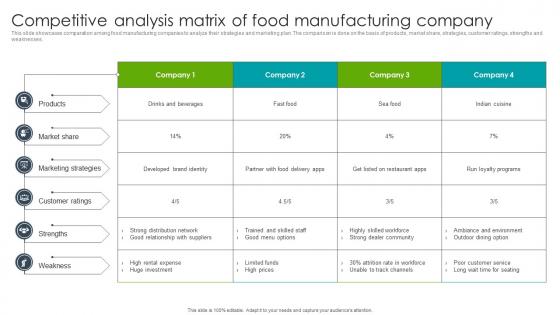
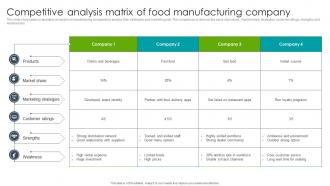
This slide showcases comparation among food manufacturing companies to analyze their strategies and marketing plan. The comparison is done on the basis of products, market share, strategies, customer ratings, strengths and weaknesses.
People who downloaded this PowerPoint presentation also viewed the following :
Competitive Analysis Matrix Of Food Manufacturing Company with all 6 slides:
Use our Competitive Analysis Matrix Of Food Manufacturing Company to effectively help you save your valuable time. They are readymade to fit into any presentation structure.





FAQs for Competitive Analysis Matrix Of
Key components of a competitive analysis matrix include competitor profiles, product features, pricing strategies, market positioning, strengths and weaknesses, and performance metrics. These elements can be effectively organized through strategic categorization by market segments, feature comparisons, and performance indicators, with many businesses finding that this structured approach streamlines decision-making and enhances competitive positioning.
Businesses can identify relevant competitors by analyzing direct rivals offering similar products, indirect competitors targeting the same customer needs, emerging market entrants, and substitute solutions. Through market research, customer surveys, and industry reports, companies can map competitive landscapes across price points, geographic regions, and customer segments, ultimately ensuring comprehensive analysis that captures both obvious threats and unexpected disruptions in their strategic positioning.
Visual representation transforms competitive analysis matrices by enabling rapid pattern recognition, clear performance comparisons, and instant identification of market gaps through color coding, charts, and intuitive layouts. These visual elements streamline strategic decision-making by making complex competitive data immediately accessible to stakeholders across departments, ultimately delivering faster market insights and enhanced competitive positioning in increasingly data-driven business environments.
A competitive analysis matrix should be updated quarterly in rapidly changing markets, with monthly reviews for critical competitors and weekly monitoring of key performance indicators, pricing changes, and product launches. Many organizations find that combining automated competitor tracking tools with scheduled deep-dive assessments enables faster strategic responses, ultimately delivering sustained competitive advantage through timely market intelligence and proactive positioning adjustments.
Common pitfalls include relying on outdated data, analyzing too many competitors simultaneously, focusing solely on direct competitors while ignoring indirect threats, and creating overly complex matrices that obscure key insights. Organizations often overlook emerging market players or niche competitors, ultimately missing strategic opportunities, with many businesses finding that regular matrix updates and focused competitor selection deliver more actionable competitive intelligence.
A competitive analysis matrix enhances strategic planning by systematically comparing competitor strengths, weaknesses, market positioning, pricing strategies, and customer segments against your own capabilities. This structured approach enables organizations to identify market gaps, benchmark performance metrics, and uncover differentiation opportunities, with many companies finding that regular competitive mapping ultimately delivers more informed resource allocation and accelerated strategic decision-making processes.
Useful metrics for competitive analysis matrices include market share, pricing strategies, product features, customer satisfaction scores, and digital presence strength. These metrics enable organizations to benchmark performance across key business areas like revenue growth, customer acquisition costs, and service delivery speed, with many companies finding that combining financial and operational indicators delivers the most comprehensive competitive insights.
A competitive analysis matrix focuses externally on comparing your business against specific competitors across defined criteria, while SWOT analysis examines internal strengths and weaknesses alongside external opportunities and threats. When used together, the competitive matrix identifies market positioning and competitor gaps, while SWOT provides strategic context for leveraging internal capabilities, with many organizations finding this combination delivers comprehensive competitive intelligence and clearer strategic direction.
Tools for competitive analysis matrices include Excel, Google Sheets, Airtable, Notion, Tableau, and specialized platforms like Crayon or Klipfolio. These solutions streamline data collection, visualization, and real-time updates by automating competitor tracking, integrating multiple data sources, and enabling collaborative analysis, with many organizations finding that cloud-based platforms deliver enhanced accessibility and strategic insights.
Qualitative data like customer reviews can be integrated through sentiment analysis scores, feature satisfaction ratings, brand perception metrics, and pain point identification across competitor offerings. Banks and retail companies increasingly use text analytics to convert review themes into quantifiable matrix elements, enabling strategic positioning decisions while delivering deeper market insights and competitive advantages.
**INPUT**: What format should be used for presenting a competitive analysis matrix to stakeholders for maximum impact? **OUTPUT**: Present competitive analysis matrices through visual formats like color-coded comparison tables, interactive dashboards, and executive summary slides with key insights highlighted prominently. These presentations deliver maximum impact by combining detailed spreadsheet data with visual storytelling, clear competitive positioning charts, and actionable recommendations, ultimately enabling stakeholders to quickly identify market opportunities and strategic advantages.
A competitive analysis matrix reveals market gaps by systematically comparing competitors across product features, pricing strategies, target segments, and service offerings, highlighting areas where no competitor excels. Through this strategic mapping, businesses identify underserved customer needs, pricing optimization opportunities, and feature innovations that differentiate their offerings, ultimately delivering competitive advantage and accelerated market positioning.
Best practices for competitor research include identifying direct and indirect competitors, analyzing their pricing strategies, product offerings, market positioning, and customer feedback across multiple channels. Through systematic data collection from websites, social media, industry reports, and customer reviews, organizations can gather comprehensive insights about competitive strengths, weaknesses, and market gaps, ultimately delivering strategic intelligence that enhances positioning and reveals untapped opportunities.
Startups can leverage competitive analysis matrices by focusing on publicly available data, social media insights, customer reviews, and basic website analysis to identify key competitors and positioning gaps. While resource constraints limit deep research, this strategic approach enables startups to uncover market opportunities, refine their value propositions, and make informed decisions that maximize their competitive advantage in targeted market segments.
A competitive analysis matrix informs marketing strategies by identifying market gaps, competitor weaknesses, pricing opportunities, and differentiation points that guide positioning decisions. Through systematic comparison of features, messaging, and market presence, businesses can craft targeted campaigns, develop unique value propositions, and strategically position offerings where competitors are weakest, ultimately delivering stronger market penetration and competitive advantage.
-
Enough space for editing and adding your own content.
-
Mesmerized with the fantastic collection! Super sleek, relevant infographics.