

Analysis of nist cyber security framework





Try Before you Buy Download Free Sample Product
 Impress Your
Audience
 100%
Editable
 Save Hours
of Time


The National Institute of Standards and Technology's (NIST) Cybersecurity Framework provides recommendations to private sector firms that own, operate, or provide critical infrastructure. It gives a fair level of cyber protection as a starting point. It establishes fundamental cybersecurity processes and controls. Organizations may use the framework to better analyse, structure, manage, and mitigate cybersecurity risks. Cybersecurity breaches can result in significant financial losses, reputational damage, or disruptions that can permanently harm a company's market position. The framework defines tiers that describe the level of implementation of the requirements. The categories are frequently referred to as maturity levels, although they are more of a tool for internal communication between cybersecurity risk management and operational risk management, according to NIST, and should not be considered such. The cyber security PowerPoint templates from SlideTeam give you all the information you need to create an in-depth presentation on Analysis of nist cyber security framework. With easy to use slides, stunning graphics, and a variety of color themes, our templates make it easy for you to get started creating a presentation that will educate your audience on this important topic. Download our templates now and see how easy it is to create a high-quality presentation that will help your viewers understand the complexities of the cyber security landscape.
People who downloaded this PowerPoint presentation also viewed the following :
Content of this Powerpoint Presentation
“If it’s known, it's manageable. If it’s well known, it’s actionable.” -Bradley B Dalina, a cybersecurity expert.
Have you just started with a cyber security program?
OR
Are you running a fairly mature cyber security program?
In both cases, all you need to tighten your cyber security game is the NIST CSF. Wanna know in details? Let’s delve deep!
NIST CSF is a cyber security framework that was drafted by the National Institute of Standards and Technology to address the lack of standards in cyber security. It is considered the gold standard when it comes to setting a cybersecurity program and has covered rules and guidelines for organisations to use in the cybersecurity industry. Using the framework will help you assess the cybersecurity risk across your organisation by acting as a high-end security management tool.
Our template on the analysis of NIST cybersecurity framework is 100% ready to use and customisable so that you can add texts pertaining to critical data of your organisation. The framework will help you understand what processes and assets would need protection and help identify them. It will help adopt safety measures to protect those assets. The next step includes the detection of the occurrence of potential cybersecurity incidents. Also, it’s going to help you to develop techniques to respond to those incidents and lastly, in case of any damage caused to the system due to a cybersecurity incident, it will help to recover and retire the capabilities and services.
Know more about the benefits of NIST cybersecurity framework with our template on major-benefits-of-nist-cybersecurity-framework
Template: Analysis of NIST Cyber Security Framework
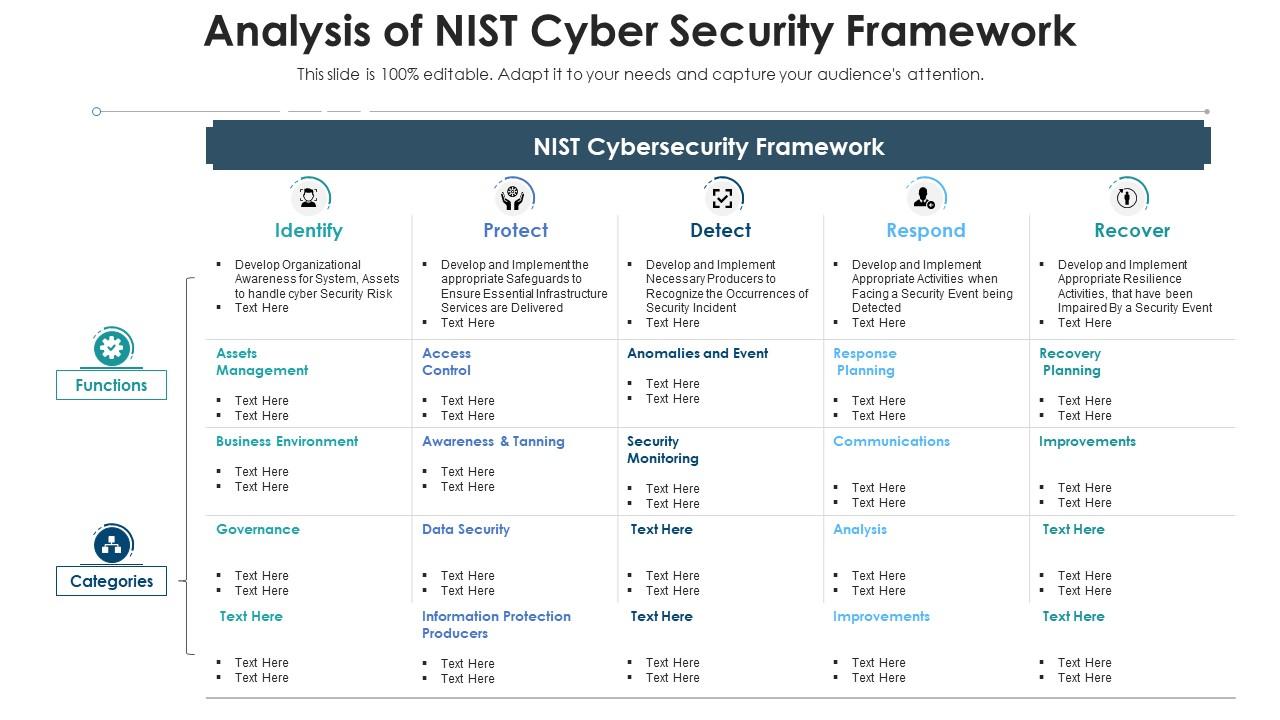
For effective functioning of the cyber security program, you need to first do the groundwork and that’s the application of this NIST Cybersecurity framework. The framework categorises the cybersecurity program into five core functions viz., identify, protect, detect, respond and recover. In Step 1, the framework helps to identify potential threats and develop organisational awareness for systems and assets in order to handle cybersecurity risks. It includes asset management, management of the business environment and management of the governance. The second step of the framework is the protection and safeguarding of essential services like access control, awareness training, data security and information protection procedures. The third step deals with the detection of the occurrences of the security incident and implementation of necessary procedures like anomalies and events, security monitoring, etc. The fourth step involves responding to the detected security events. It involves response planning, communications, analysing and improvements. The last and the fifth step ensures that you can recover data and activities that have been impaired by a security event. It includes processes like recovery planning and improvements. Download our template now and ace the cybersecurity system of your organisation!
Go for Best-Practices
Implementing the NIST cybersecurity framework will give your business the idea of the best practices to be developed for your cybersecurity project thus helping you improve and organise your cybersecurity operations.
PS: If you are facing a problem with choosing the right security controls, this template on nist-framework-process-for-security-control-selection will help you with the processes.
Analysis of nist cyber security framework with all 2 slides:
Use our Analysis Of NIST Cyber Security Framework to effectively help you save your valuable time. They are readymade to fit into any presentation structure.


FAQs for Analysis of nist
So NIST basically has five main parts: Identify, Protect, Detect, Respond, and Recover. You identify what assets and risks you've got, then protect them with whatever safeguards make sense. When something does go wrong (and it will), you detect it fast, respond to limit the damage, then get everything back up and running. It's actually pretty straightforward - way less complicated than people make it sound. Each part breaks down into more detailed stuff you can actually do. I'd honestly just figure out where you are now in each area first. That'll show you what needs work.
So the NIST thing doesn't replace what you've got - it just sits on top. Map your current stuff to those five buckets (Identify, Protect, Detect, Respond, Recover) and you'll see where the holes are. Works with whatever framework you're already dealing with, ISO or COBIT or whatever. Honestly, the best part is just having everyone speak the same language about risk - makes those exec conversations way easier. I'd start with a quick assessment, see where your practices fit, then treat it like your to-do list for patching gaps.
Banks, hospitals, power companies - they're the ones getting the most value from NIST frameworks. Heavy regulation means they need something auditors already know and trust. Manufacturing's jumped on board too since everything's connected now (which honestly scares me a bit). Any company dealing with sensitive data should consider it, but regulated industries? It's practically a no-brainer. You'll want to map your current security against those five core functions first. Shows you exactly what's missing. Oh, and healthcare especially loves it since one breach can destroy patient trust forever.
So NIST basically breaks cybersecurity into five buckets - Identify, Protect, Detect, Respond, Recover. You audit your current setup against their subcategories to find gaps. Think of it as a report card for your security posture, which honestly beats flying blind. What I dig about it is they don't push specific tools on you - just show you what capabilities you should have. Quick heads up though, their subcategories can get pretty granular if you really dive in. Start with their online self-assessment tool to see where you stand. It'll give you a baseline so you know what to tackle first.
Look, most companies bite off way more than they can chew with NIST. They want everything perfect immediately instead of just picking one area to focus on first. Leadership usually doesn't get why it matters, plus there's never enough budget or people who actually know cybersecurity. The real pain comes from trying to match what you're already doing to their categories and functions - it's honestly just boring paperwork more than anything complex. I'd say start with the "Identify" function and see how that goes. Way better than trying to tackle the whole thing at once and burning everyone out.
Jump into NIST's "Identify" function first - it's basically just figuring out what actually matters to your business. Customer data, financial stuff, you know the drill. Don't try tackling everything because honestly? You'll burn out fast. The framework's pretty flexible, so you don't need some crazy expensive enterprise setup. Basic employee training and regular backups will get you way further than you'd think. Treat it like a roadmap but pick controls that won't break the bank. Document whatever you're doing (even if it's messy at first), then expand as you grow. Small steps beat no steps.
So the NIST Framework is actually pretty smart - it gives you this structured approach that works with basically any regulatory stuff you're dealing with. Map your current compliance controls (HIPAA, SOX, whatever) to those five functions: Identify, Protect, Detect, Respond, Recover. Honestly saves you from doing the same work twice across different programs. I mean, who has time for that? Auditors love it too because they can see everything laid out clearly. First step is just writing down which regulations apply to you, then show how your existing controls hit multiple requirements. Makes your life way easier.
So risk management is like the backbone of the whole NIST thing. Before you dive into those five functions (Identify, Protect, Detect, etc.), you've gotta figure out what assets actually matter and what threats you're dealing with. Think of it like budgeting but for security - what can your business actually handle losing? I learned this the hard way at my last job when we just bought random security tools without thinking it through. The framework helps you spend money on stuff that actually reduces business risk instead of just cool-looking dashboards. Do a real risk assessment first, trust me on this one.
So there are definitely some solid metrics you can track - incident response times, how fast you detect/recover from stuff, and what percentage of security controls you've got running across those five NIST functions. Employee training completion rates matter too, plus how quickly you're patching vulnerabilities. Honestly though? Start small. Pick like 3-4 metrics that match your biggest headaches first. I made the mistake of trying to measure everything at once and it was a nightmare. Get your baseline with those few metrics, then add more later once you've got a rhythm going.
NIST is finally getting their act together with more frequent updates instead of those painfully slow multi-year gaps. Ransomware and supply chain stuff pushed them to move faster - plus they added way more detailed subcategories for third-party risks and recovery planning. Real-world breaches are actually shaping the updates now, which makes sense. The language is clearer too, thank god. Oh and IoT vulnerabilities get proper coverage now. If you're still using an older version, definitely check their site every few months rather than assuming you're covered.
Yeah definitely! NIST works fine in the cloud, just gotta tweak your approach. Map those five functions to your setup but focus hard on shared responsibility - like what you handle vs what Amazon does. Their diagrams are honestly terrible lol. Identity management and encryption are huge. Also monitoring gets weird when you're spread across different services. I'd start with inventorying your cloud assets first, then work through each function one by one. The detect/respond parts can get tricky since you're not controlling the underlying infrastructure, but it's totally doable.
So NIST is way more flexible - you get those five functions (Identify, Protect, Detect, Respond, Recover) and just adapt them however works for your company. ISO 27001 though? Total opposite. It's super rigid with specific hoops you have to jump through for certification. NIST won't cost you anything and was built for critical infrastructure stuff. ISO costs money but covers broader security management. Honestly, I'd go NIST first if you want room to breathe, but if your boss needs that shiny certification to show off, then ISO's your answer.
Honestly, don't let IT handle all the cyber stuff alone - that's setting yourself up to fail. Map your training to NIST's five areas: identifying threats, protecting systems, detecting problems, responding to breaches, and getting back online. Most companies just check boxes here which drives me crazy. Run simulations instead. Share actual threat info with your teams. When someone reports sketchy activity, celebrate it rather than making them feel stupid. Oh, and definitely bring security talks into regular meetings - tie it to performance reviews too. People need to see how their daily work connects to real cyber risks.
So here's the thing about NIST compliance - continuous monitoring isn't optional. You can't just check your security once and forget about it. It's like... imagine only checking your bank account once a year, you know? Bad idea. The whole "Detect" function depends on you constantly watching what's happening. Regular reviews and automated tools are pretty much mandatory if you want to catch problems before they blow up. I learned this the hard way at my last job actually. Without ongoing visibility into your controls, you're basically guessing whether stuff works. Set up those monitoring cycles early.
Start with the Framework Profile - map what you've got now against what you actually need. Consider your business priorities, risk tolerance, all that regulatory stuff. NIST isn't prescriptive, which is honestly pretty great. Pick the subcategories that matter most. Finance companies might go heavy on "Detect" functions, healthcare usually focuses on "Recovery" since downtime is deadly. Create target profiles for where you want to end up. But here's the thing - don't try doing everything at once. I've seen that backfire. Prioritize your biggest risks first and work within whatever resources you've got.
-
The content is very helpful from business point of view.
-
Thanks for all your great templates they have saved me lots of time and accelerate my presentations. Great product, keep them up!
-
Out of the box and creative design.
-
Perfect template with attractive color combination.
-
Best way of representation of the topic.
-
Unique design & color.
-
The content is very helpful from business point of view.
-
Nice and innovative design.
-
Great designs, really helpful.
-
Easy to edit slides with easy to understand instructions.
-
Page:
- You're currently reading page 1
- Page 2
-
