

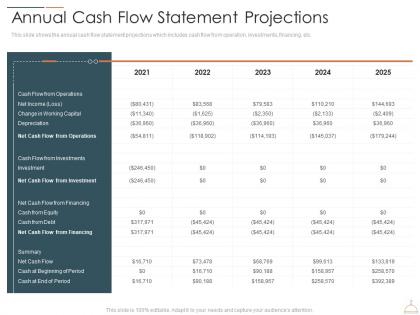
Annual cash flow statement projections restaurant cafe business idea ppt introduction




Try Before you Buy Download Free Sample Product
 Impress Your
 Audience
 100%
100% Editable
 Save Hours
 of Time


This slide shows the annual cash flow statement projections which includes cash flow from operation, investments, financing, etc.
People who downloaded this PowerPoint presentation also viewed the following :
Annual cash flow statement projections restaurant cafe business idea ppt introduction with all 2 slides:
Use our Annual Cash Flow Statement Projections Restaurant Cafe Business Idea Ppt Introduction to effectively help you save your valuable time. They are readymade to fit into any presentation structure.

FAQs for Annual cash flow statement projections restaurant cafe business
Effective annual cash flow projections include operating cash flows, capital expenditures, financing activities, seasonal variations, and contingency reserves. These components work together by tracking revenue timing, managing expense cycles, and planning investment schedules, with many organizations finding that comprehensive projections enable better resource allocation, strategic decision-making, and ultimately stronger financial resilience.
Historical financial data enhances cash flow prediction accuracy by identifying seasonal patterns, revenue trends, and expense cycles that repeat across business periods. By analyzing past performance, companies can better forecast customer payment behaviors, seasonal fluctuations, and operational costs, with many organizations finding that three-to-five years of historical data significantly improves forecasting precision and strategic planning.
Economic factors significantly influence cash flow forecasts by affecting revenue patterns, cost structures, interest rates, currency fluctuations, and market demand across different business cycles. These macroeconomic variables help organizations anticipate seasonal variations, inflationary pressures, and consumer spending trends, with many financial planning teams finding that incorporating economic indicators enhances forecasting accuracy and enables more strategic resource allocation decisions.
Businesses should update cash flow projections monthly at minimum, with weekly updates during periods of significant change, seasonal fluctuations, or economic uncertainty. Many organizations find that combining monthly comprehensive reviews with real-time monitoring enables better cash management, faster decision-making, and improved financial stability, ultimately delivering enhanced operational control and strategic planning capabilities.
Common pitfalls include overestimating revenue growth, underestimating seasonal fluctuations, ignoring payment delays, neglecting irregular expenses, and failing to account for economic uncertainties. These forecasting errors can derail financial planning by creating unrealistic expectations, inadequate cash reserves, and poor investment timing, with many organizations finding that conservative assumptions and scenario planning ultimately deliver more reliable projections and strategic advantage.
Seasonal variations significantly impact annual cash flow planning by creating predictable peaks and valleys in revenue, requiring businesses to adjust inventory levels, staffing patterns, and expense timing accordingly. Retail companies experience holiday surges while tourism businesses face summer peaks, with many organizations finding that strategic cash reserves and flexible financing arrangements enable them to navigate these fluctuations while maintaining operational stability.
Effective cash flow projection tools include QuickBooks, Excel with financial templates, Prophix, Adaptive Insights, and Float, each offering different levels of automation and integration capabilities. These platforms streamline forecasting by connecting historical data, automating calculations, and providing scenario modeling, with many growing businesses finding that cloud-based solutions like Float and Adaptive Insights deliver enhanced accuracy and real-time visibility.
Businesses can incorporate unexpected expenses by establishing contingency reserves, typically 5-10% of projected cash flow, conducting scenario planning with stress tests, and building buffer periods into payment schedules. Many organizations enhance their models through rolling forecasts, sensitivity analysis, and historical variance tracking, while maintaining liquid reserves and flexible credit facilities, ultimately delivering more resilient financial planning and operational stability.
**INPUT**: What metrics should be prioritized when analyzing cash flow projections? **OUTPUT**: Key metrics include operating cash flow ratios, cash conversion cycles, liquidity ratios, burn rates, and seasonal variance patterns. These indicators enable organizations to assess financial health, predict potential shortfalls, and optimize working capital management, with many companies finding that focusing on cash flow timing and operational efficiency ultimately delivers better resource allocation and strategic planning capabilities. **Word count: 58 words**
Cash flow projections inform investment decisions by revealing expected liquidity patterns, identifying optimal timing for capital allocation, and assessing risk-return scenarios across different timeframes. Through detailed forecasting, organizations evaluate project viability, compare alternative investments, and ensure adequate working capital, with many financial institutions finding that accurate projections ultimately minimize investment risks while maximizing strategic returns.
Annual cash flow projections aid in securing financing by demonstrating repayment capacity, showcasing business viability, and providing lenders with concrete financial forecasts that reduce perceived risk. These projections enable banks and investors to assess loan affordability, evaluate growth potential, and structure appropriate financing terms, ultimately delivering faster approval processes and more favorable interest rates for borrowers.
Businesses forecast cash inflows from new product launches through market research analysis, competitive benchmarking, pilot program testing, and historical performance modeling from similar products. These methodologies enable companies to estimate demand patterns, pricing strategies, and revenue timelines, with many organizations finding that combining multiple forecasting approaches delivers more accurate projections and strategic investment decisions.
Startup cash flow projections typically feature higher uncertainty, limited historical data, aggressive growth assumptions, and frequent fundraising activities, while established companies rely on historical performance patterns, predictable revenue streams, and mature operational metrics. Established businesses can leverage years of data for accurate forecasting, whereas startups must emphasize scenario planning and conservative cash management, with many investors finding that realistic projections demonstrate stronger business fundamentals.
Sensitivity analysis improves cash flow projection reliability by testing multiple scenarios with varying assumptions for revenue growth, expense fluctuations, market conditions, and operational changes. Through systematic variable adjustment, organizations can identify potential risks, quantify impact ranges, and develop contingency plans, while financial teams increasingly find that scenario modeling enhances strategic decision-making and investor confidence.
Scenario planning enables businesses to prepare for multiple financial outcomes by modeling best-case, worst-case, and most-likely cash flow scenarios, helping organizations anticipate potential challenges and opportunities. Through strategic scenario analysis, companies can optimize resource allocation, establish appropriate cash reserves, and develop contingency plans, with many finding that this proactive approach significantly enhances financial resilience and decision-making capabilities.
-
Nice and innovative design.
-
Easily Understandable slides.
-
Visually stunning presentation, love the content.
-
Great product with effective design. Helped a lot in our corporate presentations. Easy to edit and stunning visuals.