Projected Profit And Loss Statement Business Strategy Opening Coffee Shop Ppt Download
Try Before you Buy Download Free Sample Product
Audience
Editable
of Time
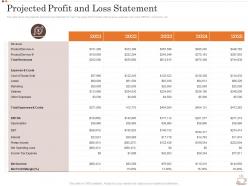
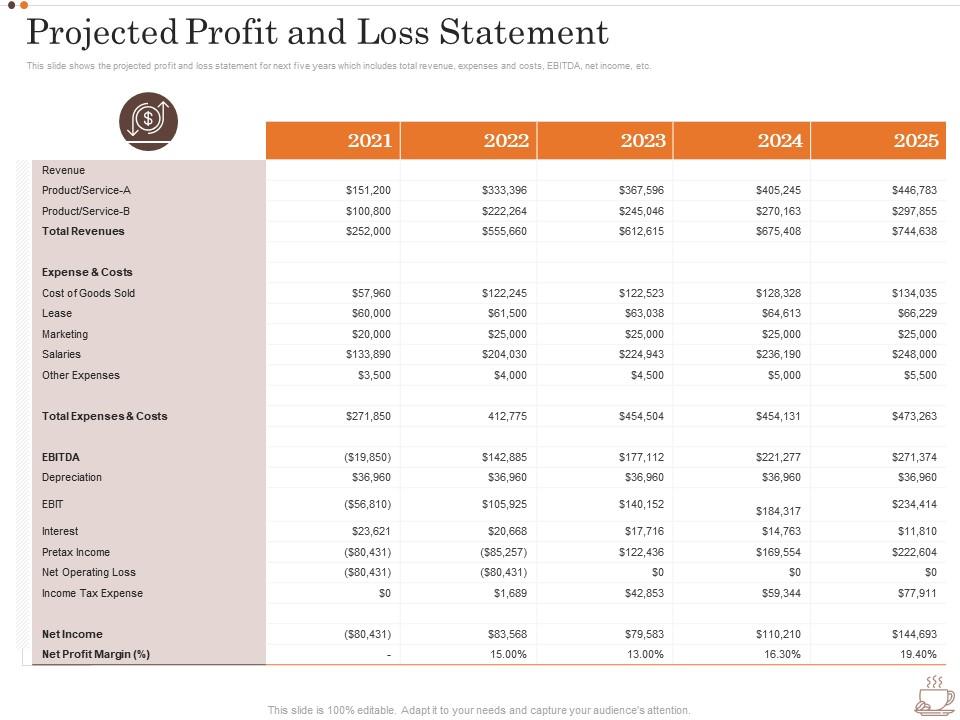
This slide shows the projected profit and loss statement for next five years which includes total revenue, expenses and costs, EBITDA, net income, etc.
People who downloaded this PowerPoint presentation also viewed the following :
Projected Profit And Loss Statement Business Strategy Opening Coffee Shop Ppt Download with all 2 slides:
Use our Projected Profit And Loss Statement Business Strategy Opening Coffee Shop Ppt Download to effectively help you save your valuable time. They are readymade to fit into any presentation structure.
FAQs for Projected Profit And Loss Statement Business Strategy Opening Coffee
Start with your revenue projections - everything else builds from there. Break costs into two main groups: COGS and operating expenses (rent, salaries, marketing, that stuff). Don't skip depreciation or loan interest if you've got equipment or debt. Three scenarios work best - realistic, best case, and worst case. The hardest part? Being honest about your assumptions instead of just hoping for the best. Calculate gross profit first (revenue minus COGS), then net profit after everything. Oh, and maybe grab some coffee before diving into the numbers - spreadsheets always look better caffeinated!
Start with your sales data from the past 2-3 years - that's your reality check. Factor in growth based on what's actually happening in your market, marketing budget, new products, seasonal stuff. Honestly, I've watched so many founders get burned by ridiculous "hockey stick" projections. Create three scenarios: conservative, realistic, and optimistic. If you're B2B, your pipeline and conversion rates matter big time. Don't just throw numbers at the wall. Every forecast needs solid reasoning behind it, not wishful thinking.
Look, spell out every assumption right from the start - growth rates, pricing shifts, cost bumps, seasonal stuff, whatever big changes you're expecting. Market conditions, competition, the whole deal. People will definitely question your numbers later (they always do), so document how you calculated things like customer acquisition costs. Being super transparent actually makes your projections way more believable. Oh, and keep a separate assumptions doc that stakeholders can check when they start poking holes in everything. Trust me, they will.
Oh man, seasonal stuff will mess up your P&L big time if you ignore it. Like, don't just spread your revenue evenly across 12 months - that's a rookie mistake I definitely made early on. Look at your last 2-3 years instead. See how retail explodes during holidays? Or landscaping basically dies in winter? Weight your projections based on those actual patterns you've seen before. It'll help with cash flow timing and inventory planning too. Honestly, most people skip this step and then wonder why their forecasts are garbage. Pull that historical monthly data and build realistic projections from there.
So for forecasting expenses, I'd start with looking at your historical data - that's usually the most reliable baseline. Zero-based budgeting is solid too, basically you justify each expense instead of just bumping up last year's budget. The percentage-of-sales method works great for variable costs since it moves with your revenue. Activity-based costing gets super detailed if you're into that, and driver-based forecasting ties expenses to specific business metrics. Honestly, mixing a few of these approaches will give you way better accuracy than just guessing.
Monthly updates are usually your sweet spot, but it really comes down to how crazy your business gets. Stable industry with predictable cash flow? Maybe quarterly works. But seasonal swings, product launches, or you're scaling fast? Yeah, you'll want monthly or even weekly check-ins. The whole point is spotting problems while you can still fix them - not three months later when you're screwed. Oh, and definitely set a calendar reminder because I always tell myself I'll remember and then... don't. It's one of those tasks that magically disappears otherwise.
Look, your P&L tracks when you *earn* money vs when you *actually get paid* - totally different things. Like if you make a sale in March but don't get paid for 30 days, your P&L shows March revenue but cash flow shows April income. P&L basically tells you if you're making money on paper. Cash flow? That's whether you can cover rent next week lol. I learned this the hard way when I had great sales numbers but couldn't pay suppliers. Both matter, but cash flow keeps the lights on.
Look, investors need to see you actually understand how to make money. Your P&L projections show them your revenue assumptions, cost breakdown, and profitability timeline - basically everything they care about when deciding to write you a check. Be realistic but don't undersell yourself. If you lowball everything to seem "safe," the opportunity looks tiny and boring. Show solid growth potential instead. Back up your numbers with market research and competitor data - they'll grill you on every line item anyway, so be ready. Honestly, I've seen too many founders wing this part. Don't be one of them.
Dude, you absolutely need market research before building those P&L projections. Otherwise you're literally just throwing numbers at a wall and hoping something sticks - learned that the hard way on my first startup attempt lol. Look at what people actually pay for similar stuff, check demand patterns, study your competitors' pricing. This grounds your revenue forecasts in reality instead of wishful thinking. Competitive analysis also shows you where your costs should land and spots pricing opportunities you might miss. Real market data beats gut feelings every time, especially for growth rates and pricing strategy.
Honestly, a projected P&L is like having a crystal ball for your business decisions. Run different scenarios - what if you launch that product or expand markets? You'll see exactly how it hits your profits over time. Super helpful for catching cash flow problems early, plus you can time big investments better. I've seen too many people dive into "great ideas" without running the numbers first - don't be that person. Set growth targets that actually make sense instead of just guessing. Next time you're considering something big, just plug in a few what-if scenarios and watch how the math works out.
Oh man, the classic mistake? Getting way too excited about potential revenue while totally lowballing your costs. Don't just copy last year's numbers either - markets shift constantly. Seasonal stuff will absolutely wreck you if you ignore it. Plus people always forget the sneaky expenses like equipment repairs, accountant fees, health insurance. I learned that one the hard way lol. Be pessimistic with sales forecasts until you've got real proof. Always pad your budget by 10-15% minimum for random crap that pops up.
So pricing hits your revenue first, then ripples through everything else on your P&L. Raise prices and you'll get more per unit but probably lose some customers - honestly, predicting how many is the hardest part. Lower them and it flips. Your margins change right away, which affects how much you can spend on growth later. I always tell people to model three scenarios: safe, aggressive, and somewhere in between. That way you won't get blindsided. Oh, and don't forget volume changes can be sneaky - sometimes they take a few months to really show up in the data.
Look, gross profit margin is just how much cash you pocket after buying whatever you're selling. For your P&L projections, it shows investors if your business actually works or if you're basically burning money. Good margins mean you can pay your bills and maybe even make profit - bad ones? You're screwed if anything goes wrong. I always check this first when looking at any business plan, honestly. Compare yours to what competitors are doing in your industry. If you're way off from the norm, either your pricing is garbage or you've found something genius. Short margins are scary because one bad month can tank everything.
Just stick a tax expense line between your operating income and net income. Apply your expected tax rate to the taxable income you're projecting. Honestly, tax stuff is such a headache - I wouldn't worry about nailing it perfectly right away. Some expenses won't be deductible anyway, plus there's weird timing stuff between what you show on books vs. taxes. Start with whatever the standard corporate rate is, then tweak it for your situation. Oh, and definitely have your accountant double-check everything before you do anything major with those numbers.
Honestly, I'd start with LivePlan - their free trial is solid and you'll get a feel for how these tools actually work. PlanGuru and Adaptive Insights are good too, but LivePlan's way more user-friendly. Excel can handle it if you're a spreadsheet wizard, but trust me, it gets ugly once you start running multiple scenarios. Oh, and if you're already using QuickBooks or Xero for your books, check out their forecasting stuff first. Might save you some headache since everything's already connected. The main thing is finding something that doesn't make you want to throw your laptop out the window.
-
Informative presentations that are easily editable.
-
Good research work and creative work done on every template.
-
Best Representation of topics, really appreciable.