

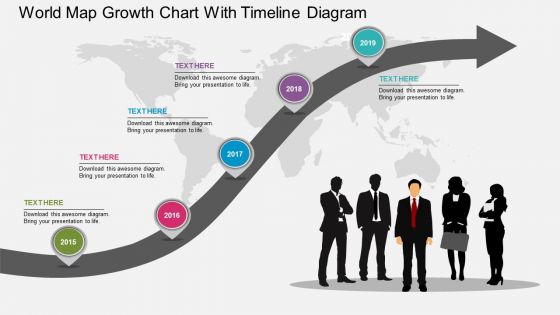
App world map growth chart with timeline diagram flat powerpoint design





Try Before you Buy Download Free Sample Product
 Impress Your
 Audience
 100%
100% Editable
 Save Hours
 of Time


Putting forward App World Map Growth Chart With Timeline Diagram Flat PowerPoint Design in front of the serious business leaders. This growth chart PPT slide template is crafted to represent the company’s growth to the targeted audience in an efficient way. The collection of world map diagrams, graphic images, vectors and the growth chart icons make it a visually stunning business progression PowerPoint slide template. Whether you want to showcase the global market growth or a minor escalation over a particular period of time, this master trade expansion slide template is perfect to download, edit and use it without putting in many efforts. The PPT icons used together with the timeline make it even more effective from the business perspective. Above all, with this trade growth chart presentation, a presenter need not to switch from one page to another , the whole data can be accessed on a single page, which is the magic of the use of business growth chart designs. Our app World Map Growth Chart With Timeline Diagram Flat Powerpoint Design are like Lego blocks. Build on them and get any shape you want.
People who downloaded this PowerPoint presentation also viewed the following :
App world map growth chart with timeline diagram flat powerpoint design with all 4 slides:
Build greater ability to absorb with our app World Map Growth Chart With Timeline Diagram Flat Powerpoint Design. Your capacity will get enlarged.


FAQs for App world map growth chart with timeline diagram
So smartphone adoption is crushing it in new markets, especially with better internet hitting rural spots in Southeast Asia and Africa. COVID basically fast-tracked everything by like 5 years - wild how that worked out. Mobile payments are way less scary to people now too. Local app stores are actually mattering more than just the big two. The magic happens when you get rising income plus people who actually know how to use their phones properly. I'd honestly target places where mobile completely skipped the desktop phase - that's where the real opportunities are hiding.
Dude, geography is everything when you're looking at app growth. Asian users go crazy for those mega-apps that handle messaging, payments, shopping - the whole deal. Meanwhile we're over here downloading separate apps for literally everything. Social features that work amazing in collectivist cultures? They'll totally bomb with individualistic users. Payment preferences are all over the map too. Even colors hit different depending on the region - it's wild how much that stuff varies. Oh and privacy concerns shift dramatically by country. Always break down your data by location first instead of staring at those useless global averages.
So here's the deal - you can't really have apps without solid internet, which seems obvious but people forget this. Better mobile coverage = way more downloads and revenue. I've seen this pattern everywhere. New users flood in once they can actually access app stores reliably. Honestly, some of these emerging markets are goldmines once connectivity improves. If you're thinking about expanding somewhere, look for places where mobile internet is getting better fast. That's where the real growth happens. Skip the saturated markets - find the ones just hitting their stride.
Dude, emerging markets are completely dominating app growth right now. We're talking 3-4x faster than the US or Europe. Makes total sense though - places like Southeast Asia and Latin America are still getting their first smartphones, and they skip straight to mobile instead of using computers first. Developed markets? Pretty maxed out honestly. I mean, my phone's already packed with apps I never use lol. But the growth in emerging markets isn't just a quick spike, it's actually sticking around. If you're thinking expansion, I'd definitely focus on those regions for finding new users.
Yeah gaming and social media are still huge, but things have gotten way more interesting lately. Fintech apps are absolutely crushing it right now - same with health/fitness and productivity stuff. Makes sense since we all went remote and became obsessed with tracking everything, right? Shopping apps are doing crazy numbers too. But here's what's wild: streaming and TikTok-style video apps are actually eating into traditional social media growth in some places. Though honestly, it depends where you're looking - Asia's trends are completely different from what we see here. If you're thinking about building something, I'd definitely look at the fintech space.
You can't just copy your US strategy everywhere - each region's totally different. Asia's all about WeChat and LINE. Europe? GDPR compliance will make or break your campaigns. Latin America loves influencer partnerships and localized content, which honestly works better than you'd expect. Africa needs optimization for cheaper devices and data limits. Payment methods matter too - what works in one place flops in another. I'd start by checking out the top 3 apps in your space per region. See where they advertise and how they talk to users. Cultural stuff matters way more than people think.
App store policies are honestly huge for understanding those growth charts you're looking at. Apple or Google tweaks their revenue cuts or changes how they approve apps? Boom - suddenly some apps can't scale anymore. Remember that whole Epic vs Apple drama? Perfect example of how much control these platforms actually have. Stricter policies mean smaller devs get squeezed out, so you get less competition but maybe better quality apps overall. Here's the thing though - you should definitely watch policy changes when you're tracking growth metrics. They're often the reason behind those random market shifts that seem to come out of nowhere.
Honestly, start with researching your target markets deeply - user behavior, cultural stuff, how people actually spend money. Don't just translate your app. Colors, UI, even features need tweaking for local tastes. Payment methods matter way more than you'd think - mobile wallets crush credit cards in some places. I bombed hard with red buttons in certain Asian markets since red screams "danger" there, whoops. Local regulations are a nightmare too and change everywhere. Oh, and app store rules? Totally different by country. Pick like 2-3 markets first instead of going crazy trying to localize everything at once.
Honestly, AI integration is where it's at right now - users want apps that actually learn from them. Hyper-personalization is blowing up too. Cross-platform stuff is pretty much expected now, people get annoyed when things don't sync between their phone and laptop. Privacy's become this massive thing, way bigger than a couple years back. Voice and AR aren't just fancy features anymore, they're becoming baseline. Oh, and here's what's interesting - apps mixing multiple trends always outperform ones doing just one thing. I'd say audit what you've got and pick maybe two of these to focus on this quarter.
Yeah, seasonal spikes are huge - you're looking at 20-40% jumps during peak times. Gaming and shopping apps absolutely kill it during holidays. Fitness apps blow up in January (we both know how long that lasts lol). Travel stuff peaks in summer obviously. Here's the thing though - these aren't just temporary download boosts. If you nail your onboarding, those seasonal users actually stick around. That's where the real money is. Oh, and start prepping your marketing like 6-8 weeks early because everyone else will be scrambling last minute. Your infrastructure needs to handle the surge too.
Focus on download velocity, user retention, and revenue per user by region - that's where the real insights are. MAUs and session frequency matter way more than total downloads (seriously, don't get caught up in those vanity metrics). Track your app's ranking in key categories and watch market penetration rates. Oh, and cohort analysis is huge for spotting how users behave differently across markets. I've seen teams waste so much time chasing download spikes that never actually convert to engaged users. Use that regional data to figure out which markets are worth doubling down on.
Honestly, competition usually boosts retention rather than hurting it. Each app has to step up their game when there's real competition - better features, smoother experience, you know the drill. Users end up getting higher quality stuff across the board, which keeps them more engaged with the whole category. It's kind of like that iron sharpens iron concept but for mobile apps. The trick is you can't just copy what competitors do. You need to find your own angle for keeping users hooked, something that actually sets you apart from everyone else fighting for the same eyeballs.
Honestly, influencers can be total game-changers for app growth if you do it right. Find creators whose followers actually match your target users - don't just go for massive follower counts because those downloads won't convert. TikTok's been insane for organic reach lately, way better than Instagram in my experience. You'll see those download spikes hit almost immediately when the right influencer posts. The trick is tracking which platforms bring quality users who stick around. I learned this the hard way with a fitness app that got tons of downloads from a beauty influencer, but retention was terrible.
Honestly, freemium is way faster upfront - no download barrier means people just grab it. But your revenue starts pretty low and takes forever to build up. Paid apps? Complete opposite problem. You're basically asking people to trust you with their money before they even know if your app sucks, which is kinda brutal these days. The geographic spread is interesting though - freemium apps go viral way easier since sharing is free, while paid ones grow slower but attract users who actually spend money. Really depends what you're after. Want massive reach? Go freemium and figure out monetization later.
Honestly, AI stuff is where it's at right now. Apps are getting crazy good at knowing what you want before you do - like personalized recommendations that actually make sense. AR/VR is finally not terrible anymore (took forever lol), especially for shopping apps. 5G means everything happens instantly now. Oh, and edge computing is pretty cool - your phone does the heavy lifting instead of some server halfway across the world. Cross-platform tools let you build once and ship everywhere, which saves tons of time. My advice? Don't just slap AI features on top - build them into the actual experience from day one.
-
Commendable slides with attractive designs. Extremely pleased with the fact that they are easy to modify. Great work!
-
Great designs, Easily Editable.